

Thank you for opening your Chartbook email.

Construction of bow block LHD2 HMAS Adelaide (ll)
by Peter Churcher 2011
Terra icognita
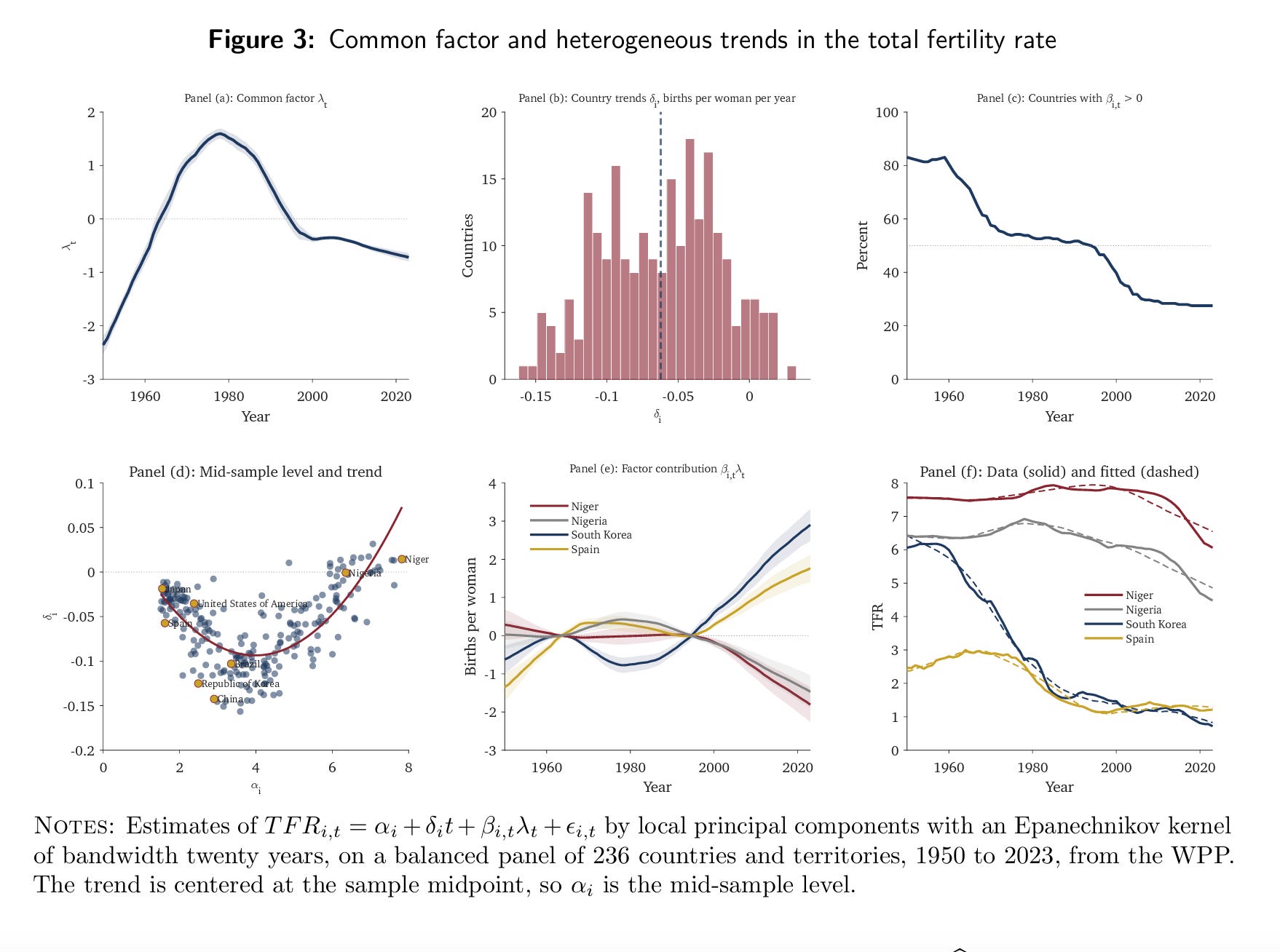
As of 2026, humanity is likely below replacement fertility. That has never happened before, not in wars or pandemics. But the real surprise is that the fall has been concentrated in low- and middleincome countries and among poorer and less educated women. We fit a single-factor model to 236 countries since 1950: the common component peaked in 1978, and what drives fertility down today are country-specific trends, 219 of them negative and not one leveling off. None of the commonly cited mechanisms can account for this pattern, so we offer a conjecture: modernity itself, which makes a third child expensive and childlessness cheap. Children come in integers, so it takes very little to move a cohort’s fertility rate from 1.8 to 1.3. And nothing in an economy pushes fertility back to 2.1. We close with the main economic consequences, in particular slow growth.
Modernity. The surprising case of Guatemala’s TFR collapse points to one final possibility: modernity. While we are aware that this view is more speculative than the mechanisms discussed so far (and what economists usually entertain), it deserves some space. By modernity, we mean a society organized around formal institutions, specialized expertise, and large-scale systems of coordination. We are influenced here by Max Weber.
He argued that 17Guldi and Herbst (2017) exploit a similar design with broadband internet access, also within the U.S. 18The TFR is cyclical due to tempo effects, so we do not read too much into the rise between 1995 and 2007 or the decline from 1.27 in 2019 to 1.14 today. 17modern societies increasingly organize economic life, law, and government through calculation, impersonal rules, and bureaucracy staffed by trained specialists (Weber, 1930, 1978). Large, complex societies become manageable only because knowledge is standardized and detached from local custom, whether through mass education, expert systems, or the state’s effort to make society legible (Gellner, 1983, Giddens, 1990, Scott, 1998).
On the economic side, our use of the term modernity is close to Mokyr (2002), who argues that sustained economic growth became possible once useful knowledge was codified, accumulated, and widely shared. Modernity is not simply another name for capitalism. If anything, the historical record points in the opposite direction. Fertility declined earlier and, often, more rapidly in socialist economies than in market economies.
Hungary, for example, fell below replacement fertility in 1960, followed by Czechoslovakia in 1966. Both countries experienced modest and short-lived baby booms in the mid-1970s, but neither reversed the broader downward trend. Our conjecture is that a modern society makes the third child expensive and childlessness cheap, even when GDP per capita is only a fraction of the frontier (i.e., the U.S. level). Children are expensive because a child must be equipped to function in a world of formal knowledge and credentials, which takes years of costly investment (Restuccia and Vandenbroucke, 2013, Doepke and Zilibotti, 2019).
At the same time, children are no longer productive in the household, not even for smaller chores, having been replaced by “engines of liberation” such as the electric appliances now available even to poor households (this idea extends the intuition in Greenwood et al., 2005). Modernity also imposes tight career schedules, set by large-scale organizations, that collide with the biological clock and with the kin networks that used to share the work of raising children (Adda et al., 2017, Compton and Pollak, 2014). And modernity makes childlessness cheap, because an impersonal society imposes next to no penalty on those who have no children: pensions and health care do the work that sons and daughters once did (Boldrin et al., 2015), and lineage counts for little. Goldin (2026) pushes this line further with an argument about a growing mismatch between genders. Modernity also changes gender roles unevenly. Women’s opportunities expand rapidly through education, work, and greater independence, while expectations about housework and childcare often change more slowly (Goldin and Katz, 2002, Goldin, 2021).
This is particularly true as economies shift toward services, where women’s comparative advantages are better rewarded (Ngai and Petrongolo, 2017). The mismatch operates at both the extensive and the 18intensive margins: more women remain childless, and mothers have fewer children on average. This argument is attractive because it explains why East Asia and now Latin America have such low TFRs. These are the societies where the gender mismatch is largest. It also suggests an intriguing possibility: societies with highly unbalanced gender norms start with very high TFRs, as men impose their preferences (Ashraf et al., 2014), and end with very low ones, as women resist (Doepke and Kindermann, 2019, Doepke and Tertilt, 2018). A paradoxical reversal of demographic fortunes. The combination of expensive children and cheap childlessness gets us well below replacement, perhaps to 1.4 or so; recall the unpleasant integer arithmetic above. When and how quickly each country arrives at 1.4 depends on how fast the process of modernization is (which is not necessarily the same as the level of GDP per capita; see Spolaore and Wacziarg, 2022).
This gives us a nearly-universal negative trend but with growing heterogeneity, exactly as in our model in Section 4. From there, countries move in either direction. Those with higher income, better work-family balance, more gender equality, cheaper housing, and less acute educational arms races (Ramey and Ramey, 2010, Seth, 2002), or that have a significant religious subpopulation (Berman et al., 2018) can climb back to 1.6 or 1.7.
The U.S. has many, though not all, of these features (Baudin et al., 2015), and the pattern is consistent with the finding that fertility turns up again at the highest levels of development if gender equality is high (Myrskyl¨a et al., 2009, Goldscheider et al., 2015). Countries with the opposite bundle (lower income, no work-family balance, less gender equality, expensive housing, brutal educational competition, and rapid secularization) fall to 0.7 or 0.8. East Asia is the obvious example: China, Taiwan, and South Korea have all of these features at once. In short, modernity in its current form seems largely incompatible with replacement-level fertility.
Source: Terra Incognita: The Economics of a Shrinking World Jesús Fernández-Villaverde and Patrick Norrick NBER Working Paper No. 35809 September 2026
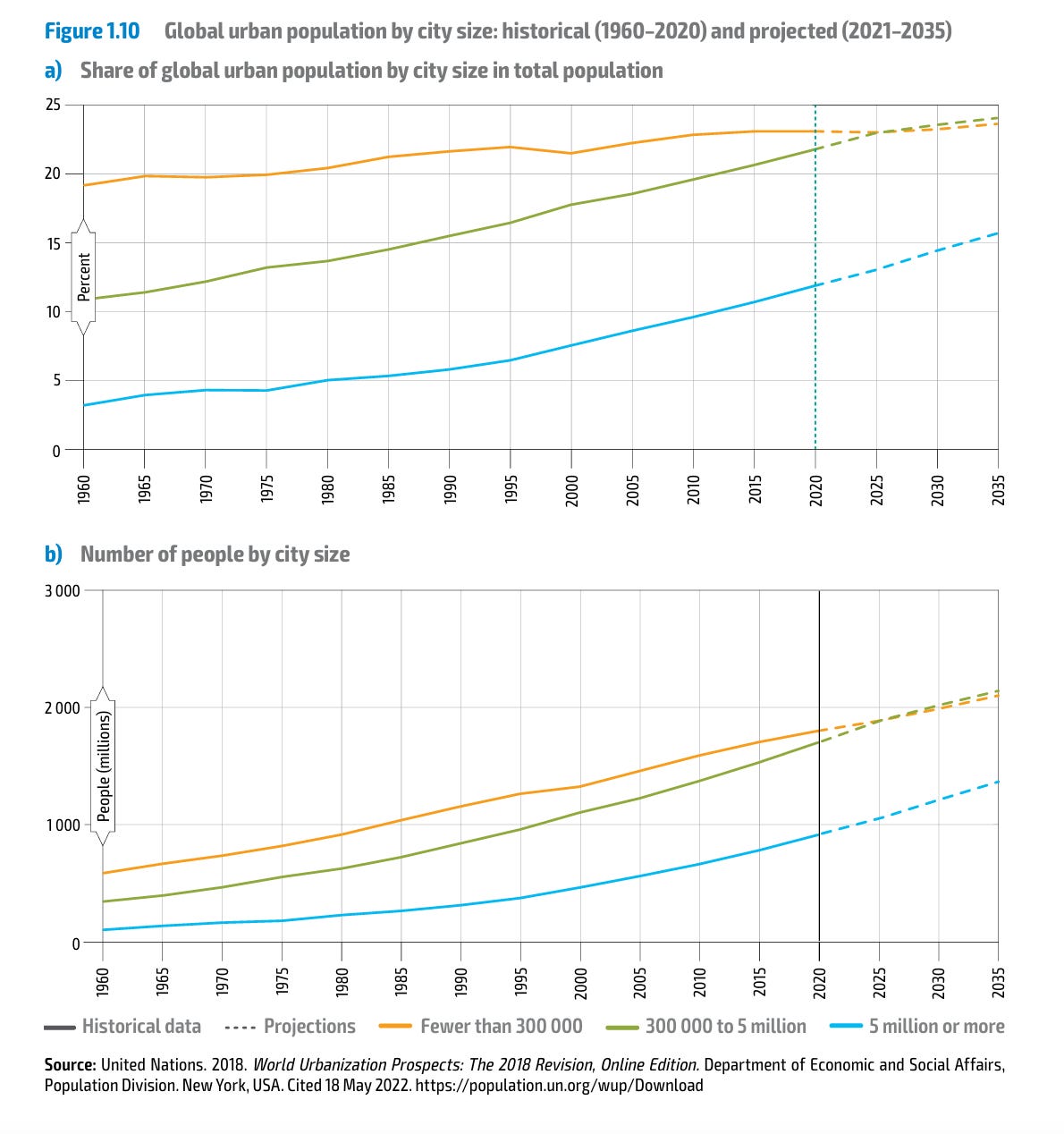
Right now, about one billion people live in cities with population larger than 5 million.
Source: FAO
Of those people living in urban areas of more than 5 million inhabitants, 95 million area in the USA.

Total food consumption
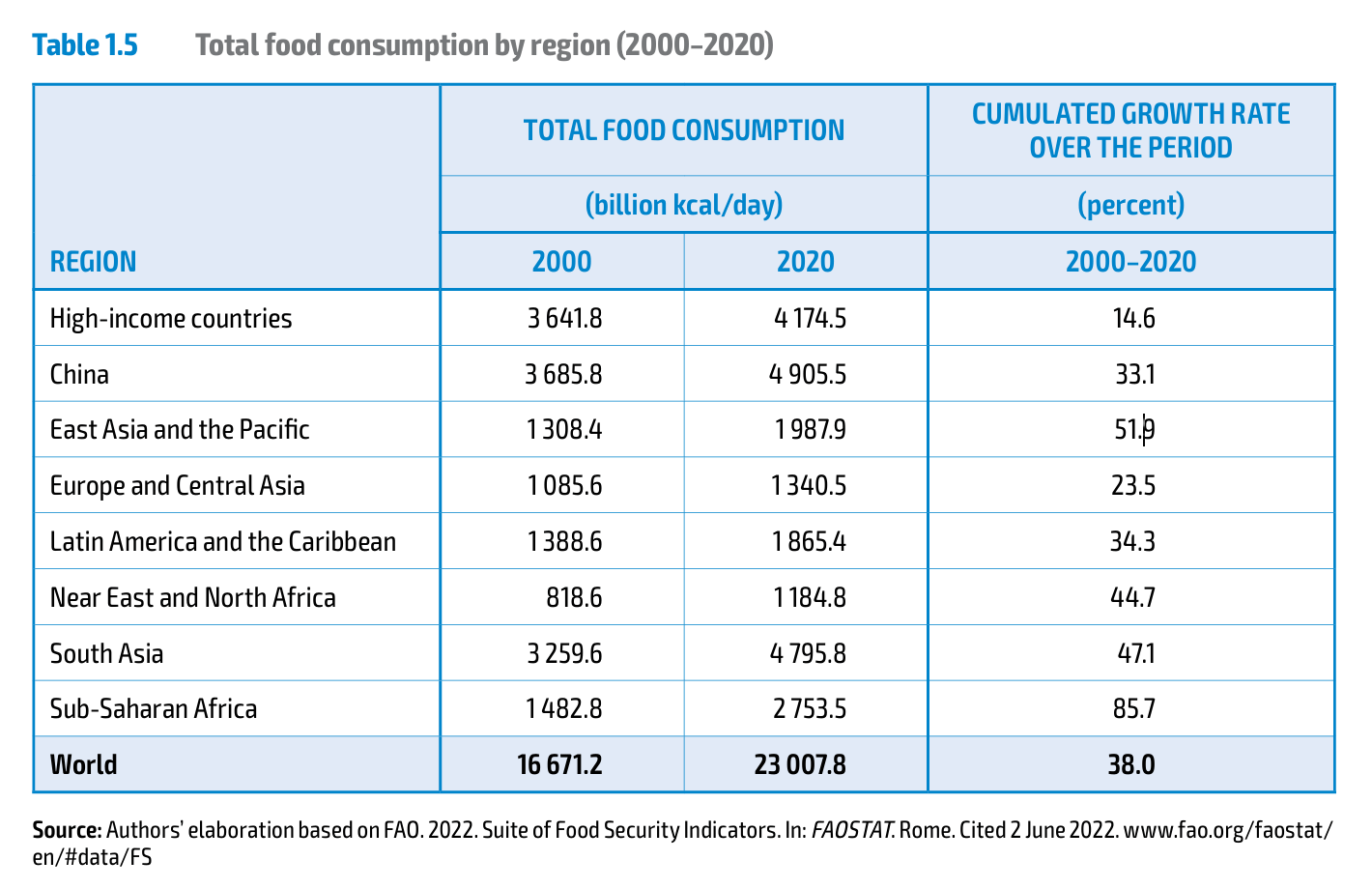
Between 2000 and 2020 alone, food consumption increased by more than 37 percent for the world as a whole, measured in terms of billions of kcal per day (see Table 1.5), significantly faster than population growth. The sharpest increase was observed in SSA where it grew by 88 percent, followed by EAP (52 percent). Despite this rapid growth of consumption, and because of the high level of inequality prevailing in all regions, almost 10 percent of the world’s population was undernourished in 2021, while 11.7 percent of global population (around 920 million people) was severely food insecure in 2020 and more than 3 billion people could not afford healthy diets7 (see also the Introduction and Section 1.7).
Source: FAO
Darkened ship – HMAS Kanimbla (ll)
by Peter Churcher 2002

HEY READERS,
THANK YOU for opening the Chartbook email. I hope it brightens your day.
I enjoy putting out the newsletter, but tbh, what keeps this flow going is the generosity of those readers who clicked the subscription button.

If you are persuaded to click, please consider the annual subscription of $60. It is both better value for you and a much better deal for me, as it involves only one credit card charge. Why feed the payments companies if we don’t have to.
It is impressive how late in the 1930s, Japanese defense spending surged.
For contributing subscribers only.
Torpedoed oil tanker of WWI.

Look Mum No Engine - The 1930s Austin 7 hot rodding scene is quite a discovery

https://www.youtube.com/@lookmumnoengine/videos
https://www.youtube.com/@thebracketfactory
Stoker in engine room one, HMAS Kanimbla by Peter Churcher 2002

If you’ve scrolled this far, you know you want to click: