Straits compared. How the naphtha shortage threatens your favorite pack of crisps. The Dassault road block & weird grass.
Great links, images, and reading from Chartbook Newsletter by Adam Tooze

Thank you for opening your Chartbook email.

Hans Grundig, On the Outskirts (German: Am Stadtrand), 1926
For a while there, there was actually a trickle of traffic through the Straits of Hormuz. That dwindled further in early June:
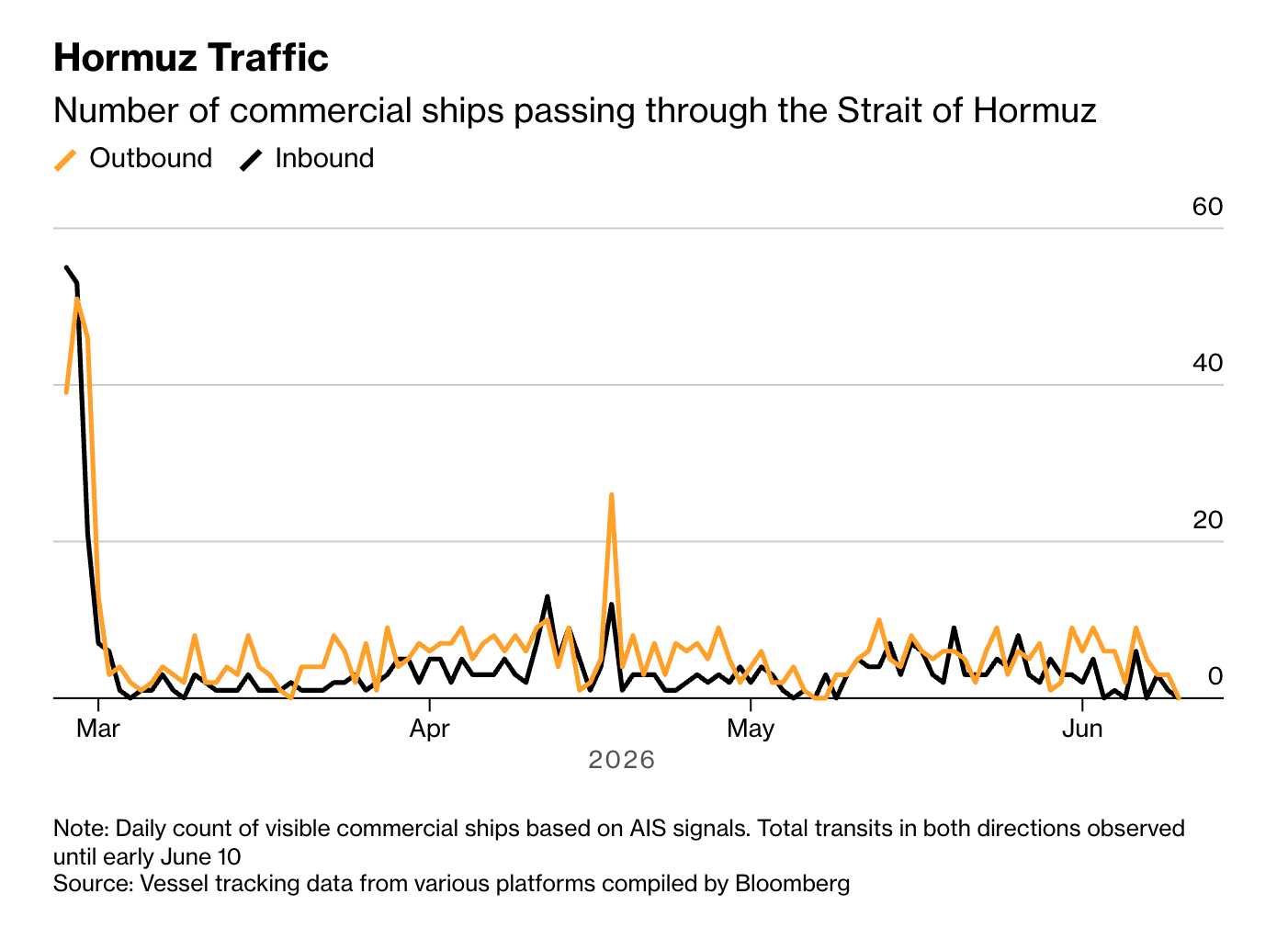
Source: Bloomberg
But you know what would be really bad: A crisis over Taiwan!
Research from CSIS estimates that approximately $2.45 trillion worth of goods—over one-fifth of global maritime trade—transited the Taiwan Strait in 2022.
How the naphtha crisis is impacting Tracy Alloway’s food nostalgia tour.
Joe and I are in Hong Kong, which means I spent the weekend hitting up some of my favorite restaurants and shops in the city. One of those is (somewhat ironically, I guess) the Don Quijote on Queen’s Road Central. Don Quijote is actually a Japanese chain of discount stores, and was a pretty regular part of my life when I was in high school in Tokyo. If you haven’t been to a Don Quijote before, they have basically everything you can imagine — from basic groceries to luxury handbags. The store in Roppongi also had a defunct rollercoaster on its roof and a giant grouper in a fish tank in the lobby, just to add to the eccentricity. Anyway! I went there hoping to find some of the new bags of Calbee potato chips. Traditionally, these chips have been sold in colorful packages with a little potato mascot (“Potato Boy”) on them. But no longer.
Now, the Calbee potato chips look like this:

Calbee announced last month that it was switching from color packaging to black and white for its chip bags, citing a shortage shortage of naphtha, a key building block of commercial inks. In doing so, Calbee has become one of the most visible examples of companies adapting to the petrochemicals crunch created by the Iran War.
Source: Bloomberg
New York City’s property tax system is a mess! Greg David, The City Reporter
Buildings with three or fewer units, primarily-single family homes, comprise almost half of the market value of all residential buildings but pay only 15% of property taxes. Rental buildings account for a quarter of the market value, but pay 40% of the levy.
No city in the country places such a huge burden on rental properties compared with homeowners, the report notes, citing data from the Lincoln Land Institute. New York taxes rental buildings at 5.67 times the rate of owner-occupied homes. By comparison, the disparity in Los Angeles is 1.01 and Chicago is at 0.98.
Taxes are rising for rent-regulated buildings that have seen their finances squeezed. Since 2019, net operating income for rent regulated buildings after adjusting for inflation declined by almost 15%, but their inflation-adjusted property taxes per unit have increased from an average of $2,843 per unit to $3,082.
Co-ops are valued at only a quarter of their market value and condos at only 20%, according to a Furman analysis of 10,000 sales in 2025, resulting in the lowest taxes when compared with market value.
Source: The City Reporter
East Africa Nations Plan Spending Boost Despite Fiscal Pressures
Hans Grundig, Paar auf der Bank, Dresdner Heide (Couple on the Bank, Dresden Heath), 1925

Dassault’s demands just killed the Franco-German project to build a joint next-generation fighter jet
German Chancellor Friedrich Merz and French President Emmanuel Macron agreed last week that manufacturers Dassault and Airbus failed to resolve key disputes, officials in Berlin and Paris confirmed on Monday. The Future Combat Air System (FCAS) program, launched in 2017, aimed to build a next-generation fighter to replace Eurofighters and Rafales by around 2040. The move to scrap one of Europe’s largest defense projects comes as Western military officials warn of a mounting threat from Russia and the United States intensifies pressure on Europe to take care of its own defense. The more than €100 billion ($115 billion) project, launched in 2017, was once billed as a symbol of Franco-German military unity. But it has been plagued by years of political and industrial disputes. French arms giant Dassault Aviation has demanded significantly more control over the project than its industry partner, European consortium Airbus Defence and Space. The two companies clashed over control of the project’s next phase, access to intellectual property and, above all, differing requirements for the aircraft.
Source: Deutsche Welle
HEY READERS,
THANK YOU for opening the Chartbook email. I hope it brightens your day.
I enjoy putting out the newsletter, but tbh, what keeps this flow going is the generosity of those readers who clicked the subscription button.

If you are persuaded to click, please consider the annual subscription of $50. It is both better value for you and a much better deal for me, as it involves only one credit card charge. Why feed the payments companies if we don’t have to.
Dassault has form: Fascinating account by Samuel Hollins of how Dassault killed a Franco-British collaboration in the 1960s
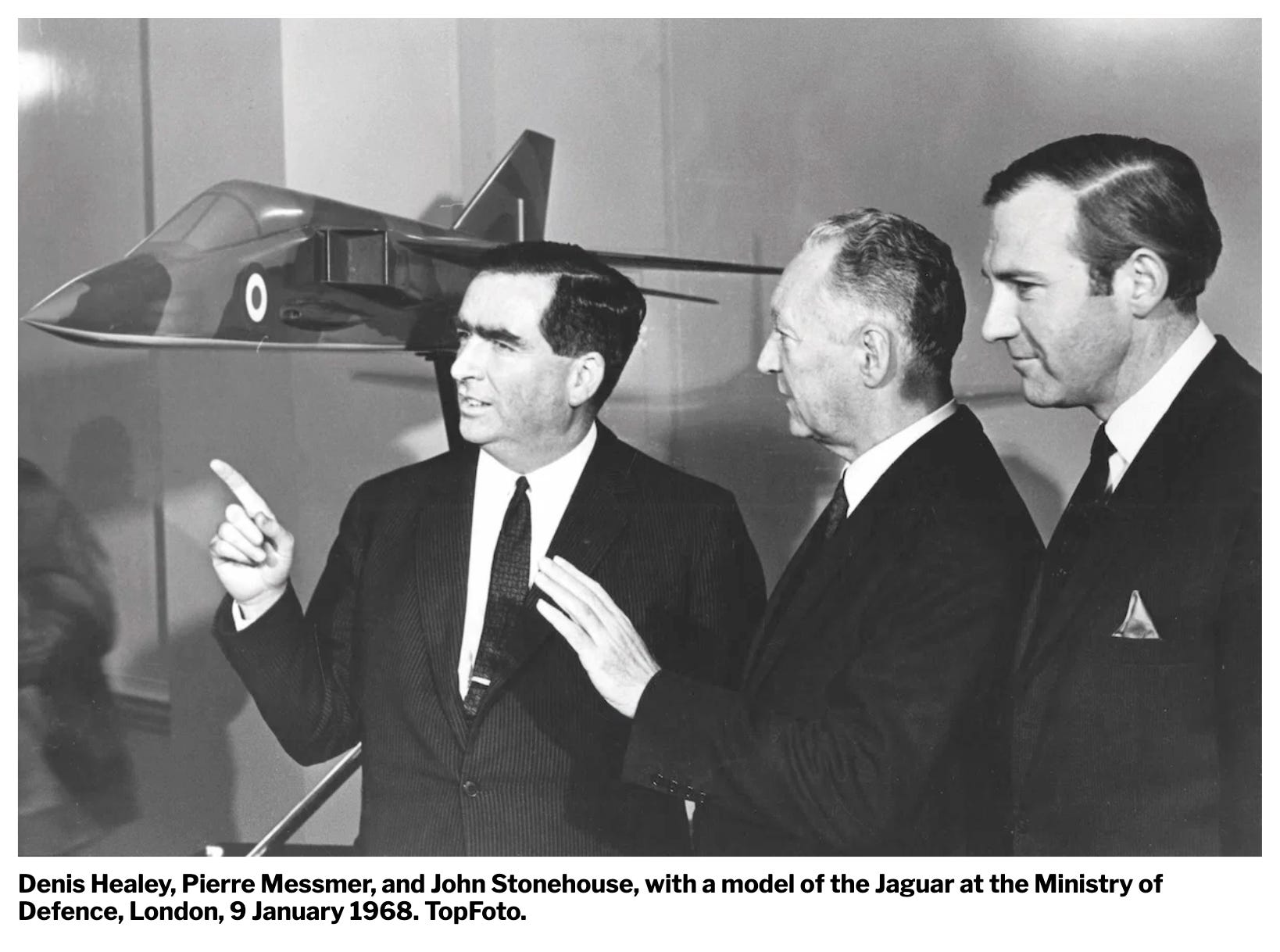
On 19 June 1967 Paris informed London that it was withdrawing from the Anglo-French Variable Geometry (AFVG) supersonic combat aircraft project. For the incumbent Labour government, the consequences were enormous. Both the Royal Air Force (RAF) and British industry had lost a vital combat aircraft. … During the 1960s Anglo-French aerospace collaboration was expansive, encompassing the Concorde supersonic airliner, military helicopters, guided missiles, the Jaguar strike/trainer aircraft, and the AFVG. Surface-to-air missile systems and interceptors proliferated during the Cold War, making operational environments increasingly hazardous and justifying larger, faster, more sophisticated penetrating aircraft. As research and development (R&D) costs surged, international collaboration became increasingly attractive.
Economic pressures in Britain and France reinforced this logic. When prime minister Harold Wilson came to power in October 1964 he sought to balance military commitments overseas with a balance-of-payments deficit. Britain’s postwar economic growth trailed behind the US, Japan, and West Germany. French president Charles de Gaulle faced similar challenges, including a major stock market crisis (1961-67), significant unemployment, and high inflation. Wilson worked to shift public funds away from military R&D towards civil industries to stimulate growth. Aerospace enjoyed significant state sponsorship and was dominated by defence-related projects. By spring 1965 Labour had cancelled Hawker Siddeley’s P.1154 and HS.681, and the British Aircraft Corporation’s (BAC) long-range strike/reconnaissance TSR-2, opting for cheaper American aircraft … However, relying fully on American aircraft risked destroying domestic capabilities, straining the balance of payments, and gifting Washington leverage.
Instead, … Labour opted to pursue a broad policy of defence-industrial collaboration with France. Together, they possessed Western Europe’s largest and most capable aerospace industries, while their air forces were roughly comparable. … The Jaguar and AFVG projects emerged following a bilateral memorandum of understanding signed in May 1965. The simpler Jaguar progressed faster, with France’s Breguet Aviation leading airframe design, seconded by BAC, and Rolls-Royce leading aeroengine development, supported by Turbomeca. London assumed that leadership roles would be flipped for the AFVG. In Paris, however, the matter remained unresolved.
Early in 1967 Wilson’s chief scientific adviser, Solly Zuckerman, corresponded with industrialists. Rolls-Royce’s Paul Willert explained that, as his firm had presumptively given ‘[aeroengine] leadership to SNECMA [Société Nationale d’Étude et de Construction de Moteurs d’Aviation] it is feared that B.A.C. will demand the air-frame leadership’. René Lucien, president of the French equipment firm Messier, warned that this arrangement would be ‘doomed to failure’. Convincing Marcel Dassault, founder and president of airframe manufacturer Avions Marcel Dassault, to collaborate had proved difficult; accepting British leadership was another matter entirely. ‘[Dassault] is not by temperament, nor is his Company, inclined to favour cooperation on anything like level terms’, Willert explained. .. Lucien credited de Gaulle with sustaining the project through its first two years despite industrial frictions and French economic instability. In May 1967 Paris even requested performance target increases, raising projected unit and R&D costs by 20 per cent. Whitehall assumed that France’s concurrent procurement of Dassault Mirage F1s had motivated these revisions to differentiate the AFVG. They cautiously accepted the revisions, provided that BAC’s leadership was affirmed. … suspicions swirled around Whitehall, centred chiefly on Dassault. …
An Anglo-French project might still be plausible, but only if BAC accepted a junior role in a Mirage G offshoot. This, the Ministry of Defence advised, would be ‘a shocking climb-down’. Britain and France parted ways following the AFVG’s demise, never again collaborating on a new combat aircraft. Labour seized an opportunity to cooperate with West Germany and Italy before 1970, ultimately producing the Panavia Tornado. This model was later replicated for the Eurofighter Typhoon during the 1980s. France, meanwhile, pursued fighter production alone through Dassault. Although French participation in Eurofighter was considered, Dassault’s familiar leadership demands soured negotiations. Today, Dassault Aviation is pushing for design leadership in the faltering sixth-generation Franco-German-Spanish Future Combat Air System. By contrast, Britain, Italy, and Japan are making tangible progress with their Global Combat Aircraft Programme.
Source: Samuel Hollins in History Today
Weird grass!
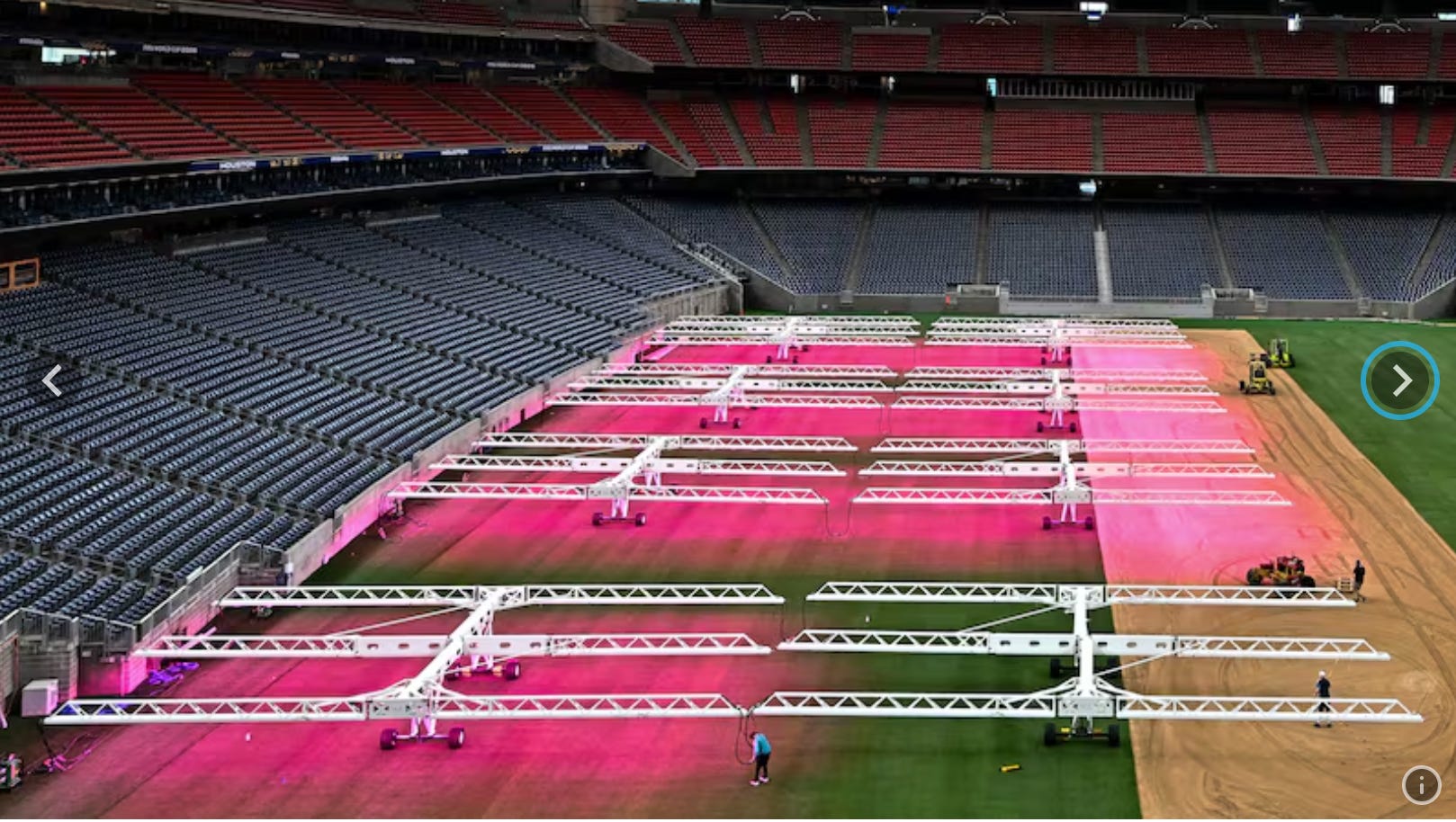
Normally, American football is played on artificial or hybrid pitches, which can’t be used for football matches at the World Cup for quality and safety reasons. The challenge for Fifa, therefore, is to offer the highest-quality grass pitches. University of Tennessee and Michigan State University were tasked with perfecting and providing the surface that would be installed and maintained across all 16 venues. According to the Associated Press, two types of surface will be used for the tournament. Bermuda grass for venues in warmer climates in places like New Jersey, Miami and Guadalajara in Mexico, and rye mixed with Kentucky bluegrass for venues in cooler climates or those indoors. Like the ones in Texas, California, Seattle, Toronto and others. “Sixteen stadiums across three countries, half of the stadiums don’t have natural grass in them ever,” Trey Rogers, a professor of turf grass research at Michigan State University, told NPR.
According to the BBC, plastic fibres similar to those used in artificial turf have been attached to the grass to make the pitches more uniform and durable. When the grass roots reach the plastic, they intertwine, which makes transportation and installation easy. Apart from the pitch, some reconstruction has also taken place. The MetLife Stadium in New Jersey, which will host this year’s final, saw around 1,700 seats removed to accommodate for run-up areas for corner kicks. According to David Graham, senior pitch manager of Fifa Tournaments Infrastructure, “close to six or seven years” of research have gone into ensuring that the pitches at all 16 World Cup stadiums are in perfect condition, and added that research was helped by observations from the Qatar World Cup. “Fifa itself, and the pitch management team, is guided by the science to deliver what we need to deliver for match day. So, it’s been quite refreshing and well publicised that this is what we do: we go with the research; it’s what guides our process,” he said. However, it has not been all smooth sailing. A video of the Senegal team training for their friendly against the US at the Bank of America Stadium in North Carolina caused concerns after the Senegalese players were seen struggling to gauge the bounce of the surface.
Source: Ajit Vijaykumar in The National News
Drink Like a Founder:
Fraunces Tavern, in Lower Manhattan, became a bar in 1762, more than four decades after it was built as a family home. In December 1783, after bidding an emotional farewell to his troops at dinner in the Long Room at Fraunces Tavern, Washington walked across the street and set sail to Virginia. The modest brick building in Manhattan’s financial district was constructed in 1719 as a family home before Samuel Fraunces converted it to a tavern in 1762. The Long Room, on the second floor, is part of the extensive Revolution-era Fraunces Tavern Museum today. The building has undergone multiple restorations but retains its colonial charm. Now, just as travelers of yore found momentary company among locals as they passed through, out-of-towners snap photos of their pints of Samuel Fraunces Tavern Ale next to office workers drinking vodka martinis.
Source: New York Times
Hans Grundig, Das Tausendjährige Reich (The Thousand-Year Reich), created between 1935 and 1938.