Thank you for opening your Chartbook email.

David Park, Portrait of Hassel Smith, 1951
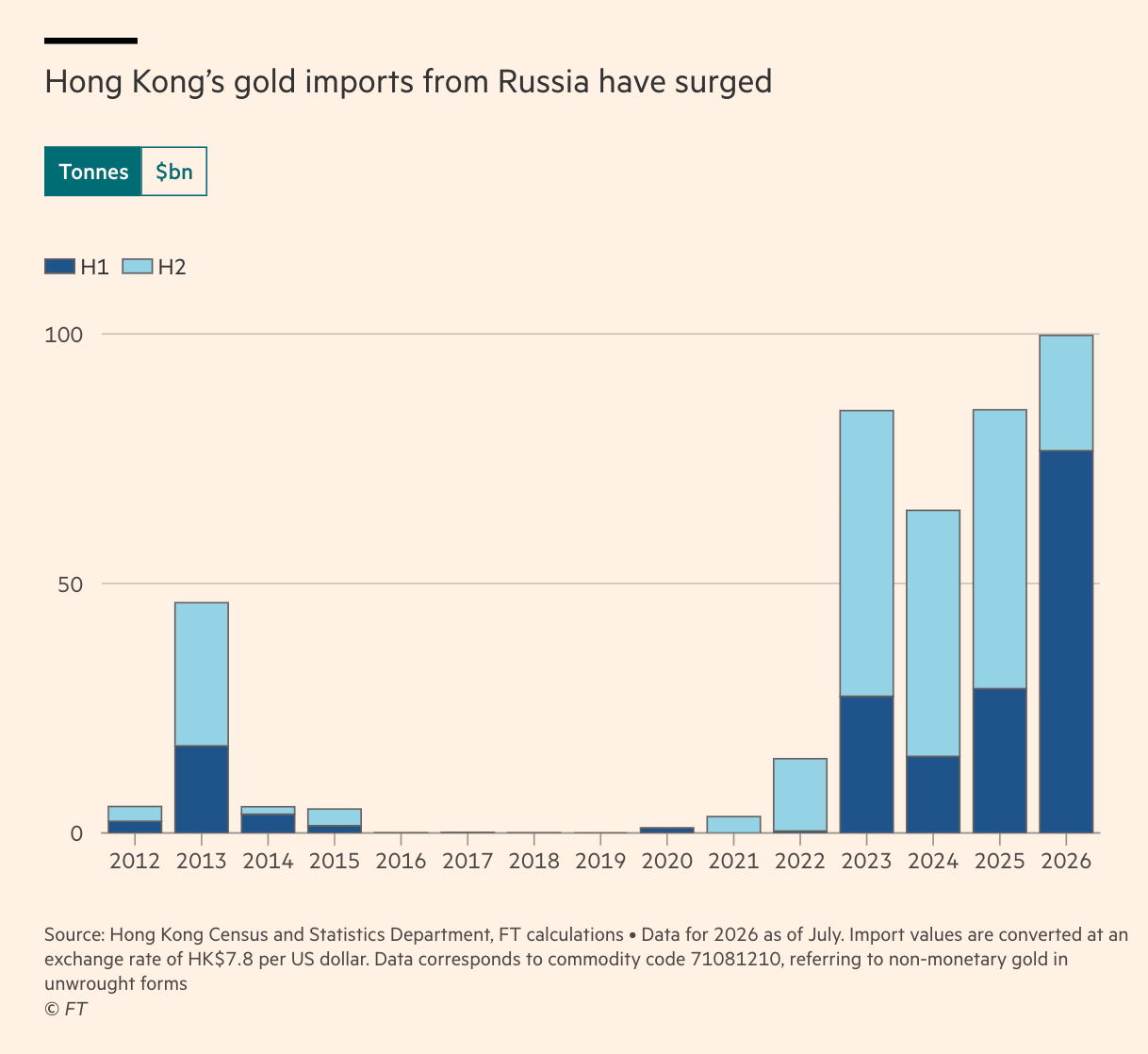
To sidestep sanctions, Russian gold is flowing through Hong Kong on a record scale.
Source: Financial Times
Could Nvidia’s financial support for the customers buying chips backfire? - from the great piece in the Economist
China was never a large investor in India, but since the Ladakh conflict of 2020 investment has flatlined. Could a successful Modi-Xi meeting change all that?
The birth of Repo from the spirit of the Liberty Loan campaigns of World War I - great excerpt from Robin Wigglesworth’s new book.
The huge crowd that gathered on Wall Street on April 8 1918 erupted with laughter when Charlie Chaplin climbed on to the shoulders of a fellow actor and started waving his signature black derby with comical abandon, trying not to fall down from the unsteady perch. “You people out there — I want you to forget all about percentages in this third Liberty Loan,” Chaplin shouted. “Human life is at stake and no one ought to worry about what rate of interest the bonds are going to bring or what he can make by purchasing them. Money is needed, money to support the great arms and navy of Uncle Sam.” This Liberty Loan was the latest US government bond being issued to pay for America’s entry into the first world war.
Chaplin’s Wall Street appearance was part of a remarkable campaign by a multitude of celebrities across America to drum up interest in the loans, at the behest of US Treasury secretary William McAdoo. The ambition of the Liberty Loan programme can scarcely be understood today. By the end of the conflict, roughly a third of the 100 million American citizens at the time had bought at least one of the five titanic Liberty Loan bonds, raising over $21bn. If you take into account the size of the US economy then and now, this is about the equivalent of selling nearly $9tn of bonds today. The primary way McAdoo pulled off this feat was through an aggressive bond marketing drive. As well as celebrities, priests gave sermons exhorting their flock to buy bonds, schools organised cake sales to raise money, factories encouraged workers to subscribe, even Boy Scouts were sent door-to-door to sell the latest Liberty Loan. A captured German submarine was converted into a sales booth in New York’s Central Park and renamed “U-Buy-A-Bond”.
But the Liberty Loan programme also received a major boost from the new Federal Reserve, which had only been created a few years before the war. Many Americans borrowed money from their banks to buy Liberty bonds. To obtain funding for these loans, banks could enter into repo agreements with their nearest Federal Reserve branch, typically selling a chunk of Liberty Loans to the Fed with an agreement to buy it back in 15 days, which was then repeated. The central bank was in effect lending cheap money to banks, which in turn lent cheaply to Americans to buy government bonds. Why did the Fed use a novel sale and repurchase process? Because a peculiarity of the US tax system at the time made cheap conventional collateralised loans uneconomic. Repo was just a fudge — of then murky legality — that gradually became foundational to how finance functions.
During the second world war, the central bank mainly bought government bonds directly. But repo was resurrected after the “Treasury-Fed Accord” of 1951. This marked the birth of the modern, independent Federal Reserve as we know it today, as it finally shed its responsibility to finance the government and instead was allowed to set interest rates to control inflation. Repo became the Fed’s main tool to ensure that the Treasury market remained orderly even as it stopped its own bond purchases. The central bank in effect privatised its role as custodian of the Treasury market’s health by offering a cheap and reliable financing tool to a select group of banks and financial institutions called “primary dealers”. By the end of the 1950s, Fed repo operations sometimes accounted for as much as 85 per cent of the financing used by these primary dealers to hold their Treasury positions. But this quickly shrank, as a private sector repo market blossomed in the 1960s. Once again, the impetus was a workaround.
Since the Great Depression the US had prohibited banks from paying interest on deposit accounts, and capped how much interest that savings accounts could pay, a rule called Regulation Q. But many investors and cash-rich companies resented this, and began pouring money into the repo market instead. After all, returns were both super-safe — lending was mostly overnight and secured by unimpeachable Treasury bonds — and higher than what they could get from a bank account. Now, the increasingly powerful magic of repo could easily transform US government debt into money. This emerging financial dark matter helped reinforce America’s position at the apex of the international financial system even after President Richard Nixon severed the dollar’s link to gold in 1971
Source: Financial Times
David Park, Rowboat, 1958

HEY READERS,
THANK YOU for opening the Chartbook email. I hope it brightens your day.
I enjoy putting out the newsletter, but tbh, what keeps this flow going is the generosity of those readers who clicked the subscription button.

If you are persuaded to click, please consider the annual subscription of $60. It is both better value for you and a much better deal for me, as it involves only one credit card charge. Why feed the payments companies if we don’t have to.
Political anger:
Economists at Harvard, HEC Paris, Paris-Saclay and the University of California, Berkeley, set out to explore the evolution of political fury. They trawled more than 150 years of congressional speeches and millions of social-media posts, categorising their emotional character using artificial intelligence, including large language models and natural-language processing. For each text they assigned a score for eight emotions—anger, sadness, pride, gratitude, fear, disgust, joy and hope—as well as for the overall level of emotion.
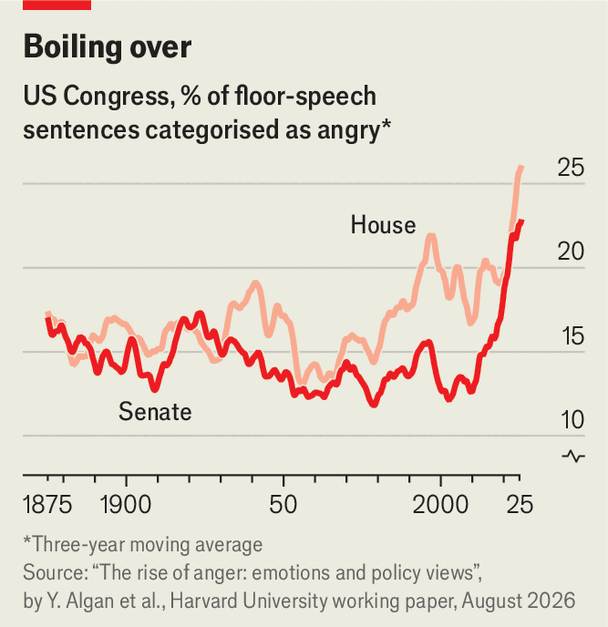
Their paper finds that angry statements in Congress shot up during Newt Gingrich’s leadership in the 1990s, before receding in the early years of this century. More recently such statements have become ever more common, rising by 50% since 2013 (see chart). Voters are more irate, too. From 2013 to 2025 the share of policy-related sentences expressing anger in voters’ tweets rose by 35%. In comments on Reddit, an internet forum, it rose by 46%.
Source: The Economist
“Ernst Jünger: A Dialectician of Treason”, Marcus Bullock, Cultural Critique 2008
The extraordinary story of the failed effort to bring the metric system to the United States
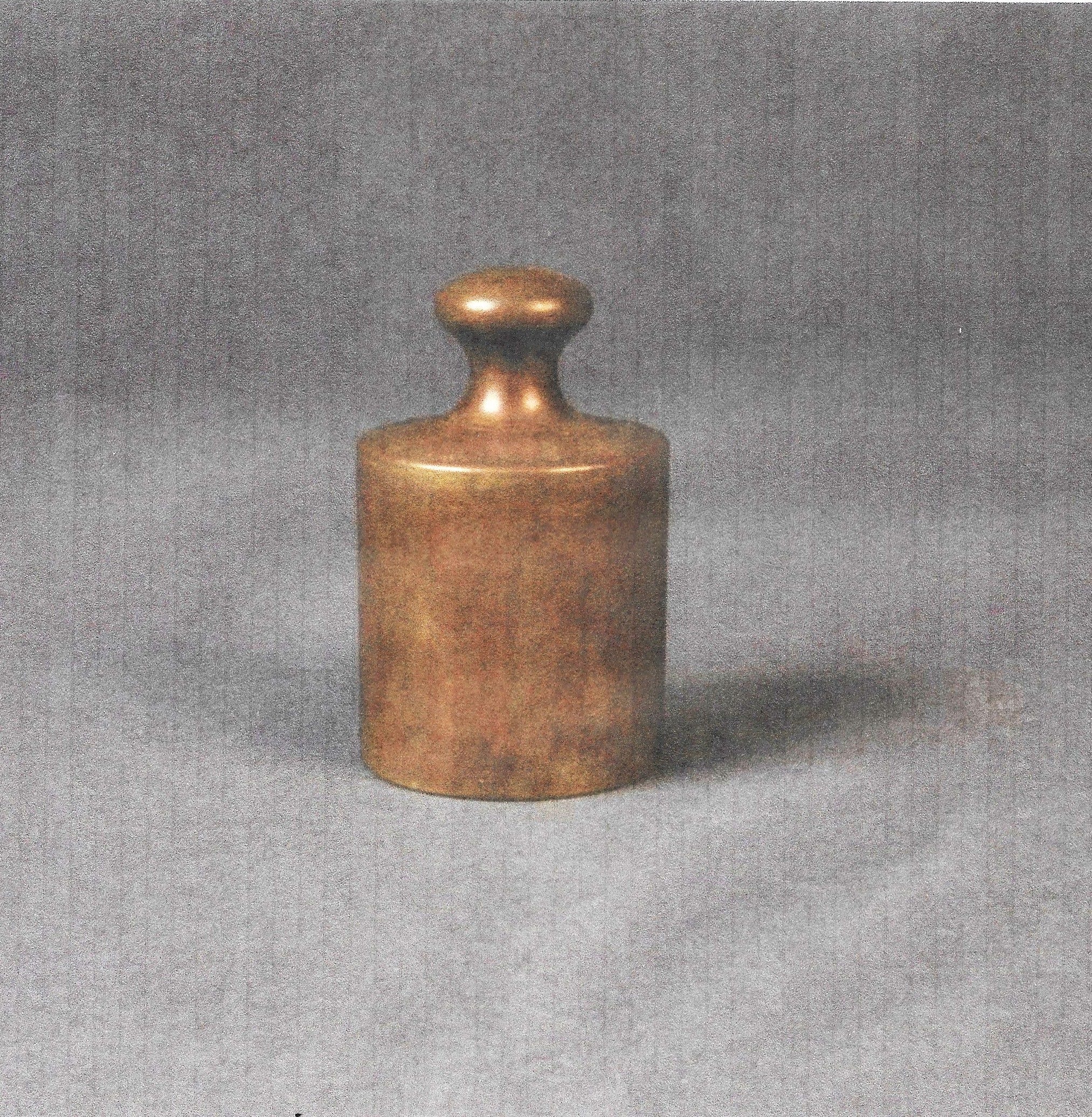
A small, strange-looking object sits in a glass display case at the National Institute of Science and Technology Museum in Gaithersburg, Maryland, on the outskirts of Washington, DC. This museum houses a collection of measurement devices, scientific instruments, artefacts, and archives relating to measurement, standardisation, science and technology in the United States. The object is a small copper cylinder with a little handle on top. It weighs one kilogram and it’s called a ‘grave’. Looking at it, most people would not know and could not guess its purpose. Nevertheless, this seemingly inconsequential object has a dramatic story to tell; one based on international relations and fraught with peril on the high seas during the Georgian Era. The story begins with Thomas Jefferson’s desire to bring the French metric system to the United States.
Serving under President George Washington, Thomas Jefferson (1743 – 1826) was the United States’ first Secretary of State (1790 – 1793). Among his other priorities, he wanted the US to adopt a nation-wide standard of weights and measures. At the time, the country used a hodgepodge of measurement systems. New York used Dutch measurements, while most of New England relied on English measurements. Jefferson knew that a standardized system would end the practice of merchants buying goods according to one unit, selling in another, and pocketing the ill-gotten profit. Moreover, a standardized system would simplify scientific calculations and promote international trade. Jefferson was interested in advancements in science, and he loved the precision of mathematics.
In 1784, as a member of the Virginia delegation to the Congress of the Confederation, he proposed that the US adopt a unified currency, based on the most familiar coin then in use, the Spanish dollar, which would henceforth be called the US dollar. However, the Spanish dollar was composed of halves, quarters, and eighths. Jefferson proposed that the US dollar would consist of decimal units. Thus, under the Coinage Act of 1792, the US dollar became the first decimal-based currency in the world (although the US still has the US quarter). Jefferson also wanted a standardized, decimal-based system for weights and measures. He wanted the US to adopt the newly-developed French metric system. In 1790, having returned to the US and serving as Secretary of State, Jefferson submitted to Congress a ‘Plan for Establishing Uniformity in the Coinage, Weights, and Measures of the United States’. Hoping that Congress would implement his plan, Jefferson corresponded with his contacts in France, arranging for the delivery of a one-meter copper rod and a one-kilogram copper weight from the Paris Academy. At the time, the set was one of six in existence in France.
The National Assembly chose Joseph Dombey to deliver the two objects to the US. Joseph Dombey (1742 – 1794) was a French physician and prominent botanist whose career was overshadowed, it seems, by continuing misfortune. In 1778, with the agreement of Charles III of Spain, he accompanied Spanish botanists Jose Pavón and Hipolito Ruiz on an expedition to Peru, South America to study exotic plants and minerals that might be useful in France. He would be there for five years. In 1780 he sent a portion of his collection home to France, but the British seized the vessel carrying those plants. Today, that collection resides in the British Museum. The incident became known as the ‘Dombey Affair’.
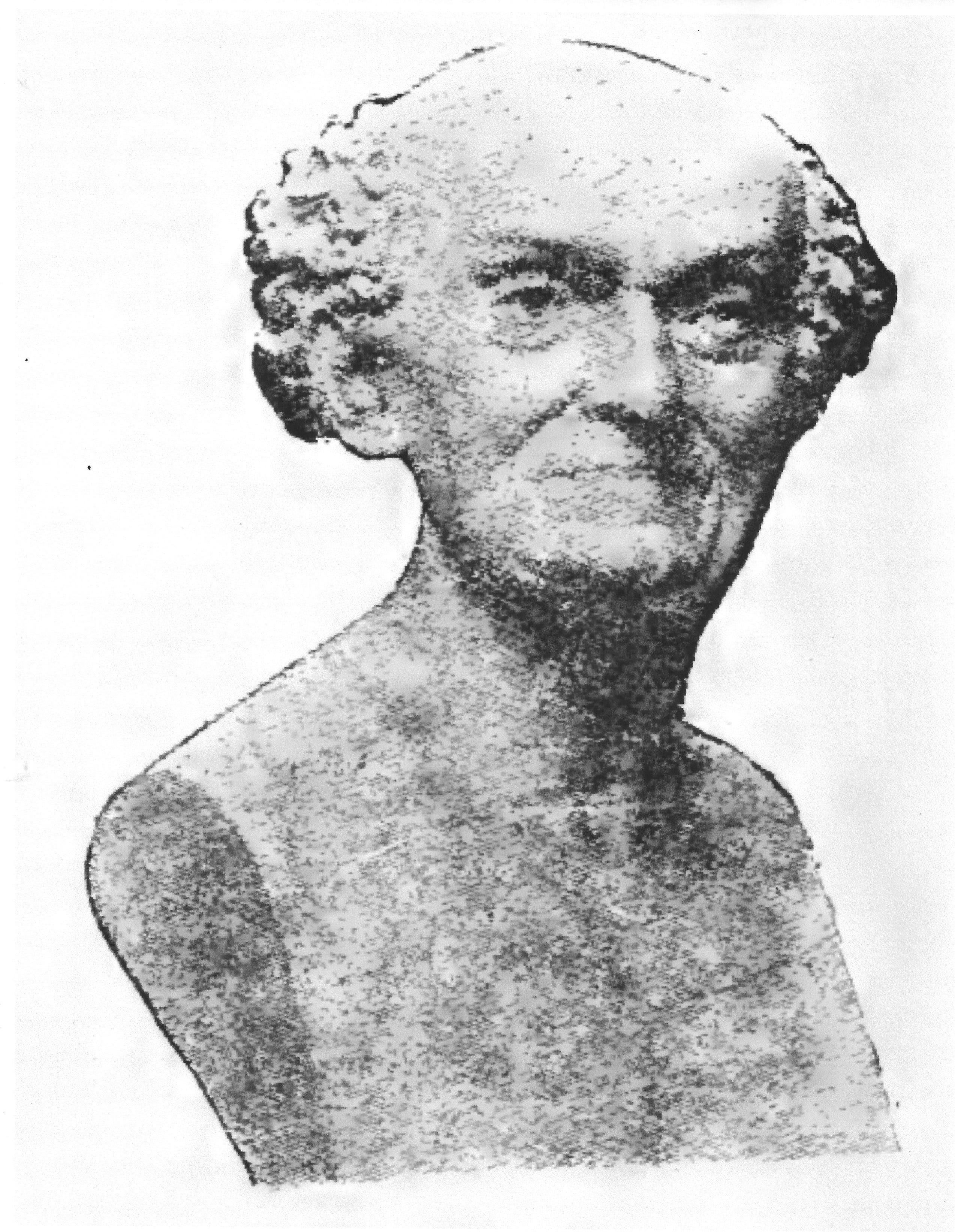
In 1793, at Jefferson’s request, the French National Assembly agreed to deliver a set of copper artefacts to the US: A one-meter rod and a grave (eventually called a kilogram) to serve as the US prototypes for a metric system of weights and measurement. Dombey volunteered to carry these objects to the US. He was eager to escape the bloodshed that the Jacobins had inflicted on Lyons and he wanted to collect plants native to North America. With his understanding of the scientific importance of accurate weights and measures, the French thought it likely Dombey could help Jefferson persuade Congress to adopt the French standards, which would later come to be known as the metric system. Dombey was also sent to sign an agriculture agreement that would strengthen the ties between France and the US. On 17 January 1794 Dombey boarded the brig Soon sailing for Philadelphia from Le Havre under the command of Captain Nathaniel Williams Brown of New York (sources do not say what flag the brig sailed under). Dombey bore a letter of introduction from the Committee of Public Safety, the executive body that ruled France during the Reign of Terror. At the time, France was at war with England and a number of other countries in the War of the First Coalition, so the crossing would be risky. In March, as the brig crossed the Atlantic, a fierce storm damaged the vessel and blew her course into Caribbean waters. When the crew put in at Point-à-Pitre in Guadeloupe, Dombey’s luck went from bad to worse.
… suffice to say Dombey and his meter measure never made it! Privateers, disease, imprisonmen, enranged French colonists ….
Source: Georgian Era
David Park, Kids on Bikes, 1950