
Hyper-scaling. Rotterdam. Crossing Africa by car and Napoleon IV.
Great links, images, and reading from Chartbook Newsletter by Adam Tooze

Thank you for opening your Chartbook email.

The Goddess and the Owl Françoise Gilot (b. 1921) 1969
Now begins an arms race … Big Tech’s AI-driven spending boom.
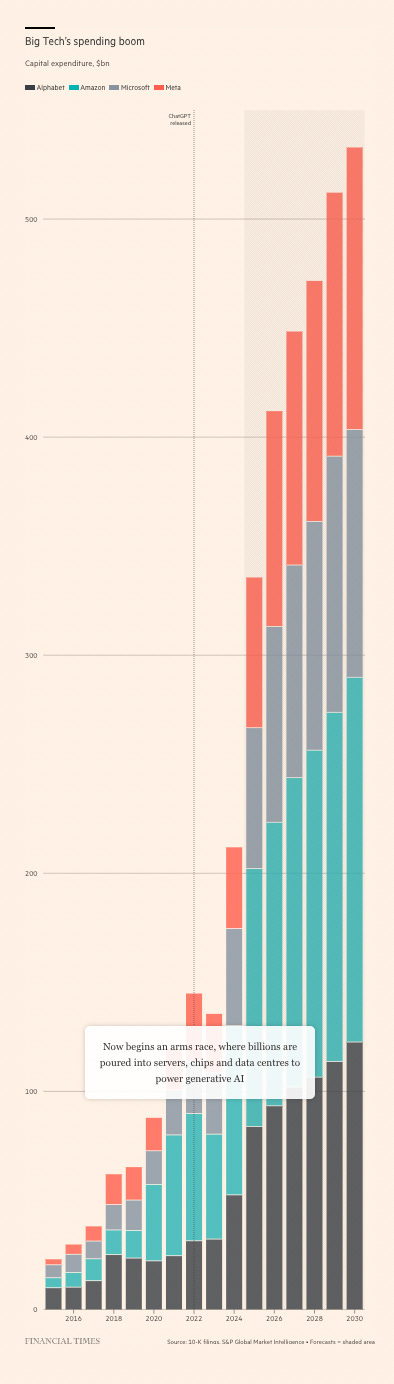
Historically, most of the spending by the “hyperscalers” — Amazon Web Services, Microsoft Azure and Google Cloud — building data centres for their cloud services businesses was self-funded. But the scale of computing power needed for generative AI is changing that. While internal cash flows largely covered costs of up to $200bn last year, costs are projected to double this year and increase further next. Some economists have started to question how much further hyperscalers’ cash reserves can be stretched, and investors want to know when their spending will translate to real revenues from AI services. Hyperscalers’ generative AI revenues were just $45bn last year, according to Morgan Stanley analysts — although they predicted revenues would exceed $1tn by 2028. This has left a funding chasm that financiers are rushing to fill. JLL estimates $170bn of assets will require construction lending or permanent financing this year. Between now and 2029, however, global spending on data centres will hit almost $3tn, according to Morgan Stanley analysts. Of that, just $1.4tn is forecast to come from capital expenditure by Big Tech groups, leaving a mammoth $1.5tn of financing required from investors and developers.
Source: Financial Times
HEY READERS,
THANK YOU for opening the Chartbook email. I hope it brightens your day.
I enjoy putting out the newsletter, but tbh, what keeps this flow going is the generosity of those readers who clicked the subscription button.

If you are persuaded to click, please consider the annual subscription of $50. It is both better value for you and a much better deal for me, as it involves only one credit card charge. Why feed the payments companies if we don’t have to.
And when you sign up, there are no more irritating “paywalls”
How US commercial real estate adjusted to the shock of COVID and higher interest rates.
For contributing subscribers only.
The Economist believes that the market has bottomed out and will now turn the corner.
A turnaround is more obvious in the CMBS market, where volumes have surged this year. In total $15.2bn in bonds that are between half and fully collateralised by offices have been issued, up from $4.3bn in 2024 and just $400m in 2023. With four months to go, 2025 is already the third-strongest year in the past decade. The market is undergoing structural change, too. As the value of offices slumped, the loan-to-value ratios of mortgages attached to them rose. That left banks holding riskier loans and drove up their own loan-to-value ratios—a closely watched measure of financial health. As the banks have pared back lending, a variety of alternative lenders with higher risk appetites have stepped in. This year Blackstone, a private-investment giant, raised $8bn for its joint-largest real-estate fund, which will hunt out distressed properties. Brookfield Asset Management, another investment firm, raised almost $6bn for its own new real-estate fund. This trend is set to continue. Moody’s, a credit-rating firm, expects about $1trn-worth of commercial property mortgages in Europe and America to shift to new private creditors over the next three to five years. Life insurers and private-credit funds are especially likely to snap up the mortgages banks no longer want.
Source: The Economist
The Largest Seaport In Europe: Port of Rotterdam Map
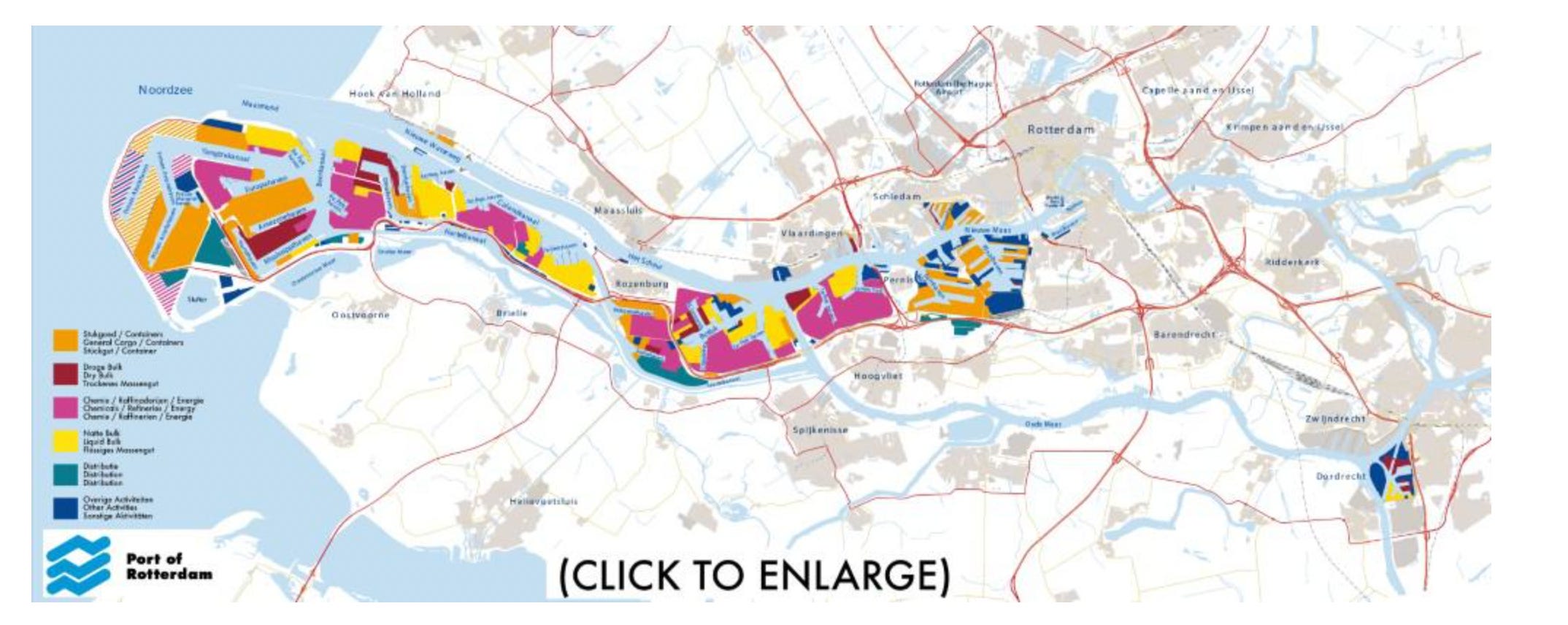
From 1962 until 2004 it was the world’s busiest port.
Consists of five distinct port areas and three distribution parks
It stretches a distance of 40 kilometres (25 mi)
It covers 105 square kilometres (41 sq mi)
In 2018 it handled 14,512,661 twenty-foot equivalent units (TEU), which is only a third as much as Shanghai, the world’s busiest port
It employs 1,100 people directly and they claim 384,500 jobs depend on the port in some way
In 2018 it recorded 29,476 sea going vessel arrivals with an additional 107,000 inland vessels being used
It generates annual revenues of €707.2 million with added value (direct and indirect) of over €45.6 billion
The length of all quays is an impressive 77.3 km
In terms of weight, imports (323 million tonnes) are more than double exports (146 million tonnes)
Their website claims that there are 15 dolphins living in the port
Source: Mover DB

Françoise Gilot (French, b. 1921) Puck, 1970. Lithograph on paper. 22 x 30 inches. Gift of Dr. and Mrs. John Hallick, 1985.2.34
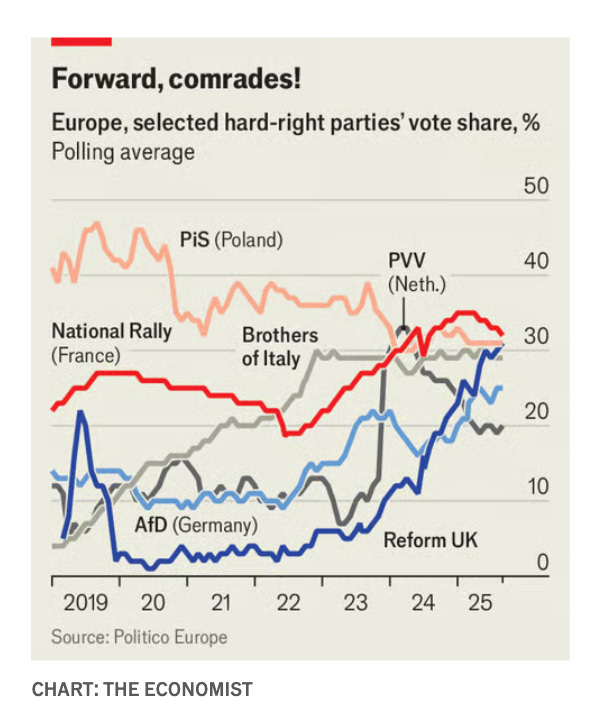
Far-right parties in Europe are gathering around 20-30 percent of the electorate.
Source: The Economist
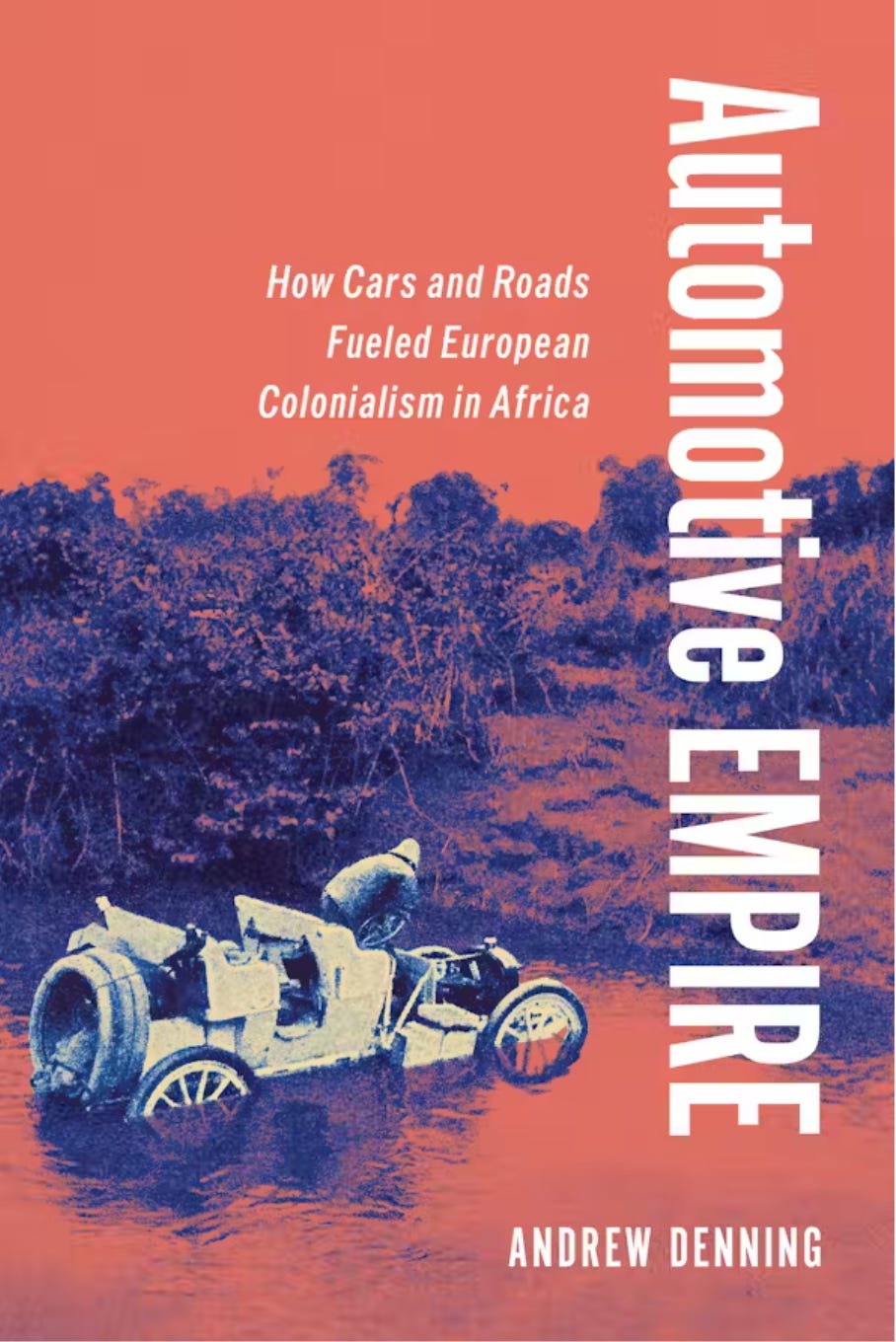
Andrew Denning. Automotive Empire: How Cars and Roads Fueled European Colonialism in Africa. Cornell University Press, 2024.
Source: Cornell Press
Wood for war
“in 1916–18, when German U-boats interrupted Britain’s trade routes, the country had to fell nearly half of its commercial woodland in order to satisfy military needs. Similarly, during the Second World War, Japan lost 15 per cent of its forests.”
Source: Bonneuil, Christophe; Fressoz, Jean-Baptiste. The Shock of the Anthropocene: The Earth, History and Us (Function).
How German explorer (and an army of helpers) drove a car across Africa in 1907-1909.
For contributing subscribers only.
How “Napoleon IV” died in combat in Africa fighting for Queen Victoria
Napoléon, Prince Imperial (Napoléon Eugène Louis Jean Joseph Bonaparte; 16 March 1856 – 1 June 1879), also known as Louis-Napoléon, was the only child of Napoleon III, Emperor of the French, and Empress Eugénie. After his father was dethroned in 1870, he moved to England with his family. On his father's death in January 1873, he was proclaimed by the Bonapartist faction as Napoléon IV. In England, he trained as a British Army officer. Keen to see action, he persuaded the British to allow him to participate in the Anglo-Zulu War. In 1879, serving with British forces, he was killed in a skirmish with a group of Zulus. His early death caused an international sensation and sent shockwaves throughout Europe, as he was the last serious dynastic hope for the restoration of the House of Bonaparte to the throne of France.
Source: Wikipedia
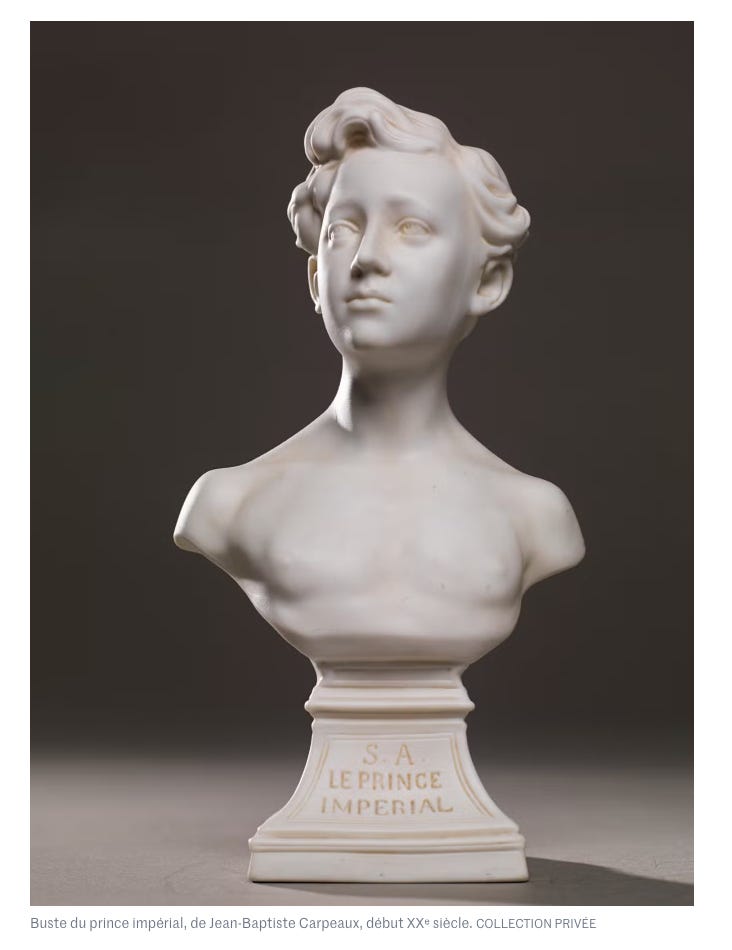
Source: Lemonde
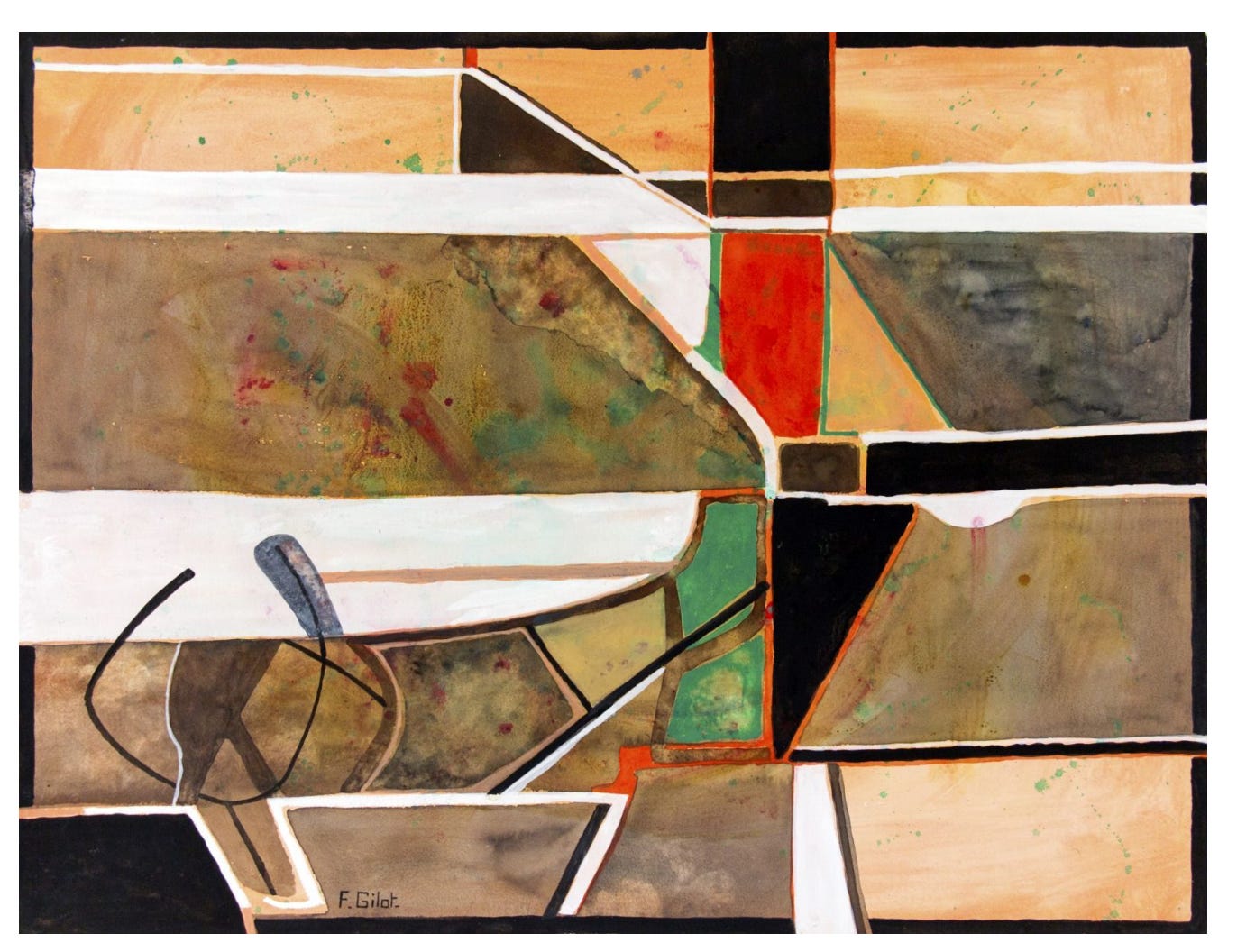
Gilot, Study for the Black Sail 1962
If you’ve scrolled this far, you know you want to click: