Thank you for opening your Chartbook email.

Dame Ethel Walker, British 1861-1951 - The Mirror; 1927
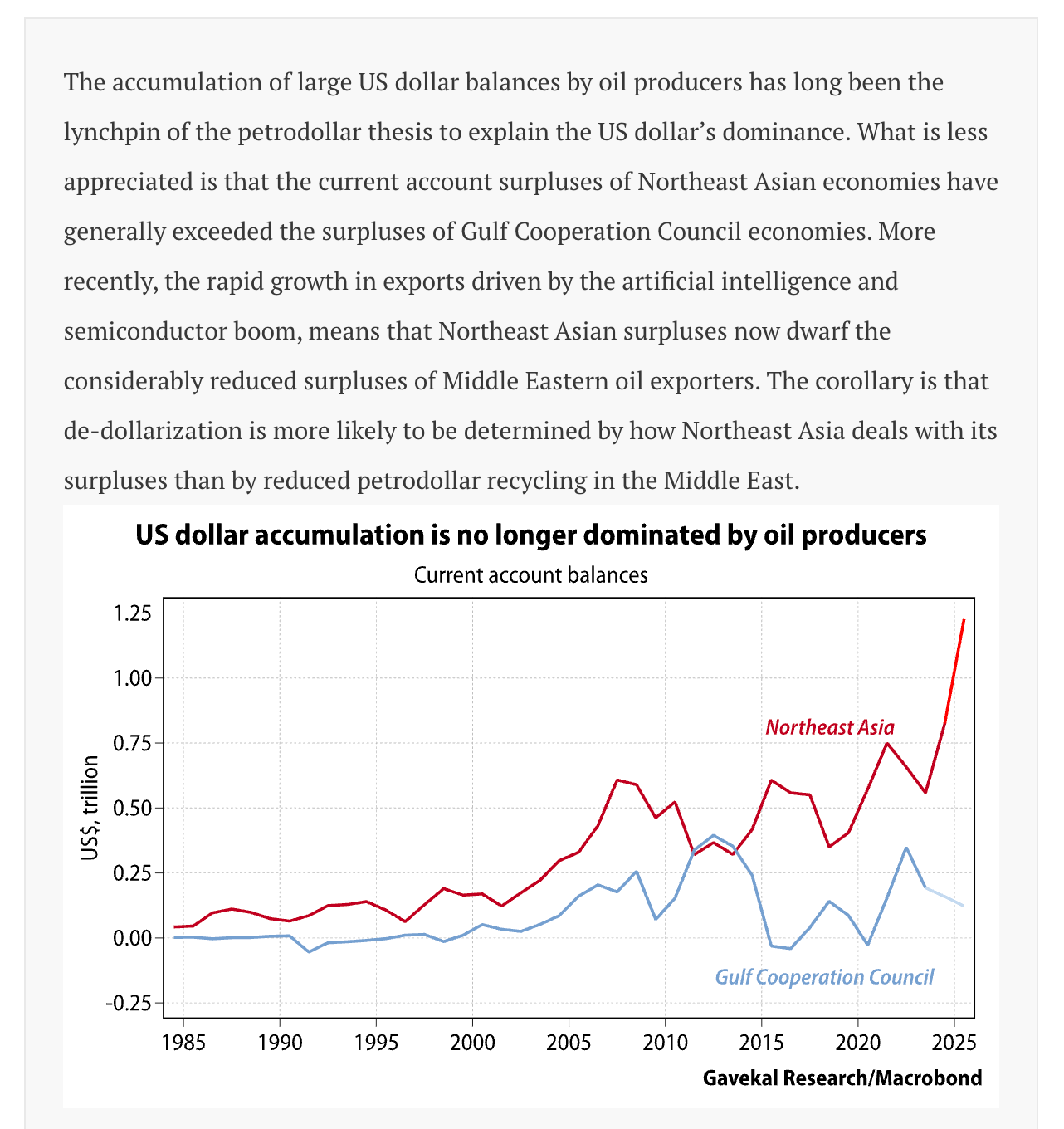
How Asia trumps the petrodollar
Source: Gavekal Research
Far from dominance: American consumers have seen the biggest hike in petrol and diesel prices of all countries across the G7 since the start of the war on Iran
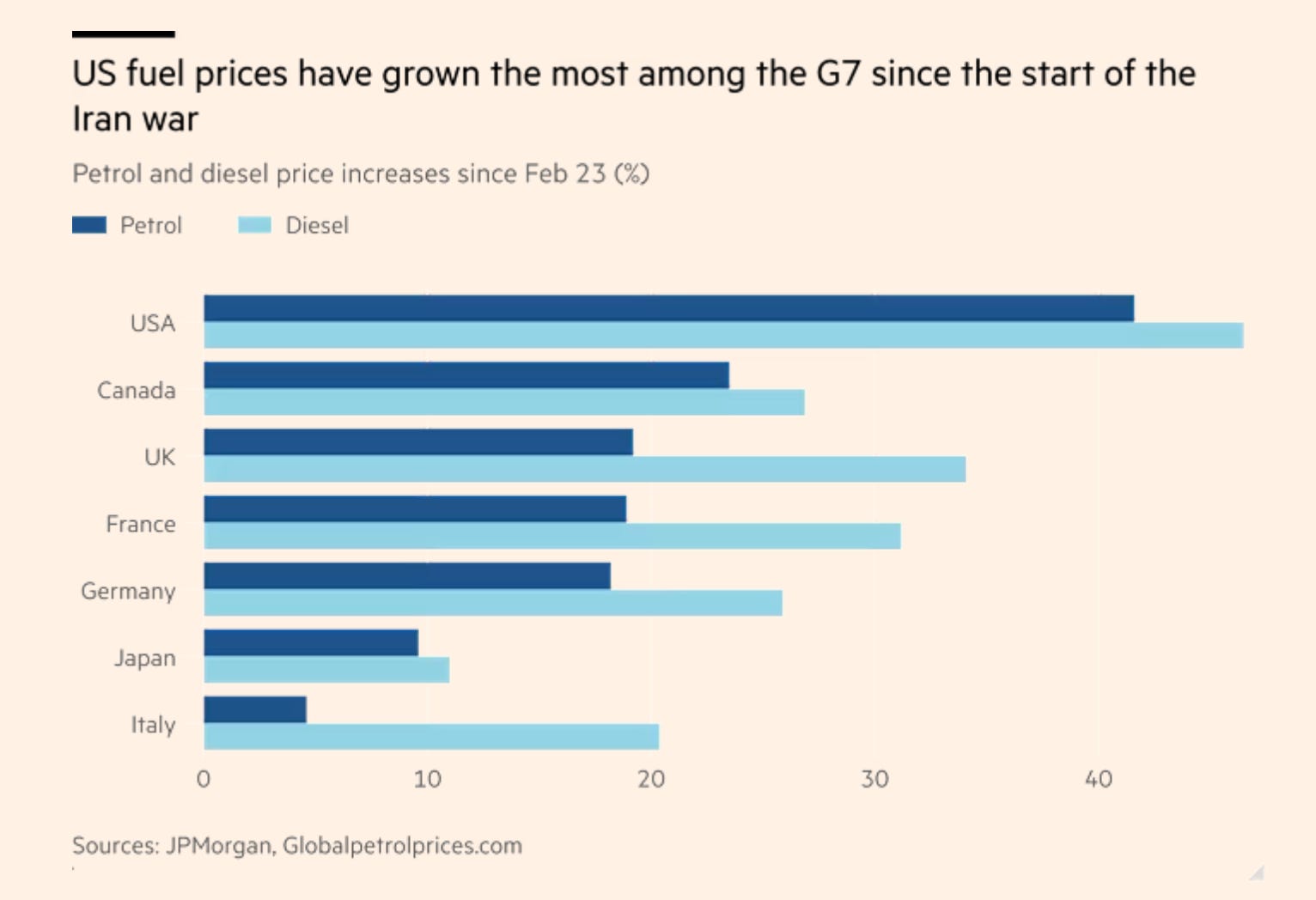
“I was at an industry meeting this week, and I can tell you one of the biggest concerns was that we might see diesel prices [in the US] go to $10, and the equipment, you know, the pumps and the dispensers and so forth can’t handle a number that high. That’s incredible,” he said.
Source: Financial Times
HEY READERS,
THANK YOU for opening the Chartbook email. I hope it brightens your day.
I enjoy putting out the newsletter, but tbh, what keeps this flow going is the generosity of those readers who clicked the subscription button.

Photo by Jakub Dziubak on Unsplash
If you are persuaded to click, please consider the annual subscription of $50. It is both better value for you and a much better deal for me, as it involves only one credit card charge. Why feed the payments companies if we don’t have to.
$40 bn energy bill
For contributing subscribers only.
Iran war saddles global companies with $25 billion bill - and counting
For contributing subscribers only.
Electric scooters as mobile backup batteries
There are about 300mn electric scooters in China, which Wang said averaged between 1.5 and 2 vehicles per household, while the declining population would limit growth. He said Yadea was still trying to increase its market share by upgrading its product range. In overseas markets frequently hit by electricity supply shortages, Yadea is eyeing the potential to “build an entire ecosystem”, Wang said. “In countries with power shortages, Africa for example, even charging mobile phones can be affected. I actually see this as an opportunity.” He said vehicles could serve as a backup for households. An electric scooter with a 4kWh battery “can supply power during outages — enough to run basic household appliances like a TV, refrigerator or charge phones.”
Source: FT
Debt Bill Hits 51.8 Bln US Dollars As Domestic Borrowing Pressure Mounts Yared Seyoum May 7, 2026
Ethiopia’s domestic debt burden has climbed to 18.3 billion US dollars, pushing total public liabilities to 51.8 billion US dollars …
External debt stood at 33.5 billion US dollars, while domestic debt reached 18.3 billion US dollars, according to the ministry. The figures show that local borrowing has become a larger fiscal pressure point at a time when the government is trying to restore debt sustainability, secure concessional financing and complete restructuring talks with external creditors. Of the external debt stock, 22.1 billion US dollars is owed by the federal government, while state-owned enterprises account for the remaining 11.5 billion US dollars. Domestic liabilities are more concentrated within the central government, which holds 17.5 billion US dollars of the 18.3 billion US dollars total. …
debt previously carried by state-owned enterprises had declined after commercial bank loans held by public enterprises were transferred to the Ministry of Finance under the government’s macroeconomic reform framework and began to be serviced through the federal budget. The disclosure comes as Ethiopia remains under an IMF-backed reform programme approved in July 2024. The four-year, 3.4 billion US dollars Extended Credit Facility was designed to support the Homegrown Economic Reform agenda, including a market-based exchange rate, tighter monetary policy, domestic revenue mobilisation, debt restructuring and reforms to state-owned enterprises. The IMF completed the fourth review of the programme in January 2026, unlocking about 261 million US dollars. It said the authorities had made progress, citing stronger growth, improved exports, better revenue mobilisation, reserve accumulation and declining inflation. But the Fund also warned that prudent spending control, domestic revenue mobilisation, fuel subsidy reforms and debt treatment remained critical to containing debt vulnerabilities. …
The debt update also comes as external financing inflows remain below target. The government planned to mobilise 4 billion US dollars in external financing during the fiscal year. For the first nine months, it targeted 3.1 billion US dollars but secured only 2 billion US dollars, or 65.1 percent of the plan. The World Bank accounted for 914.2 million US dollars of the amount raised. The World Bank has become a central source of budget support for the reform programme. In July 2025, it approved a 1 billion US dollars Development Policy Operation to support Ethiopia’s shift toward a more inclusive and private-sector-led growth model, following an earlier operation approved in July 2024. A World Bank debt sustainability document also shows 1.5 billion US dollars in budget support was disbursed in 2024/25, with a further 1 billion US dollars programmed for 2025/26 and another 700 million US dollars expected in early 2026/27.
Ahmed said external financing inflows were expected to improve in the coming months following discussions held during the 2026 Spring Meetings of the World Bank Group and the IMF in Washington.
The Ministry of Finance said the talks focused on expanded World Bank support, coordinated financing with the IMF, debt restructuring, crisis response support and measures to preserve reform gains amid global economic pressure. The government is also seeking to cushion social sectors from disruptions in donor funding.
Ethiopia and the United States signed a five-year health cooperation memorandum of understanding in December 2025 worth up to 1.6 billion US dollars, including 1.016 billion US dollars in US grant financing, an additional 150 million US dollars in performance-based grant funding and 450 million US dollars in Ethiopian government co-financing. The funds are to be channelled through government systems to support health priorities including HIV and AIDS, tuberculosis, malaria, maternal and child health, polio eradication and outbreak preparedness. The pressure from donor funding gaps has already been visible in humanitarian programmes.
The World Food Programme said in April 2025 it had suspended malnutrition treatment for 650,000 women and children in Ethiopia because of severe funding shortages, warning that 3.6 million people could lose assistance without additional resources.
Source: Birrmetrics
Dame Ethel Walker - Three Graces

The Fall of Victory Day in Kazakhstan
While Russia continues to place heavy emphasis on celebrating the Soviet victory over Nazi Germany 81 years ago, the holiday’s importance is diminishing across much of the former Soviet space. Kazakh President Kassym-Jomart Tokayev was one of only two Central Asian heads of state present when Russia hosted its annual commemoration of victory in World War II. While Tokayev’s attendance at the much-diminished May 9 parade signalled continued diplomatic support for Moscow, commemorations inside Kazakhstan continue to drift away from their Soviet roots. This year saw no military parades anywhere in Kazakhstan while the president was in Moscow. Instead, officials laid flowers at the Defenders of the Fatherland memorial in Astana.
Meanwhile, a local version of the Immortal Regiment march, where families parade with portraits of relatives who fought during World War II, took place in the southern city of Almaty after questions about its approval. Despite Soviet flags still being visible during the march – now known as Batyrlarga Tagzym, Tribute to the Heroes – they were far outnumbered by Kazakh flags and ribbons. Officials further reinforced this shift by handing out ribbons in Kazakhstan’s turquoise-and-yellow national colors before the march began. In recent years, Kazakhstan has worked extensively to reshape the national meaning of the holiday, minimizing Soviet symbolism at celebrations across the country.
This was already evident at last year’s parade in Astana, where Soviet remembrance was almost entirely replaced by displays of Kazakh nationalism. This trend reflects not only changing historical memory, but Kazakhstan’s broader pragmatic effort to strengthen ties with foreign partners and position itself more clearly as an independent actor on the international stage.
Source: The Diplomat; Albert Otkjær
V.S. Naipaul on displaced, late-stage Anglo-centrism, from Guerillas (1975).



Decoration: The Excursion of Nausicaa
1920, Dame Ethel Walker