

Oligarchs, wealthy and influential capitalists - what you might call “personal capital” as opposed to “institutional” or “societal” or “class” capital - are an increasingly important feature of contemporary political economy.
The profile of this top wealth is worth understanding.
There are about 3500 people worldwide worth more than $1 billion. Their share of global wealth is “only” roughly 3-3.5 %. Nevertheless, their huge wealth, the business and technological wagers they engage in, their political, societal and cultural alignments exert an outsized influence on contemporary reality.
I’m not at all convinced by talk of a neo-feudal mode of production. But we clearly do live in a world in which this kind of oligarchic, capitalist “aristocracy” matters more than it did in the age of corporate capitalism or even first stage financialization where the talk was of “shareholder value”.
FYI: Billionaires exert their huge pull on the contemporary imagination in part because they are often used as a cipher for ultra-high net worth individuals, or “the rich” which are, in fact, a much wider group. In 2025 the world's richest 1.5 percent, owned 48.4 percent of all the world's wealth – equivalent to roughly $251 trillion. To qualify for that group your net worth had to exceed “only” $1 million. There are about 7-8 million adults worldwide in this group. As for the group worth $100 million or more, accounting is frustratingly imprecise, but there are somewhere between 30,000 and 100,000 people in this category. Super billionaires those with fortunes in excess of $50 billion are a truly exclusive group, numbering around 30 worldwide.
It is tempting to imagine this oligarchic world of huge fortunes existing beyond the ordinary reality of states, borders, jurisdictions etc. To a considerable extent they are drivers of the “offshore” world, centered on “jurisdictions” like the Cayman Islands. But the very existence of the “offshore”, as an “exceptional” space, pays backhanded homage to the fact that the vast majority of the world’s business continues to be framed by nation states or structures like the EU. And nowhere is this more clear than in the case of China, a giant economy ringed with foreign exchange controls.
In a couple of recent posts I’ve coined the phrase “walled-in wealth” (Chartbook 455) to refer to the way in which capital account and foreign exchange controls separate China’s wealth from that in the West.
In Chartbook 476 I was mulling over the historical point that the rise of China’s billionaire wealth coincides almost exactly with Xi Jingping’s rise to power. From the beginning of reform and opening up in the 1980s, successive Chinese leaders had to address the question of business wealth and influence and issues like corruption. But Xi is the first who has to had to wrestle with the questions posed by an increasingly entrenched and powerful billionaire oligarchy. In 2020 with the intimidation of Jack Ma and the deliberate deflating of the real estate boom, Beijing stamped its authority on the Chinese economy. Industrial policy has become a powerful force driving national economic development giving rise in the West to the China shock 2.0 narrative.
The publication of the Hurun rich list for 2026 last week, gives us a chance to update the “walled-in wealth” story and to explore how the wealth of China’s personal capitalists is connected to the country’s wider economic development.
Hurn is a research outfit named for British-Luxembourgish businessman Rupert Hoogewerf whose Chinese name is Hu Run (胡润). The Hurun wealth list for China has been published since 1999. Hurun has also published a list for India since 2012.
In its 28th edition, the Hurun list has become a valuable historical source on the rise of Chinese wealth. This post is based on the press release that accompanies the latest list.
As for methodology Hurun noted:
Valuing the wealth of China’s richest is as much an art as it is a science. We have missed some people, many of whom go to extraordinary lengths to hide their wealth, but we believe the Hurun Rich List to be the most serious attempt to identify China’s top wealth creators and to measure their holdings. There are shareholders missing from the likes of ByteDance, Alibaba, Tencent, Huawei, and other big companies, where as little as 0.1% ownership of the company might be enough to make our cut. Our team of researchers has - for the 28th year running - traveled the length and breadth of the country cross-checking information with entrepreneurs, local government, industry experts, journalists, bankers and regulators, as well as previous years’ databases. For non-listed companies our valuation was based on a comparison with their listed equivalents using prevailing industry Price/Earnings ratios.
Hurun Research found 1,529 individuals in mainland China, Hong Kong and Taiwan with more than CNY 5 billion (equivalent to US$740 million) so there are a mass of fascinating individual stories here. What are the patterns of general interest that we can distill out?
The first is that Chinese personal wealth is back on the rise. This list is the longest in the history of the survey, surpassing the previous peak of 1,460 set in 2021, as the crackdown on real estate and oligarchic hubris was beginning.
According to the Hurun list there are now more dollar billionaires in China (1176) than in the USA, where the number hovers around 1000.
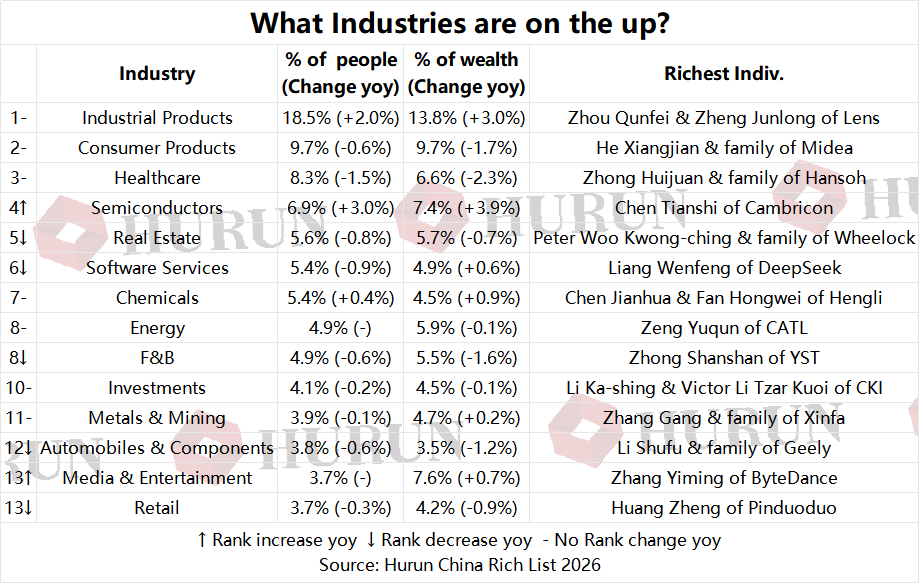
A two-speed economy. The wealth record was set “in a year when the majority of the list saw their wealth go down: 911 fell or stood still, against just 785 risers.” “AI, semiconductors and robotics surged ahead, whilst those in consumer, real estate and traditional manufacturing saw their wealth shrink — a two-speed economy.”
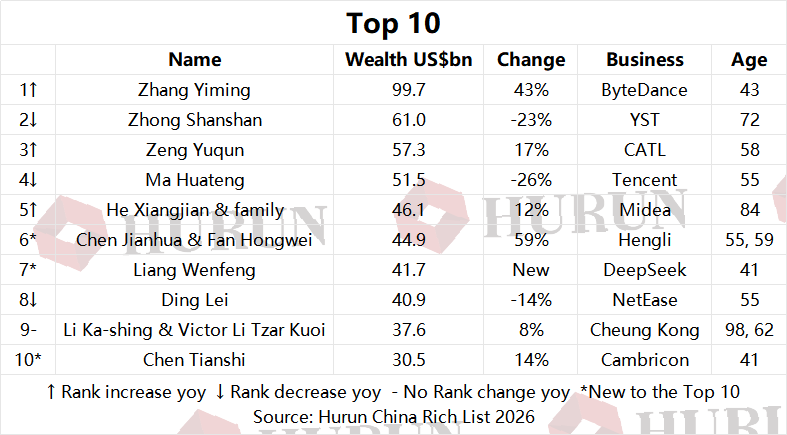
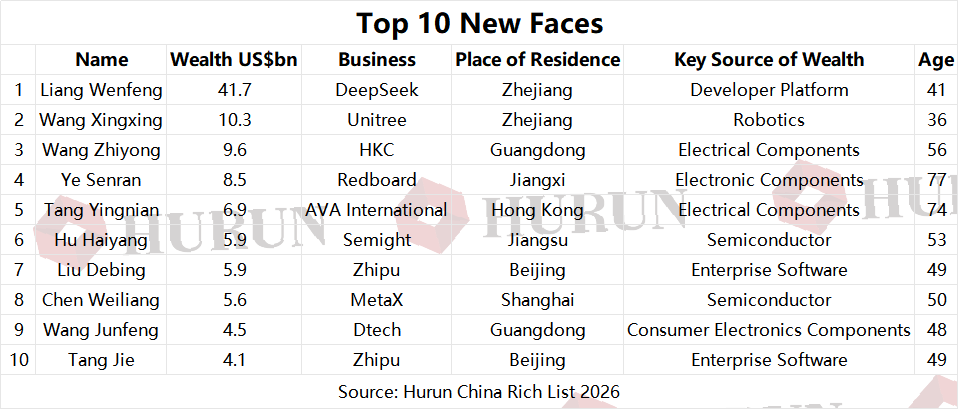
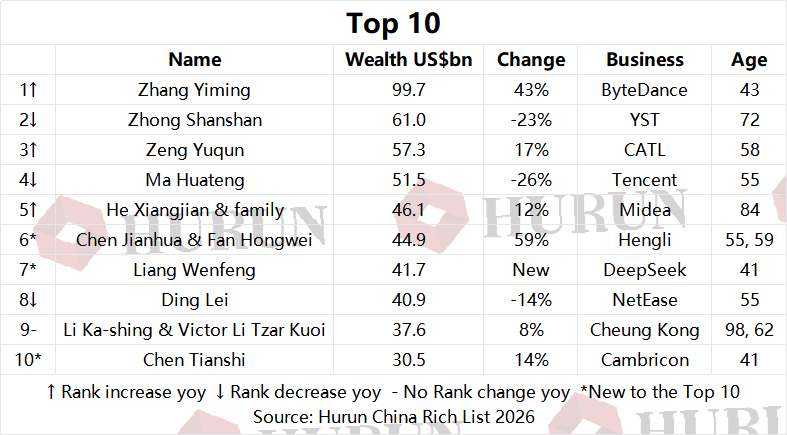
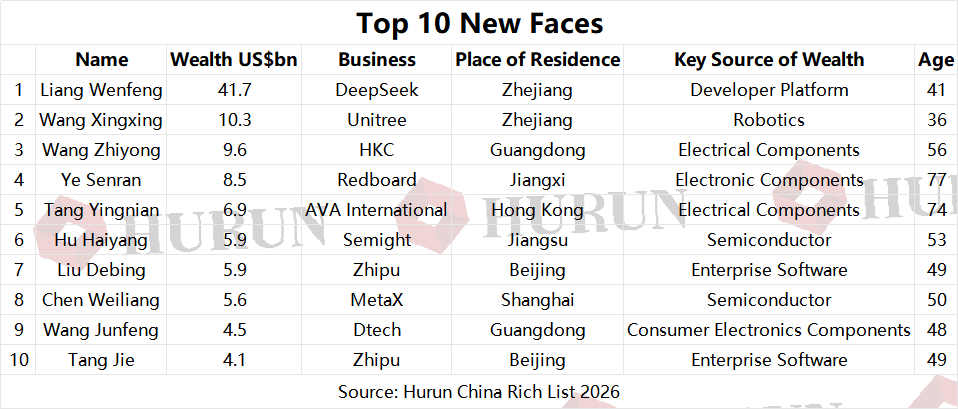
“AI is the biggest single wealth engine on this list: 160 Hurun rich listers — one in ten — now make their money from AI. … China now consumes hundreds of trillions of AI tokens a day, more than any other country.” “The AI economy — semiconductors, large models and embodied AI — boomed so hard that the list broke the record for the number of rich list entrants. Top of the list is still ByteDance founder Zhang Yiming with a personal net worth of US$99.7bn, but the huge surge in his wealth, up 43%, came on the back of “ByteDance’s aggressive push into AI”. “DeepSeek founder Liang Wenfeng, 41, was the sensation of the year, breaking straight in at Number 7 with US$41.7bn, and Chen Tianshi, also 41, of AI chipmaker Cambricon breaks into the Top 10 with US$30.5bn.” “Zhu Yiming is the man of the moment: ChangXin Memory, the chipmaker he founded just ten years ago, listed in July and peaked at over half a trillion US dollars — overtaking ByteDance and Tencent and more than double Moutai’s US$240bn. China’s most valuable company has travelled a long way, from a baijiu maker to a memory-chip maker. Behind the chips, a full-blown memory supercycle — prices up some 70% in a single quarter — and an AI datacentre shortage lifted the whole computing-power chain.” Behind DeepSeek there are a raft of other model builders: Moonshot AI, Zhipu, MiniMax. GPU designer MetaX made the fortune of its founders.
Robotics: “’Embodied intelligence’ — AI with a body — entered large-scale commercial application this year, and this list is where you see it: 80 Hurun rich listers now make their money from robotics. Frank Wang Tao of DJI, the drone pioneer who has mentored much of Shenzhen’s robotics scene, remains the sector’s biggest fortune with US$16.4bn. The sensation of the year was Wang Xingxing, 36, of humanoid-robot maker Unitree, who debuted with US$10.3bn as the year’s second-highest new face after taking Unitree public in August — the stock jumped 629% on its first day, briefly valuing the company at US$66bn and Wang’s own stake at nearly US$20bn — his wealth has almost halved since that IPO peak, with the company settling around US$35bn.” AgiBot, AI2 Robotics, LinkerHand, Galaxea AI, Ecovacs and UBTech are other key players.
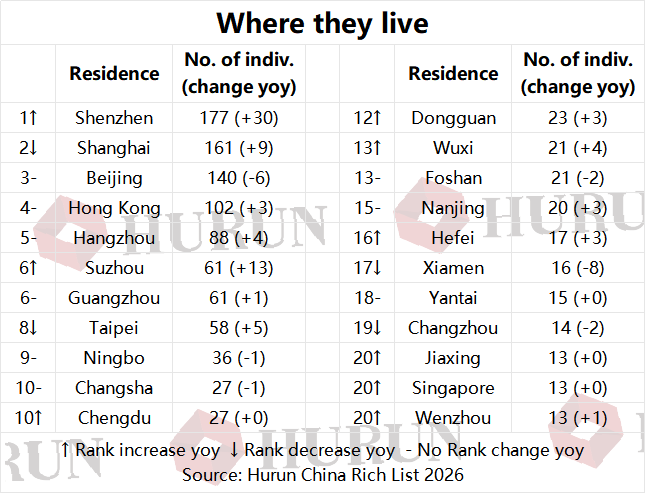
As a result of the sectoral shift, the geography of wealth in China is shifting: Shenzhen is now the main cluster of extreme wealth in China, with 177 individuals, up 30, on the back of its semiconductor, AI and robotics clusters. Shanghai was second with 161, up 9, and Beijing third with 140, down 6. Hong Kong (102, +3 — its first time over 100). So-called “hardtech” is the key to wealth formation in Shenzhen. “This is the city of Tencent’s Pony Ma, BYD’s Wang Chuanfu and DJI’s Frank Wang; of Grace Wang, who started on a Foxconn assembly line and then founded Luxshare, Apple’s biggest assembly challenger; and of this year’s new fortunes in the AI supply chain — Wang Zhiyong of display-maker HKC and Cai Huabo of memory-maker Longsys, whose fortune more than tripled this year.”
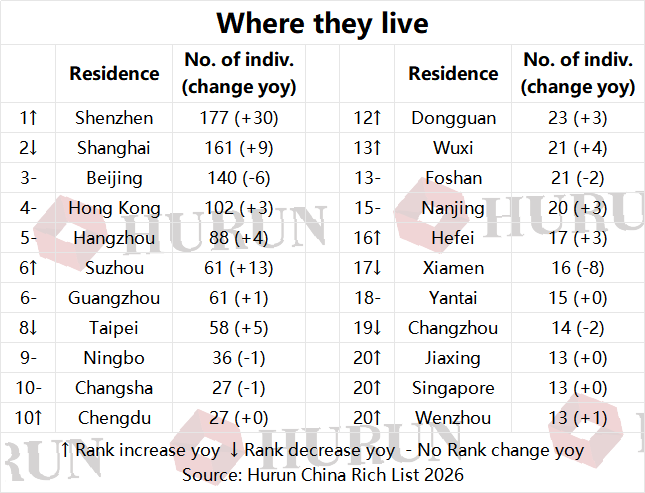
It is worth underling this point. These residences and city attachments are not merely symbolic. The overwhelming majority of the wealthiest Chinese live and work in China and their wealth is there. As much as they may enjoy the privileges of the global elite, there is no serious question as to the authority exercised over them and their fortunes by Beijing.
Aside from AI and hardtech, new energy is very much a theme in the rich list: Battery king Robin Zeng Yuqun, 58, moved up to third with US$57.3bn. All told, according to Hurun, “Around 100 … rich listers made their money from renewable energy and storage this year, and their stories tell of consolidation: scale and storage won, overcapacity lost. The sector’s biggest riser was Zhang Hejun of Deye, nearly doubling to US$9.4bn, as blackout-prone emerging markets from South Africa to the Middle East snapped up its storage inverters. Robin Zeng Yuqun of CATL added US$11bn as energy storage became the fastest-growing business inside CATL’s US$250bn market cap. Cao Renxian & Su Lei of Sungrow, the world’s largest inverter maker at US$45bn, held nearly steady. Solar manufacturing told the harder story — Liu Hanyuan of Tongwei fell 24% on polysilicon overcapacity. Among new faces, Xu Yingtong debuted with US$3.7bn after listing storage maker Sigenergy, which he founded only four years ago after leaving Huawei. China dominates every link of the energy-transition supply chain, and it shows on this list.” “CATL’s US$5.3bn Hong Kong offering in May 2025 was the biggest HK IPO since 2023, priced at a rare premium to its A-shares, with proceeds funding its new plant in Hungary”.
Along with AI, hardtech and new energy, high quality machinery is also a key contributor to Chinese wealth. This is the flipside to the China shock 2.0 story about the rise of Chinese industrial production and exports: Chen Jianhua & Fan Hongwei of Hengli broke into the Top 10 for the first time with US$44.9bn. “Chen built his fortune in chemicals for the apparel industry, then in 2022 bought a bankrupt Dalian shipyard for just US$300mn. Four years on, Hengli Heavy Industry holds the world’s largest single-yard order book: the world’s fleet is old, green-fuel rules are forcing a replacement wave and, with Korean yards sold out, orders flooded to China — Hengli signed over 200 ships in the first half of this year alone and is booked out past 500 vessels to 2030. His story is part of a bigger one: some 100 Hurun rich listers made their money in high-end equipment — the machines that make the machines — and they are replacing the old heavyweights. Liang Wen’gen & Liang Zaizhong‘s Sany sells excavators in 150 countries against Caterpillar and Komatsu; Wang Liping‘s Hengli Hydraulic (no relation) broke the German and Japanese monopoly on high-pressure hydraulic cylinders; and Wu Bo‘s Estun is taking robot market share from ABB and Kuka. Germany, Switzerland, Japan and Korea defined this industry for a century; the names on this list are redefining it.”
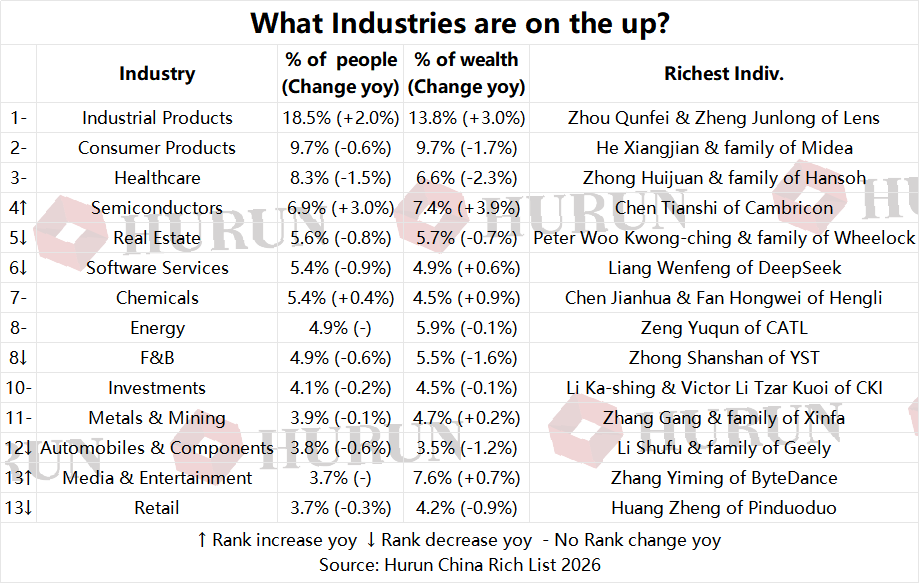
This is a useful reminder, that though the biggest fortunes may be in glamorous sectors like tech, AI, chips etc, these are not the sectors that dominate the overall list of 1500 names. Industrial products come top.
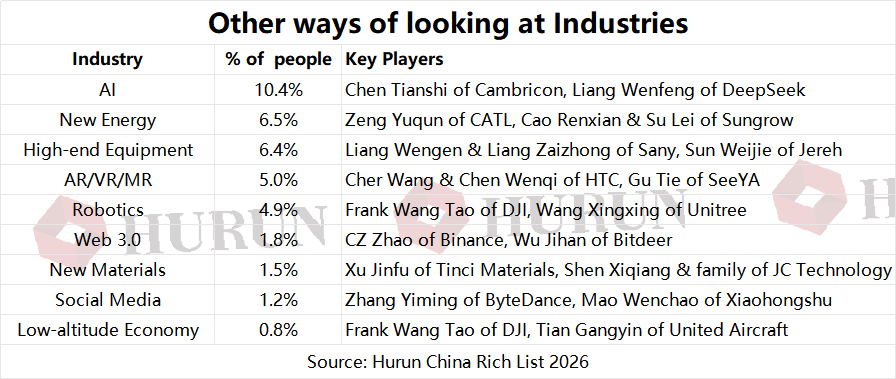
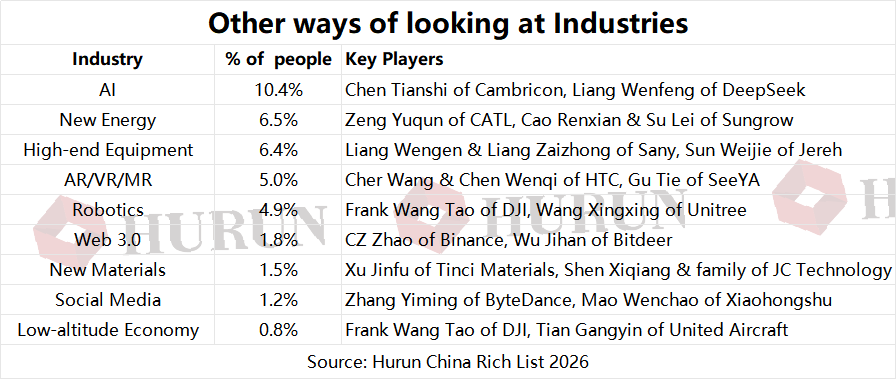
As Hurun points out, the picture is somewhat different if one classifies wealth not in terms of conventional sectors, but in terms of what technology was embodied in the products and services being sold. Under this classification: “10.4% of Hurun rich listers are now active in AI, up from 9% last year. 6.5% in New Energy, 6.4% in High-end Equipment, 5.0% in AR/VR/MR, 4.9% in Robotics, 1.8% in Web3, 1.5% in New Materials, 1.2% in Social Media and 0.8% in the Low-altitude Economy (drones and flying taxis).”
Which brings us by way of technology back to politics. Though entrepreneurs with a political ‘voice’ make up only “5.7% of the list, down from 6% last year and close to the historic low of 5.1% in 2021 (the high was 38% in 2004 for the top 100). NPC delegates unchanged at 44, CPPCC delegates up 2 to 43.” Nevertheless, despite the surprisingly small share of direct participation in party political processes, the priorities of China’s government are clearly stamped on the list. As Hurun comments: “This was the year ‘Made in China 2025’ came home — the ten-year plan to lead in ten key technologies. Five of this year’s Top 10 and 60% of the Top 100 make their money from the sectors it targeted, from semiconductors and AI to robotics and new energy. The new five-year plan, which began this year, doubles down on the same bet — naming ‘AI Plus’, quantum technology, biomanufacturing, embodied intelligence, commercial aerospace and 6G among its frontier industries. The people on this list are its delivery mechanism.”
And with an eye to the high-tech priorities set by the latest five year plan, Hurun comments: “The next rich list is already visible in this one. SpaceTech put three rocket founders on the list for the first time: Zhang Changwu, 43, of Landspace — whose Zhuque-3 reusable rocket made global headlines this summer, praised by Elon Musk as a potential Falcon 9-beater — Kang Yonglai of Space Pioneer and Yang Yiqiang of CAS Space. Expect these names to be much bigger over the next few years. Quantum computing, brain-computer interfaces and quantum computing do not have a rich lister yet, but it probably won’t be long.”
If on the other hand you are not in the favored group, the results are stark: as Hurun notes: “property wealth has fallen on every list since the Evergrande crisis broke in 2021.” “… A decade ago, China’s urbanisation drive made property developers the biggest fortunes in the land: Wang Jianlin of Wanda and then Xu Jiayin of Evergrande topped the list, and one in three of the Top 100 were in real estate. Today, for the first time ever, not a single mainland property developer remains in the Top 100 — the only property names left at the top are the Hong Kong landlord families. … The era when property was China’s wealth-creation engine is definitively over.”
Also suffering from the pressures of a K-shaped economy are China’s consumer giants. Even the once unbeatable internet players are no longer in the limelight. “Baidu’s Robin Li is out of the Top 100 for the first time since 2004, Jack Ma is out of the Top 10. … Lei Jun of Xiaomi was the year’s biggest faller, his wealth halving to US$25.1bn — and his story is China’s consumer story: he built one of the country’s best-loved brands on affordable premium, then bet the company on cars, straight into the fiercest price war on earth, where this year even the winners got marked down. Consumer fortunes fell across the board: Pop Mart’s Grant Wang Ning halved from the Labubu peak and Nongfu Spring’s Zhong Shanshan gave back US$13bn — though he is still up 20% on two years ago after his record 2025. This is what deflation looks like on a rich list: prices have been falling for ten straight quarters, the consumer won’t spend, and the bottlers and brand owners feel it first.” The only new fortunes in consumer brands were in small luxuries and services — bubble tea (Chagee and Heytea) and China’s homegrown ‘Luxury King’ Laopu Gold’s Xu Gaoming.”
As has been widely discussed in the context of the China shock 2.0 narrative, export markets are key to Chinese business prosperity and this shows in the wealth list: “Zhang Yiming‘s ByteDance kept a 19.9% stake in TikTok’s US business after this year’s landmark restructuring, which valued the US operation at US$14bn; Wang Chuanfu‘s BYD shipped 70% more cars overseas in the first half — overseas is now more than half of revenue for the first time — with factories rising from Hungary to Brazil. Then there are the born globals, designed for the world from day one: Frank Wang Tao‘s DJI has led the world drone market since its first products; JK Liu Jingkang‘s Insta360 sells the world’s best-selling 360-degree cameras mostly outside China; Chris Xu Yangtian‘s Shein does not sell a single item in its home market; and Zhu Zhaojiang‘s Transsion is Africa’s biggest phone maker without selling one phone in China. One-third of this year’s list is in export business — and they are the reason China now accounts for close to 30% of global manufacturing value-add.”
“Wealth is concentrating. China’s first renminbi trillionaires are a matter of when, not if: Zhang Yiming is already two-thirds of the way there, and I expect China to have three trillionaires, in yuan terms, within five years and ten within a decade. The most likely challengers for future Number Ones are Liang Wenfeng of DeepSeek … CZ Zhao Changpeng of Binance.. Chen Tianshi of Cambricon, already on US$30.5bn at just 41, as China races to build its own AI chips. Behind them comes the future-tech generation in humanoid robots. Watch also life sciences fused with AI, and commercial rockets — this year put three rocket founders on the list for the first time. And then there is the ultimate wildcard: the ‘one-person unicorn’, or OPC — a billion-dollar company built by a single founder directing an army of AI agents. Given China’s unmatched combination of engineers, AI adoption and entrepreneurial hunger, I would not be surprised to find someone with an OPC on this list within one or two years.”
Global success may be key to business fortunes in China, but back home social media matters. “By social media following, Lei Jun of Xiaomi is undoubtedly China’s ‘top influencer’ entrepreneur, with some 45 million followers on Douyin alone and an estimated 70 million across platforms — more than any other Chinese business leader, though still less than a third of Elon Musk‘s 230 million followers on X. Others include Michael Yu Minhong of New Oriental, Zhou Hongyi of 360, Liu Qiangdong of JD.com, Eric Li Shufu of Geely and Wei Jianjun of Great Wall Motors. We have noticed quite a few entrepreneurs now run their own social media, saving their companies significant advertising costs.”
So much for the trends of the moment.
Looking back, it is striking how the Hurun list confirms the historical point about the coincidence of the emergence of billionaire wealth with the era of Xi Jinping.
Hurun takes a more capacious definition of Chinese wealth by Forbes, but in Hurun’s data too, 2012-2013 marks a threshold. Xi’s first full year in office was the moment at which the average wealth in its list of the thousand richest Chinese people exceeded $1 billion.
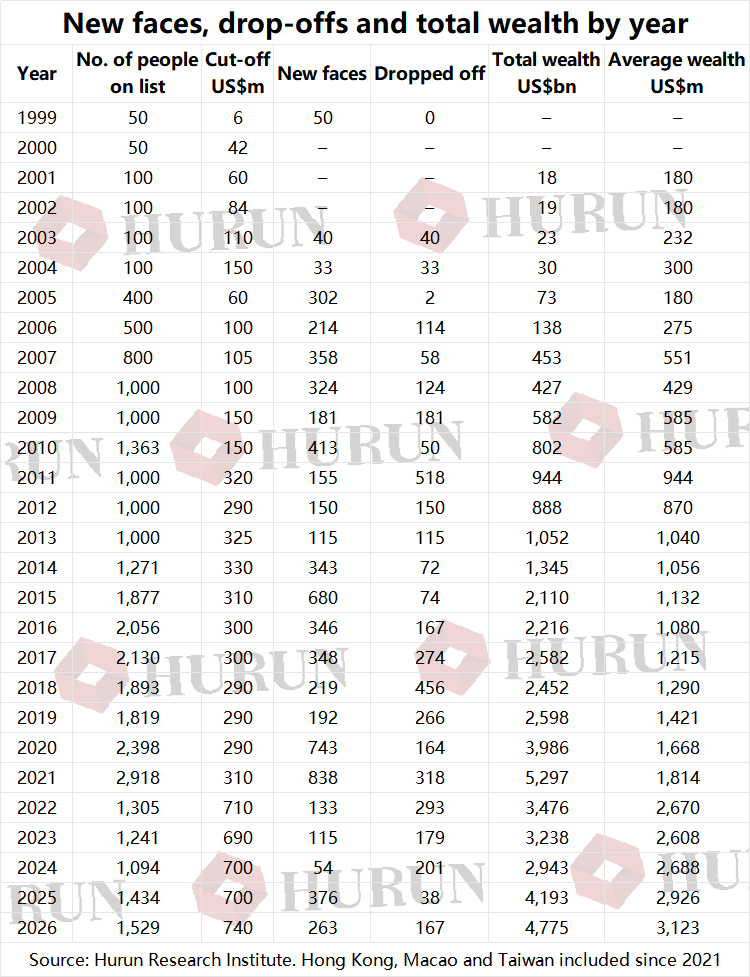
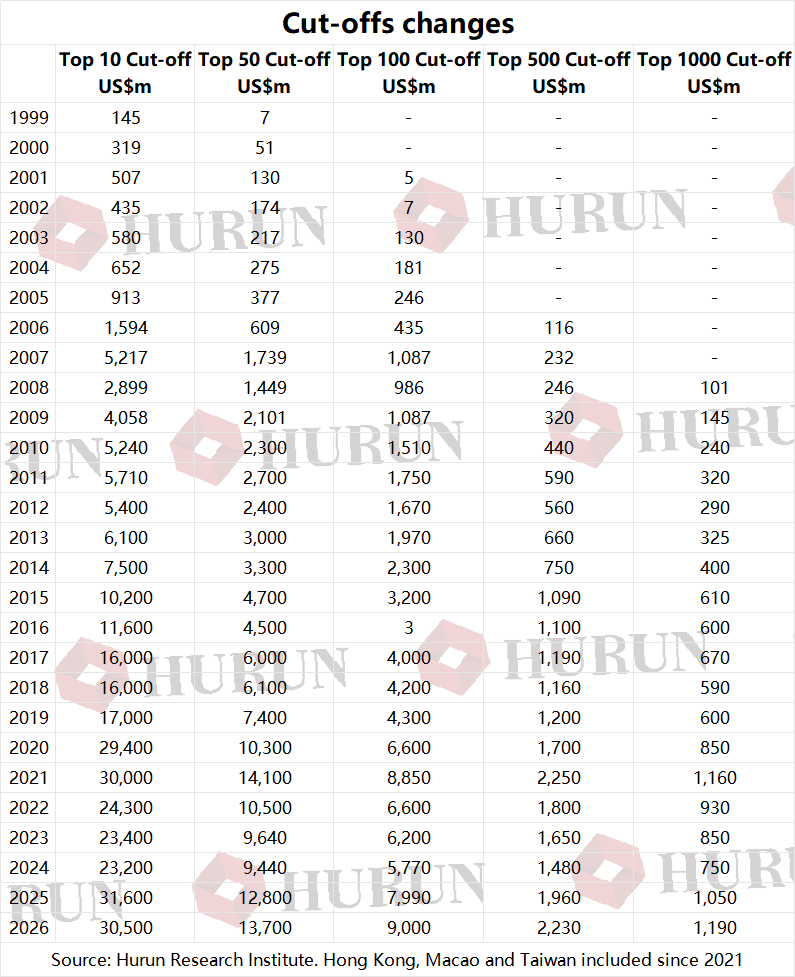
Since then, personal wealth exploded. Between 2013 and the 2020s, the cut-off threshold for the top ten of the Hurun list has increased fivefold to over $30 billion.
What overarching conclusions to draw?
China has been the arena for a huge accumulation of private wealth in the course of a single generation. Now, after four decades of ultra-fast growth, China is on the cusp of becoming a society with a significant, inherited haute bourgeoisie: “headline wealth is ageing with the first generation of reform-era founders, whilst the fastest-growing fortunes belong to a new generation barely half their age. But the pipeline thins at the very bottom: there is no self-made Under-30 on the list this year, the 10 Under-30s listed are all inheritors, and the youngest self-made entrepreneur is Zhang Junjie, 31, of bubble tea brand Chagee. Of the 59 Under-35s, just six are self-made. … The children of the rich listers are now in their early 30s and the number of NextGen successors on this year’s list remains at a record high — Chinese family wealth has officially entered a phase of large-scale inheritance. 98 of the Under-40s on the list are second-generation inheritors.”
Before this large-scale wave of inheritance has fully begun, the party under Xi Jinping has stamped its authority on the situation both by prominent interventions against individuals and by drastically reorientating the economy. The decline in real estate fortunes is the most drastic change in the composition of the rich list. The clear imprint left by the new industrial policy is another. In both cases it might be said that the party was simply following economic and technological logic. It was high time to prick the real estate bubble. The trends of new economy were dictated by technology not by policy. But in both cases the Chinese government has asserted leadership over those trends.
Furthermore, Beijing has done so, whilst at the same time pulling back from the tight embrace between Party and personal capital that was becoming the norm in the early 2000s under the sign of the “three represents” under which then General Secretary Jiang Zemin welcomed the leading edge of Chinese capitalism into the party.
All in all this would seem to conform well with the pattern suggested by the thesis of party-state capitalism developed by Pearson, Rithmire and Tsai, who see the party from the mid 2010s pivoting away from the “three represents” towards a more hands off model of “grand steerage” (Naughton), in which an increasingly gigantic private economy is controlled by corporate governance, dispersed party cells, regulation, anti-corruption drives and broader instruments such as industrial policy and macroeconomic policy.
I love putting out Chartbook. I am particularly pleased that it goes out for free to thousands of subscribers around the world. But, writing this newsletter takes a lot of work. If you are enjoying it and would like to support the project, sign up for one of the subscription options here. It is the equivalent of a fancy cup of coffee per month!
This is very interesting, both at the macro level and on the Chinese elite. One point on the macro: the transition from "corporate capitalism" to the present oligarchic capitalism was in large part facilitated and accelerated by the breakdown of corporate-governance norms: multi-class shareholdings that allow Zuckerberg and like founders to continue to control their companies while also enabling them to exploit the public equity markets have a lot to do with it. 30-40 years ago, this would have been much more difficult and would have been obstructed by state blue-sky laws, equity market underwriting norms, listing standards, the SEC, the accounting standards board, and the Delaware chancellor. Now, of course, all of that has been deregulated or loosened up, giving the oligarchs free hand. And they've become so powerful that it is hard even for the UK and the EU to stand up to them. Of course, the lemming-like desire of many investors to hand money over to the likes of Musk played a role as well.
This November 12th virtual event may be of interest: https://event.newschool.edu/india-and-china-in-the-making. Wondering how China's biggest dependency, Russia, impacts & is impacted. Both also undergird Iran. Whither the US?