

The dollar remains the central currency of the world economy, but the economic logic underpinning that status is subject to continuous metamorphosis. This constant change leaves us struggling to understand and predict what the behavior of the “dollar system” may be.
The reserve currency model that took shape in the 2000s centered above all recycling current account surpluses by way of foreign accumulation of US sovereign debt, Treasuries. Though the twin deficits - in the US budget deficit and on its current account - are still with us, we are no longer in that reserve currency world. As Brad Setser has painstakingly demonstrated we live in a world of de-reservification not de-dollarization. Net claims on the US are accumulated by way of state banks, pension funds, and other quasi-sovereign investors. Meanwhile in value terms, the growth in foreign holdings of US assets is increasingly dominated by equities rather than US Treasury bonds. The dollar today functions far less as a piggy-bank, rainy-day “reserve” currency and more as a vehicle for financial capital accumulation. Some call it a “portfolio currency”. I have dubbed our current era, the era of the “profit dollar”.
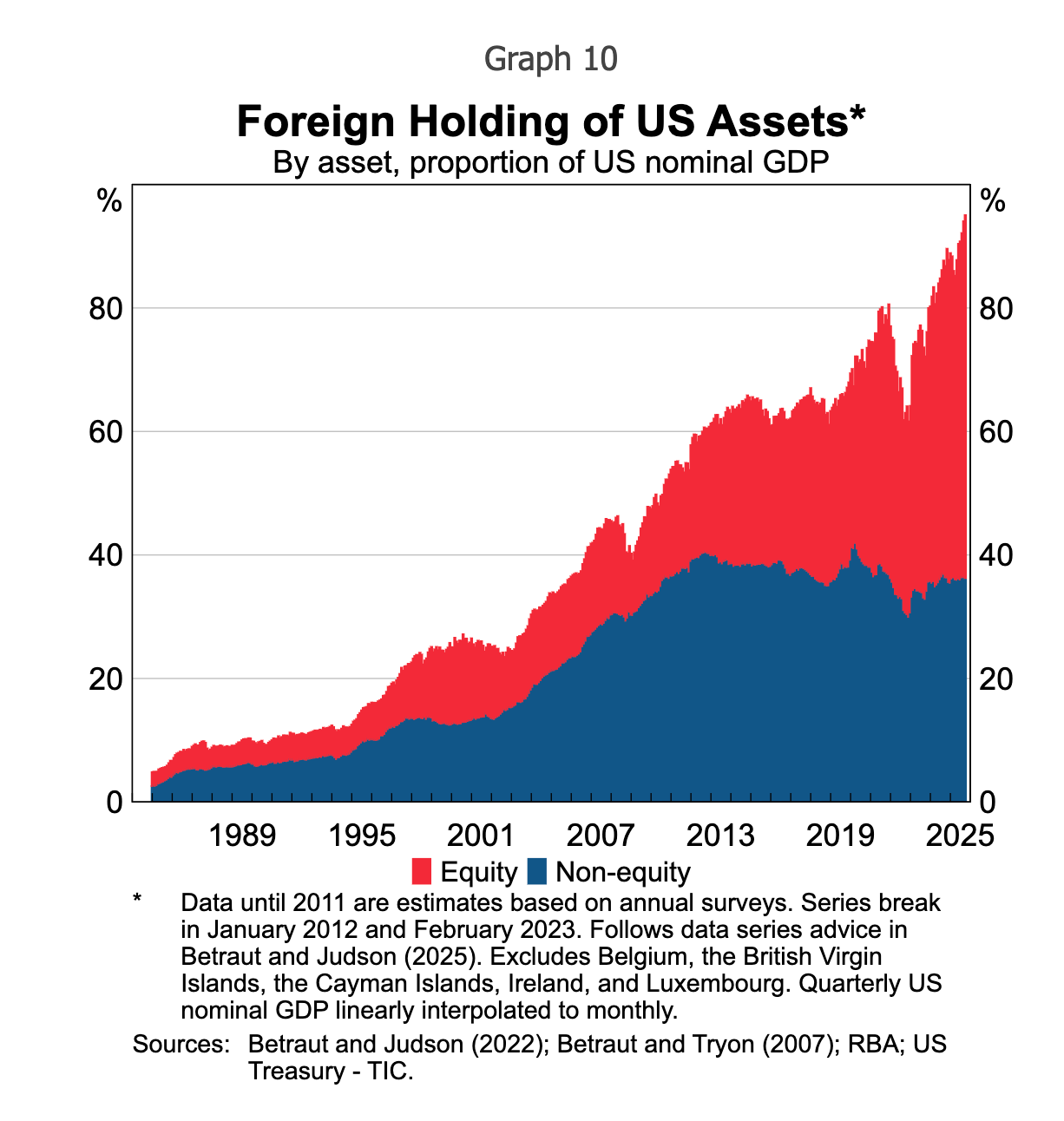
Source: RBA
This shift has been driven both by the increasing unwillingness to accumulate American government debt and by the long-run out performance of US equity markets.
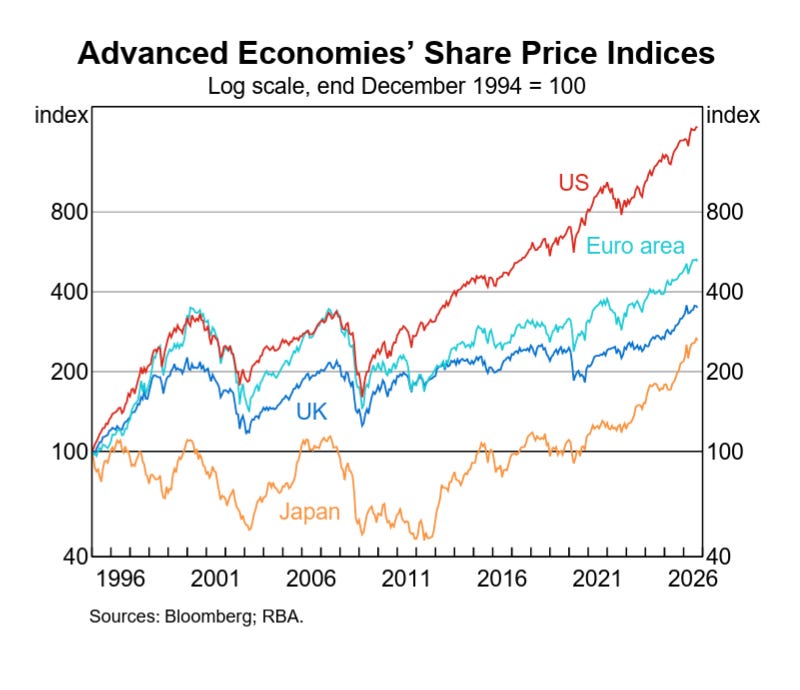
Source: RBA
The upsurge in US equities valuations in foreign portfolios compounds net new inflows accelerating the shifting balance from bonds to equities.
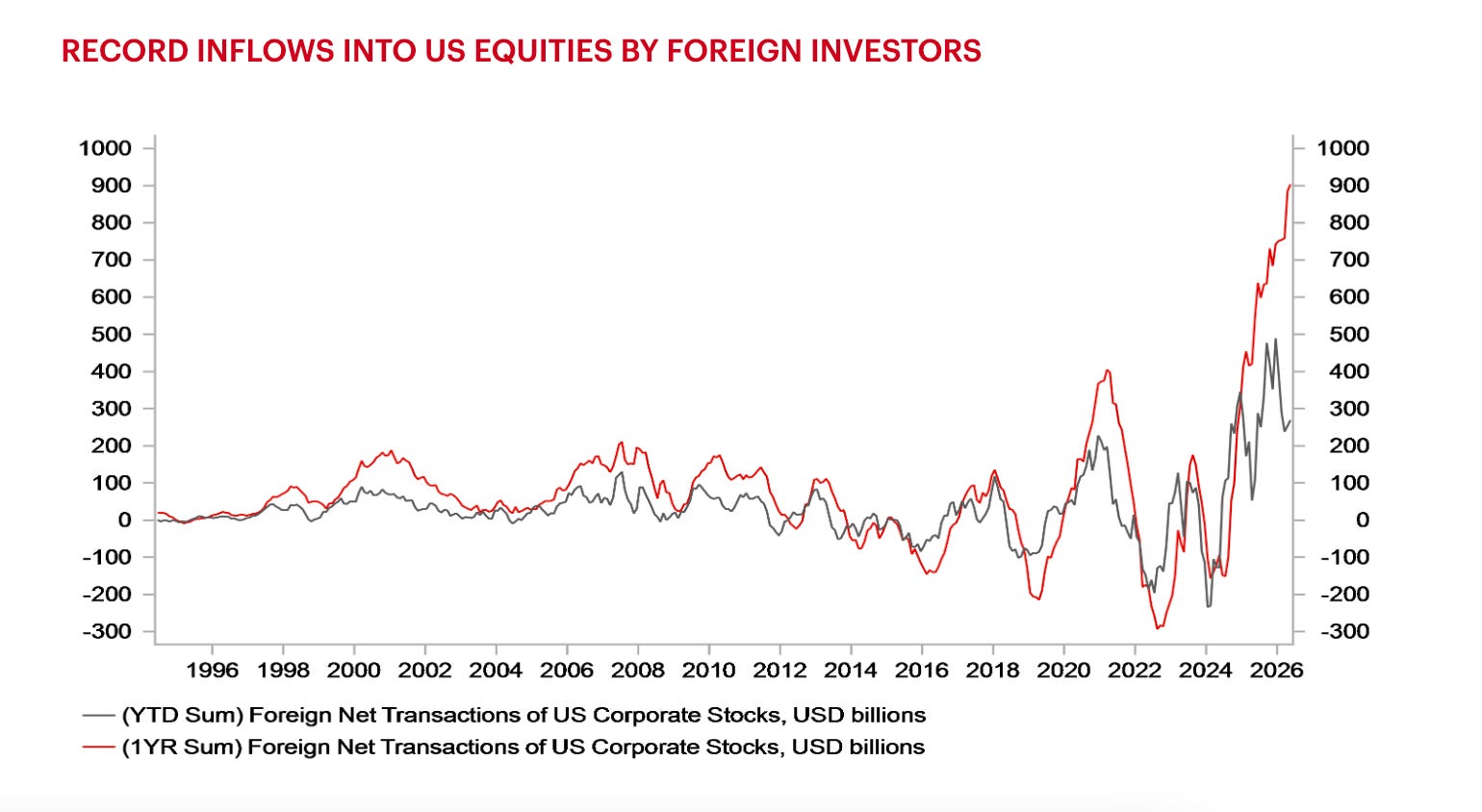
Clearly this new model has considerable momentum, added to by the enthusiasm for the “AI trade”.
As MUFG analysis by Lee Hardman commented in July.
the latest Treasury International Capital (TIC) data suggest that enthusiasm for AI continues to support the USD through robust capital inflows into US financial markets. Record inflows into US equities reflect investors' desire to increase exposure to AI-related companies, with foreign investors continuing to add to US equity positions even during the period of heightened geopolitical tensions associated with the US-Iran conflict. Net foreign purchases of US equities totalled USD 244 billion in April and May alone, lifting total purchases over the past 12 months to USD 904 billion. The bulk of these inflows has been driven by private investors, who accounted for USD 781 billion of net purchases, while official investors contributed a comparatively modest USD 123 billion. This pattern highlights the extent to which private-sector demand for US assets, particularly AI-related equities, has become an important source of support for both US asset prices and the USD.
The question now, is, how stable is the profit dollar?
At Reuters today, Karen Brettell had a fascinating piece on the anxieties in the market following the sudden loss of confidence in AI stocks last week.
Market chatter brings home clearly the difference between the dollar as a profit-driven portfolio currency and a “reserve currency”.
Erik Nelson, global head of FX strategy at Wells Fargo, likens these allocations to the “hot money” flows that dominate emerging markets. The AI boom has reinforced expectations of stronger US growth, firmer inflation and higher rates, lifting the dollar alongside Treasury yields, analysts said. “The whole AI trade caused US rates to reprice higher, which has caused the dollar to rally,” said Noah Buffam, FX strategist at CIBC Capital Markets.
Tellingly, market jitters are compounded, not just by questions about the AI boom, but by concerns about the dollar itself.
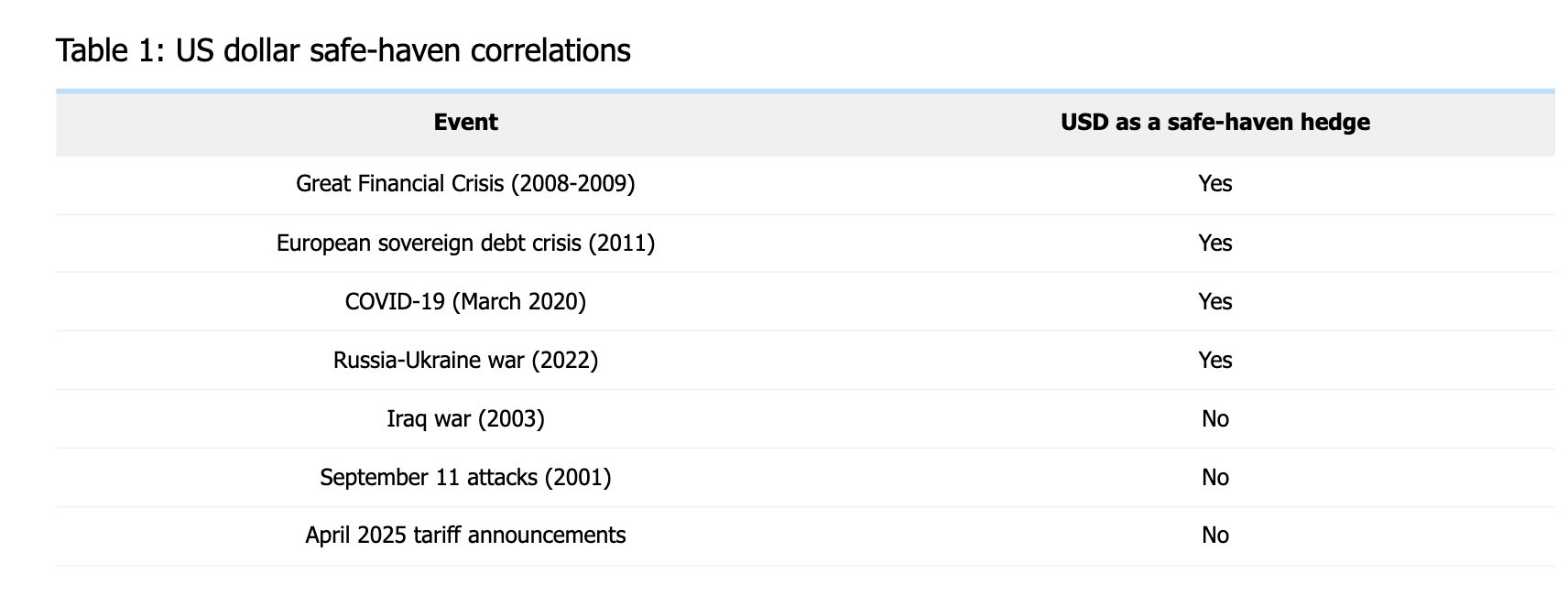
One of the assumptions underpinning foreign interest both in the dollar and US assets has been the experience that in the event of a shock the dollar acts as a “haven currency”. US Treasuries are the ultimate “safe asset”. When the system as a whole is subject to shocks, even when those emanate from the US itself, investors run into the American currency and US safe assets. Losses on any specific set of investments are offset by gains on currency positioning relative to portfolios that give less weight to US assets.
Does this assumption extend to the profit dollar regime? As the Reuters report asks:
Investors have long treated the US dollar as a refuge when markets fall, but foreign money chasing returns from the AI boom could weaken that safe-haven role if the trade unwinds. Foreign capital has poured in to US mega-cap equities, hyperscaler corporate bonds and power-grid infrastructure. That has made the dollar an increasingly crowded bet on American exceptionalism, backed by faster growth, higher yields and persistent foreign demand for US assets.
What happens if this crowded trade unwinds?
In the face of recent shocks, investors have not always turned to the dollar. They have looked for safety in other currencies. When this happens, the dollar weakens and this risks unleashing a self-sustaining down spiral of selling with investment and currency losses compounding each other - the sort of thing that happens to Emerging Markets that find themselves in trouble. Indeed, one way of defining an Emerging Market financial system is precisely that it is vulnerable to this kind of triple shock - selling of equities, bonds and the currency.
Source: RBA
The “Liberation Day” event in April 2025 made global headlines precisely because it seemed to be a “triple shock”. It was not just Trump that unsettled markets. The announcement of DeepSeek’s modeling breakthrough had rattled investors in US AI firms. And to make matters worse, the uncertainty was compounded by a fall in the dollar.
As a report by the BIS explained earlier this year, the sell off was exacerbated by hedging activities by foreign investors who were determined to hold on to their US equity positions but had decided ex-post to hedge further currency risk. As the Shin, Woolridge and Xia explained:
Equity investments are less commonly hedged than fixed income portfolios due to the dominance of equity return volatility over currency return volatility and equities’ attractiveness to investors seeking higher returns. Moreover, historically the US dollar has tended to appreciate during risk-off episodes, thereby dampening losses in local currency terms for US equity portfolios that are left unhedged. …
In the spring of 2025 that assumption was put to the test and found wanting. As investors retrospectively decided to increase their heading this produced one-off downward pressure on the dollar, further compounding the triple shock.
In the wake of US tariff announcements in early April 2025, US securities markets experienced a “triple decline” in which equities, bonds and the US dollar fell in unison. The unusual depreciation of the dollar during a risk-off episode initially led to commentary about a broad-based loss of confidence in dollar assets and a diminished role for the dollar in global capital markets. However, available evidence suggests that a more plausible explanation for the slide in the dollar during this period is the hedging activity of non-US investors to mitigate losses on unhedged dollar asset exposures. Institutional investors from outside the United States with unhedged dollar exposures took steps to reduce their currency risk. Investors retained their holdings of US assets but added to their foreign exchange (FX) swap and forward overlays to reduce their exposure to further declines in the US dollar. In April and May 2025, the largest declines in the US dollar occurred during Asian trading hours, suggesting that the ex post hedging activity of Asian investors played an important role. This Bulletin examines the potential contribution of FX hedging to the dollar’s slide in April and May 2025, and provides some clues as to the location of investors behind this hedging activity.
There was no general loss of confidence.
But the very fact that investors felt it necessary to add protection against a “triple decline” was itself indicative of a shift in expectations and helped to compound the selling pressure.
The question being asked in October 2026 is whether another triple shock might be in the offing, this time driven not by the antics of the White House but by big tech?
The Reuters report by Brettell envisions just such a scenario. As she points out, a sharp loss of confidence in the AI trade around 22 October 2026 went hand in hand with selling of the dollar.
When AI valuations came under pressure, haven flows favored the Japanese yen and Swiss franc over the dollar. The greenback managed to eke out modest gains against the euro, mainly due to the single currency being dented by concerns over French civil unrest. “The relationship between the AI trade and the dollar has become much more visible when the AI trade comes under scrutiny,” said Kevin Ford, lead FX and macro strategist at Convera.
Of course, shock is not equal to shock. Crisis is not equal to crisis.
In the event of some more general type of financial crisis, in which the first concern is liquidity, it is likely that the dollar would once again be king, at least until liquidity needs were met.
A shock severe enough to trigger a scramble for dollar funding could initially strengthen the dollar. In 2008 and March 2020, investors rushed to obtain dollars to meet dollar-denominated liabilities, creating a powerful but temporary bid.
But a more focused setback in AI that put in question, not the stability of the global financial system as a whole, but US exceptionalism in particular, might well see powerful negative interactions between equity markets and the dollar.
If the AI trade unwinds, “it’s not as clear the dollar benefits in the same way it would have done in the past,” said Dominic Bunning, head of G10 FX strategy at Nomura. …
Would a combined AI and dollar downturn be a bad thing?
It depends on who you are!
If we start from the premise that the AI boom is a key driver of the K-shaped economy in the US today, then it stands to reason that the US economy is suffering from an intensifying case of AI-Dutch disease. Might an unwind in tech stocks and a fall in the dollar actually come as welcome relief for the rest of the US economy? Would it free the Fed to pay more attention to sectors such as the housing market?
If there were to be a pullback in tech sector and a sell off of the dollar, we would not be in entirely new territory. As Brettell reminds us, something similar happened in the early 2000s and the correlations are complicated.
An equity rout alone would not automatically sink the dollar … After the Nasdaq peaked in March 2000, the dollar stayed firm for nearly two years before cracking when US credit markets came under stress following collapses such as WorldCom’s, and due to other factors such as a recovery in global growth.
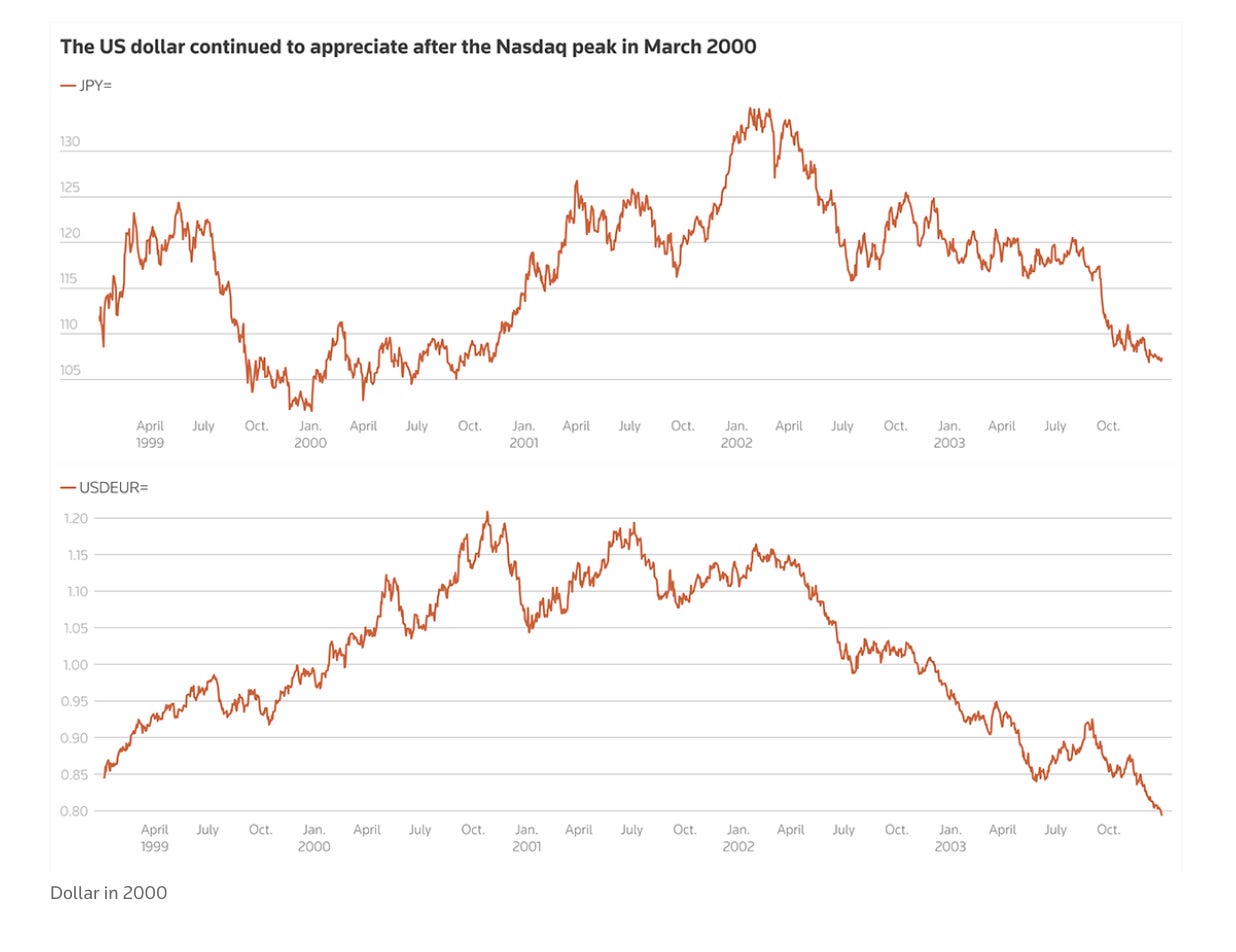
But familiar though the dot.com bubble may seem, the scale of the flows was far smaller then than they are now. Furthermore,
… the AI buildout is more US-centric.
And the overvaluation of the dollar is now of unprecedented duration.
Nelson said the real trade-weighted dollar has stayed above its long-run average, measured since 1973, for 12 consecutive years, the longest stretch on record. Foreign inflows are also more concentrated in equities and corporate bonds than in 2000, while foreign direct investment is weaker.
And America’s fiscal position today is totally different from that around 2000.
In 2000 the US was running a budget surplus of 2.4 percent of GDP and the debt stood at less than 35 percent of GDP. One of the risk-factors in the 2000s was that the US Treasury was not issuing enough debt to meet the global demand for safe assets.
Today our situation is radically different. The AI boom is unprecedented in its own right. The fact that it is happening in a period of unprecedented fiscal incontinence and shifting global appetite for dollar assets, makes the situation even harder to read.
But anxiety is mounting. As the Reuters report concludes:
“The sensitivity of global investors to a large re-rating or selloff in the dollar is substantial,” Nelson said. “As we go into ‘27, it’s a vulnerability for the dollar that I think is worth watching.”
Are we approaching peak profit dollar? Or is there is more room to grow into? We are in uncharted waters.
As the BIS team point out, foreign holdings of US assets are still heavily skewed to fixed-income bonds.
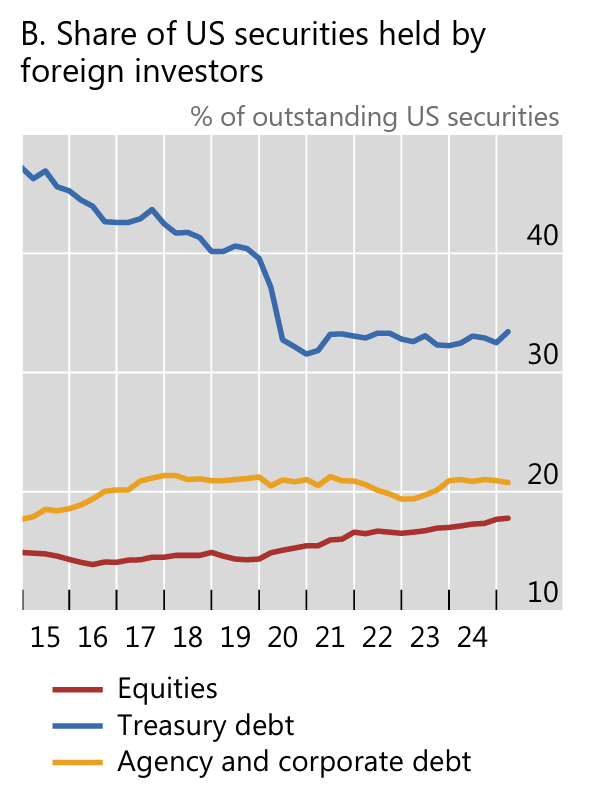
While equities account for a significant and growing share of non-US investors’ dollar assets, foreign investors hold a larger share of the US bond market than the US equity market. In March 2025, non-US investors’ holdings of US equities exceeded $17.6 trillion, compared with their US bond holdings of $13.6 trillion. However, they held only 18% of US equities, compared with 33% of US Treasury securities and 21% BIS Bulletin 1 of US agency and corporate bonds (Graph 1.B). Non-US investors likely hold an even larger share of the $13 trillion in dollar bonds issued by non-US borrowers, mostly in the offshore (eurodollar) bond market.
I read that as an indication that unwinding the highly lopsided reserve currency system of the 2000s still has much room to run. One thing is for sure, the dollar system will continue to evolve.
One of the most brilliant pieces of financial writing of late, came in a recent Schumpeter column in the Economist magazine, which announced a new era of “speedball capitalism”:
In the past year American markets have digested the largest-ever initial public offering (SpaceX), equity raise by a public company (Google) or a foreign firm (SK Hynix), private-funding round (OpenAI) and private-debt deal (Broadcom), as well as most of the biggest bond issue in history (Amazon). There was the first $1trn exchange-traded fund, or ETF (Vanguard), a record-breaking cash pile (Berkshire Hathaway) and stock-buyback programme (Nvidia), and the consummation of the largest-ever leveraged buyout (Electronic Arts). Then there are the enormous mergers in railways (Union Pacific and Norfolk Southern), utilities (NextEra and Dominion Energy) and media (Paramount and Warner Bros Discovery)—the last of which led, this week, to the largest ever junk-bond offering, beating a record set only last week (SoftBank). New markets have been created out of thin air (for compute) or become much bigger (for predictions). Worries about massive corporate scandals (First Brands) and hedge-fund blow-ups (Situational Awareness), which would have once occupied investors’ attention for months, are steamrollered by the relentless, totalising and extraordinarily flexible machine that is American finance. …
The great powers of this system increasingly defy categorisation. Old distinctions—between the state and the market, individuals and firms, financial and non-financial firms, public and private markets, investment and gambling—have bent under their weight. What, for instance, is Nvidia? A company, certainly (the world’s most valuable); a venture-capital investor (arguably Silicon Valley’s most important); a source of American power (run by a showman with the ear of the president); and a lender, with plans to backstop loans made by the likes of Goldman Sachs and Apollo. And what, pray tell, are they? Goldman Sachs is best known for trading and giving advice on mergers, but increasingly resembles a giant asset manager, having just bought two firms that issue ETFs. And Apollo? Part life-insurer, part private-equity fund. …
A much-chatted-about new paper by Stijn Van Nieuwerburgh of Columbia Business School calculates that if (an admittedly punchy) 183GW of new data-centre capacity is built by 2032, the capex bonanza will be larger, as a share of the economy, than America’s railway and dotcom booms combined. Spillovers are visible everywhere …
All this brings to mind a speedball, that combination of heroin and cocaine popular among rock stars a generation ago. …
Those at the white-hot centre of it all now ask: “What might break?” This is a sly question, since anything “might break”; and the thing that actually “breaks” matters less than all the things that are almost broken when it does.”
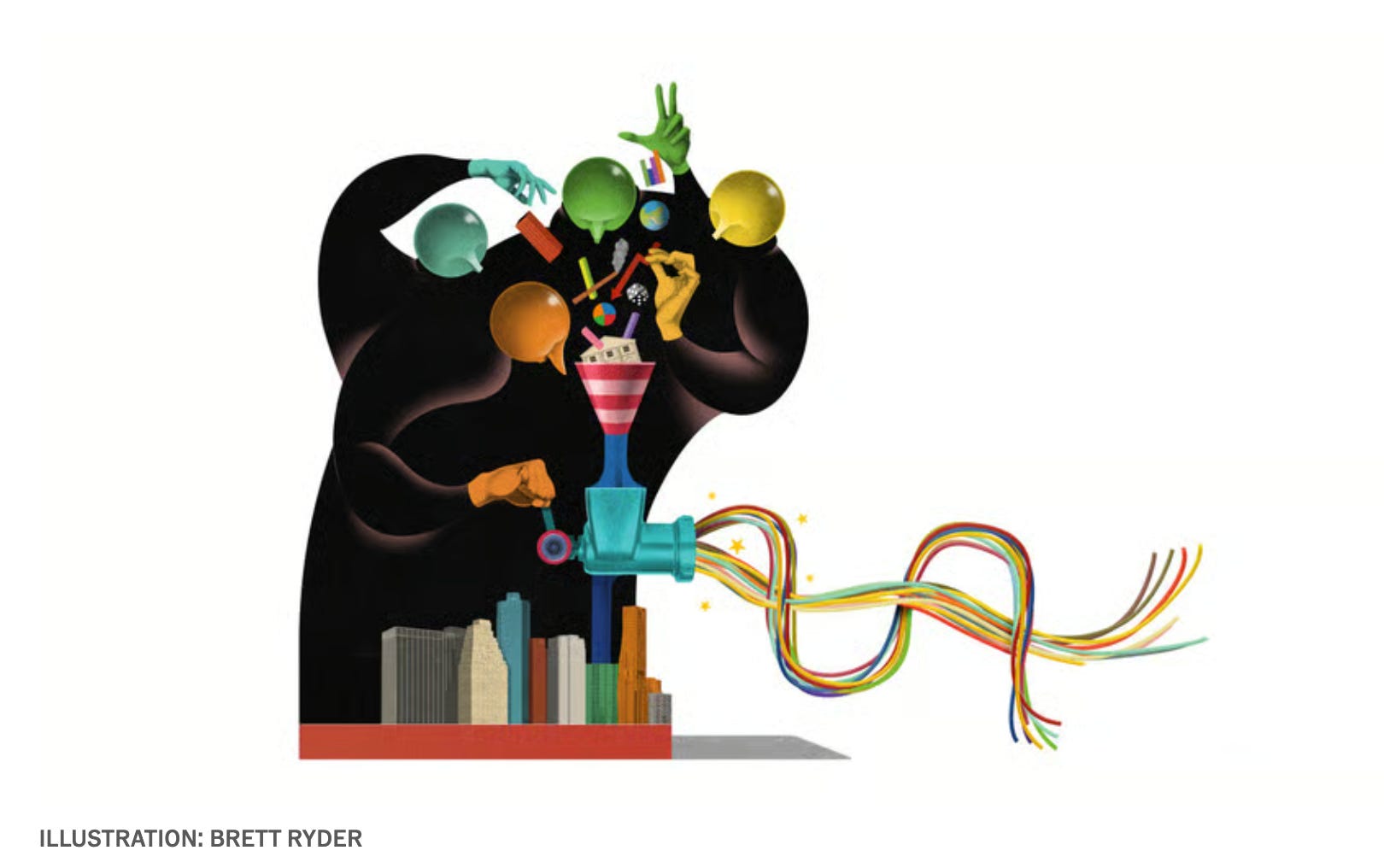
One way to paraphrase this newsletter would be to ask whether the dollar system is one of those things that are already “almost broken”?
Indeed, given the “relentless, totalising”, all-consuming and endlessly innovative “speedball dynamic” of this era, one must surely wonder whether it isnt’is it not hopelessly prim and out of touch to talk of a “dollar system” at all.
Is this something closer to a dollar rush? Or a dollar high?
I love putting out Chartbook. I am particularly pleased that it goes out for free to thousands of subscribers around the world. But, writing this newsletter takes a lot of work. If you are enjoying it and would like to support the project, sign up for one of the subscription options here. It is the equivalent of a fancy cup of coffee per month!
For a sane person, 'Enough is as good as a feast.' For a risk-seller, a feast is never enough.
They will do what they're doing until it breaks. It's how they roll. They have no reason not to, right? They are risk sellers, or risk intermediaries. They earn fees. 'Originate to distribute.' 'A rolling loan gathers no loss.' We learned something about this from the GFC, but the risk-sellers didn't. They're in life insurance general accounts, and aiming for 401(k) plans. Then, who knows. Maybe Social Security.
Adam, I think the profit-dollar framework captures an important transformation, but the stability question requires separating mechanisms that are often treated as one.
The demand for dollars to settle obligations is not the same as the demand for dollar-denominated assets to earn returns. One is embedded in the international payments and funding architecture. The other depends on valuations, expected returns, financing conditions, and the balance sheets of marginal investors.
Two developments matter.
First, the US primary-income balance turned negative on an annual basis in 2024, ending a remarkable period in which the US earned positive net investment income despite a deeply negative international investment position. Subsequent quarterly balances have fluctuated, but the historical income advantage can no longer be assumed to offset the growing external claims stock.
Second, the identity of the marginal Treasury buyer is changing in ways that conventional reporting does not adequately capture. Barth et al. at the Federal Reserve estimate $1.85 trillion in Cayman-domiciled hedge-fund Treasury holdings at end-2024, with approximately $1.4 trillion undercounted in TIC. Under their stated assumptions, these funds absorbed 37 percent of net Treasury notes-and-bonds issuance during 2022–24.
This is not simply a question of who wants to hold dollars. It is a question of who finances the next increment of dollar claims, on what balance sheet, at what leverage, and under what conditions that financing remains viable.
The distinction also matters for the haven question. A scramble to meet dollar liabilities can strengthen the dollar even while a repricing of US exceptionalism weakens demand for dollar assets. These are different balance-sheet mechanisms. They need not produce the same exchange-rate response.
The April 2025 episode illustrates the intersection. Foreign investors could retain US securities while reducing their dollar exposure through FX swaps and forwards. The BIS identified currency hedging rather than wholesale portfolio exit as a plausible explanation for much of the dollar's decline, using the timing of trading activity to help infer the geographical origin of those hedges. The distinction between ownership, exposure, and funding matters.
The reserve currency, settlement currency, funding currency, and portfolio currency are related functions. They are not identical functions.
Consider the divergence in the data. The dollar's share of official reserves has fallen from roughly 71 percent around the turn of the century to approximately 57 percent, while SWIFT's trade-finance messaging data still show dollar shares above 80 percent in recent observations. These measures cover different activities, but that is precisely the point. Reserve allocation and trade-finance currency use need not move together.
Portfolio demand can reverse while dollar funding obligations persist. A crisis in the profit-dollar mechanism need not immediately become a crisis of the dollar's international settlement role.
The question is therefore not simply whether the dollar system survives. It is which mechanism absorbs the adjustment, at what price, and with what consequences for the existing stock of claims.
The crisis of the profit dollar is not necessarily the crisis of the dollar.
I have been examining this distinction through the external claims stock, the international settlement architecture, the Treasury reporting gap, and the changing composition of marginal financing:
https://speculativa.substack.com/p/the-stock-elephant-part-iv-the-curse
I would be interested in your assessment of where the portfolio and settlement mechanisms cease to reinforce one another.