

In the world of extreme wealth, we are currently witnessing two striking geo-ecoomic developments.
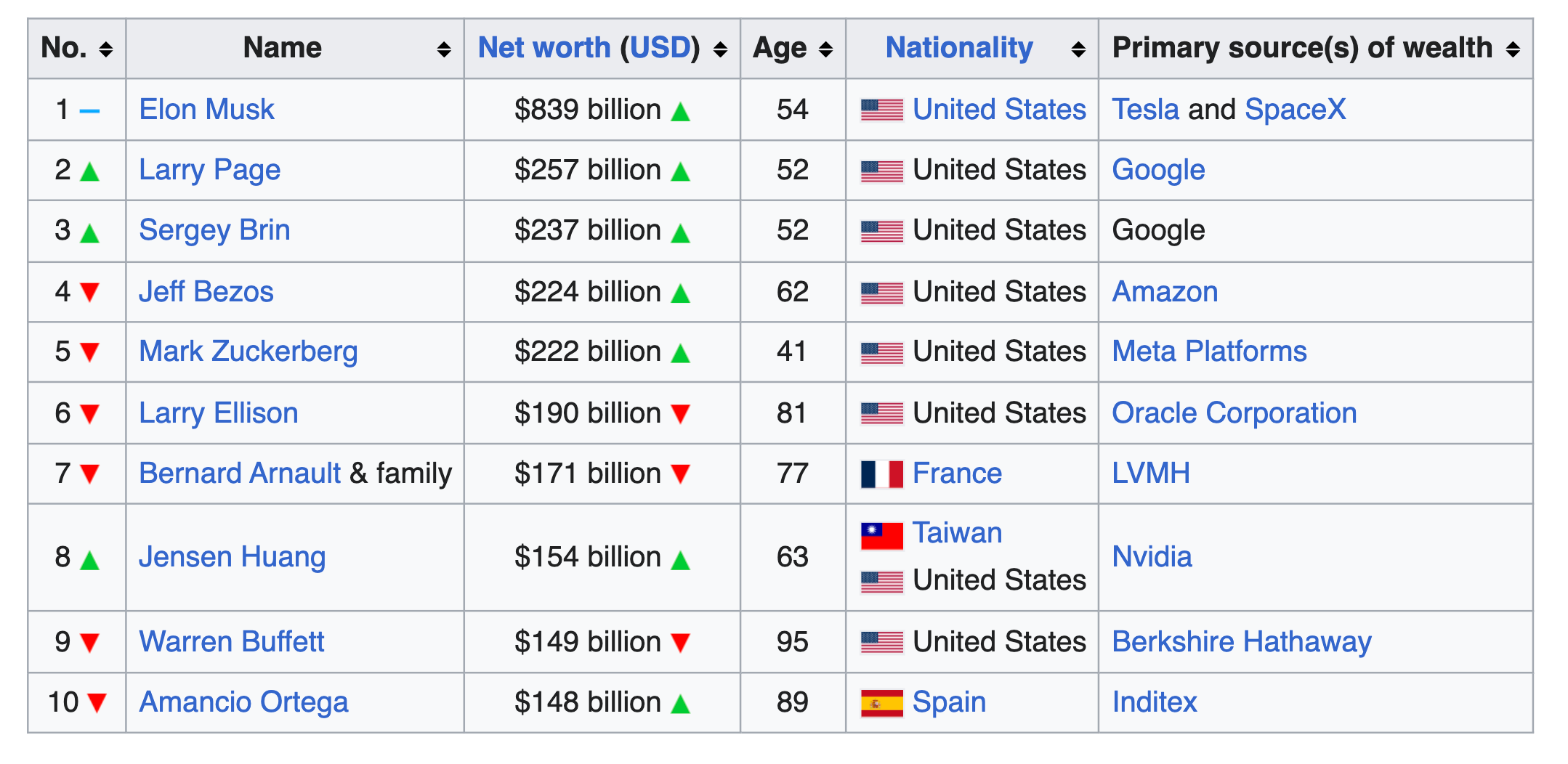
One is the staggering dynamism of US tech oligarchs and their increasingly loud and public presence in the political life. Here are the data from the Forbes billionaire list for the spring of 2026. This shows a remarkable degree of US dominance both in share and absolute values.
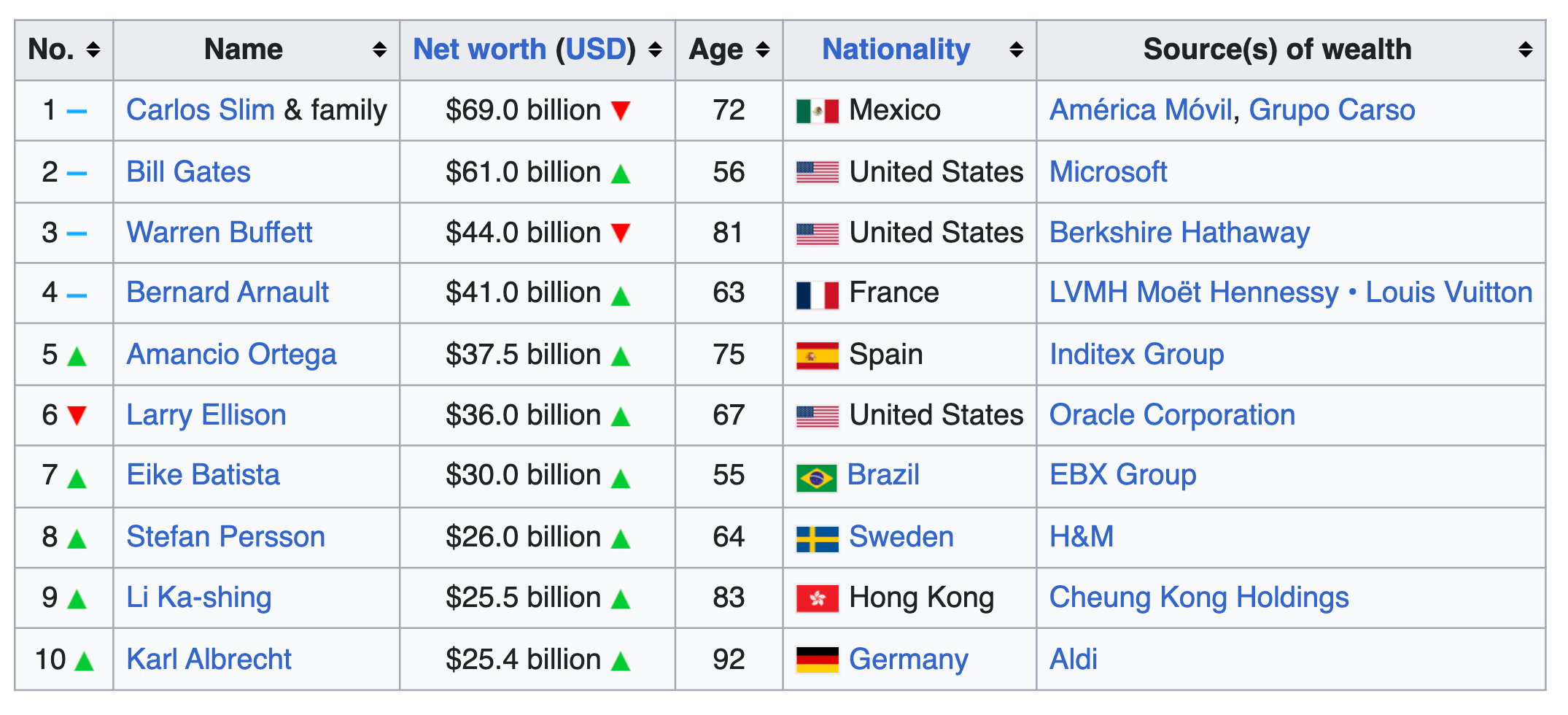
Back in 2012 there were only three Americans and two tech barons in the top ten.
The second, contrasting, development, is the abrupt regime shift in China with regard to oligarchic wealth. Whereas in the US tech wealth is running rampant, in China at the same moment, the party has asserted its leadership. In an earlier post I referred to this as walled-in wealth. These contrasting developments in personal fortunes underline dimensions of “decoupling” that are not well-captured by trade data or balance of payments statistics.
The long arc of China’s development is remarkable. It is not sufficiently appreciated that Xi’s period in office coincides almost exactly with the moment in which China’s mega fortunes, born out of real estate and tech industries, began to break into the global top 100.
The history of chinese wealth is recent. In 2003 there was probably no one in China worth one billion dollars. Over the following decade Chineses capital accumulation exploded.
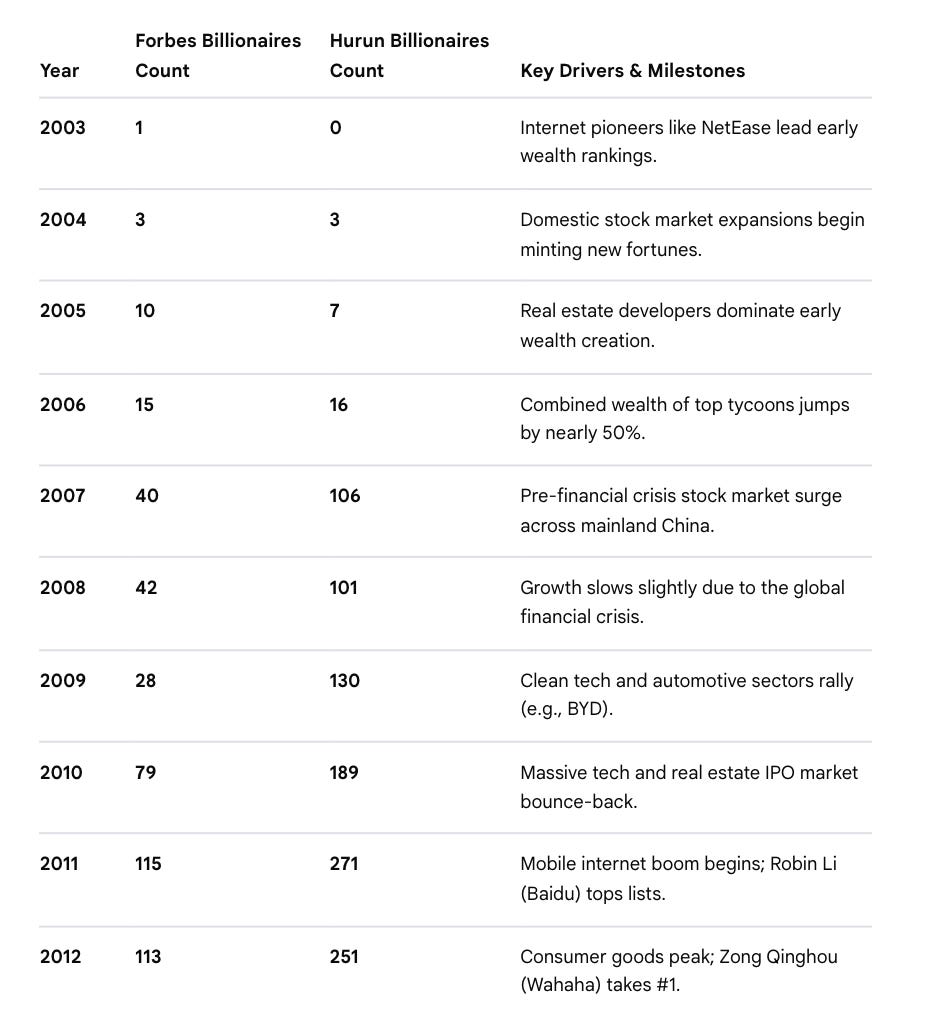
But, for all this growth, China’s position in the global rankings was still modest when Xi took power. In 2012, it was an open question whether there was even one Chinese individual in the list of top 100 billionaires. Over the first phase of Xi’s time in office that changed. By 2015 there were seven Chinese businessmen in the top 100.
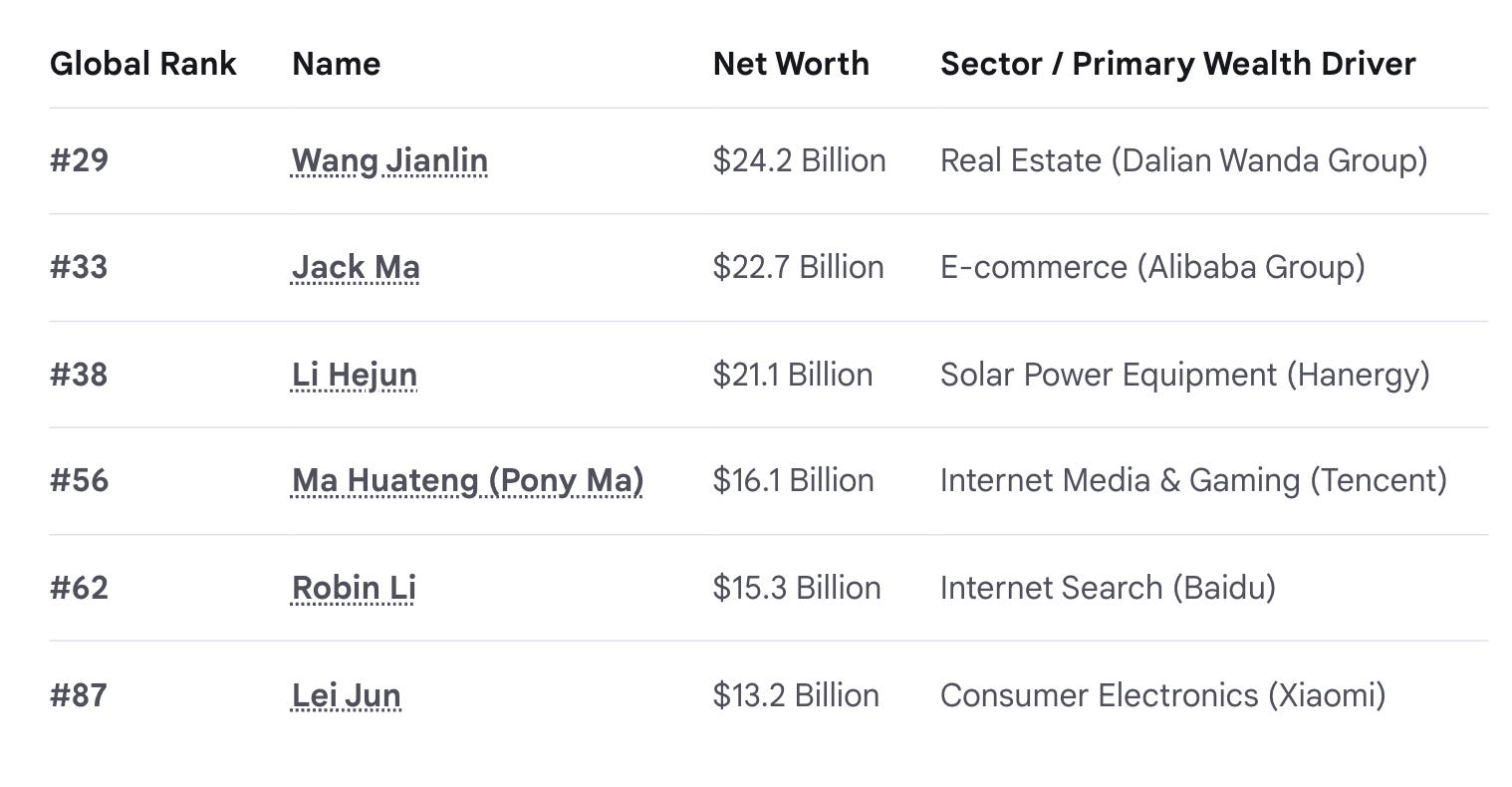
In 2021, the statistical peak of wealth exuberance in China, there were twenty mainland Chinese in the Forbes top 100 and four were now in the top 30.
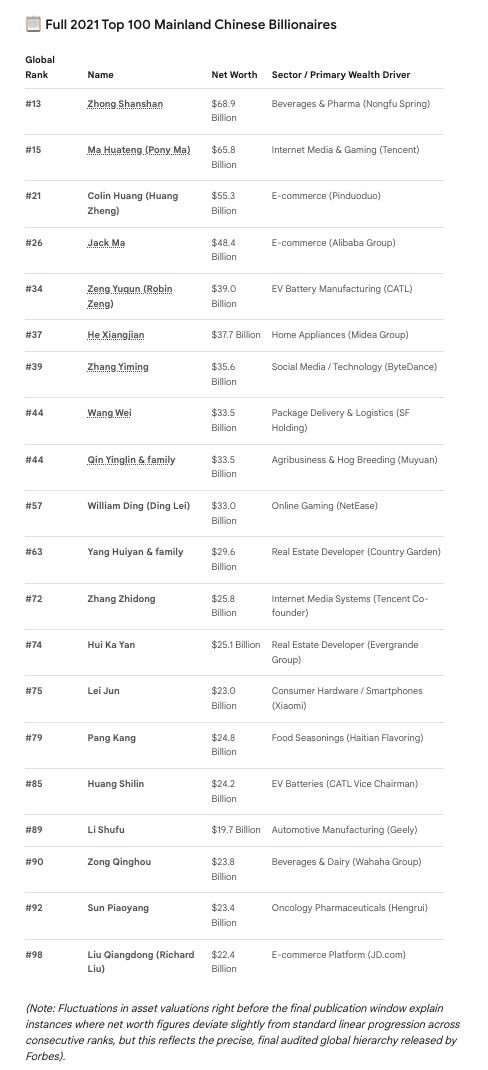
By that point, the spring of 2021, the decisive turn had already been inaugurated. Amidst the bullish mood in Beijing in the early summer of 2020 after the CCP had won its “peoples war” against the first wave of COVID, the Chinese government took a series of key decision: the security law for Hong Kong was introduced, the real estate growth-boom was ended, common prosperity was declared a top priority and upstart tycoon Jack Ma was humbled. Those measures depend on the willingness to deploy discretionary policy and the power of the Party against individuals and their businesses. But they also depended on infrastructural power with regard to both data and money.
The partitioning of tech-fueled capitalist development by China goes back to the building of the firewall from 2006 and the increasingly difficult environment for Western operators that resulted, in 2010, in Google’s withdrawal in China. At the time, Eric Schmidt of Google opined that the West had history on its side.
“I personally believe that you cannot build a modern knowledge society with that kind of [censorship],” Google chairman Eric Schmidt told Foreign Policy in 2012.“In a long enough time period, do I think that this kind of regime approach will end? I think absolutely.”
Instead what happened was an explosion of Chinese tech entrepreneurship and the development over the following decade of a fully autonomous Chinese internet sphere behind the Great Firewall. Those tech fortunes were heavily represented in China’s billionaire list in 2021. Unlike in the US however, that same moment marked a turning point towards a reassertion of political control.
At the macroeconomic level, the presumption of the 2000s was that China’s “Bretton Woods 2.0”-currency and exchange controls were transitional measures that would ultimately give way to capital account liberalization. That did not happen. Far from it. In 2015, following the near-miss financial crisis, Beijing significantly tightened controls. Ten years on, it is showing every sign of further intensifying those regulations, taking steps to crack down on tax payment and limiting personal movement by controlling passports.
So long as the development of Chinese and US platform businesses was running along roughly parallel lines and oligarchs enjoyed a large measure of autonomy, these infrastructural walls could be ignored. Chinese wealth was rising to meet its Western peers.
It is that convergence that has now been broken, from both sides. On China’s side by the party’s assertion of control. In the US by the explosion in the valuation of the US platform businesses supercharged by the AI boom. The result of these twin developments is that the number of Chines in the top one hundred billionaires is now less than half what it was at the beginning of the 2020s.
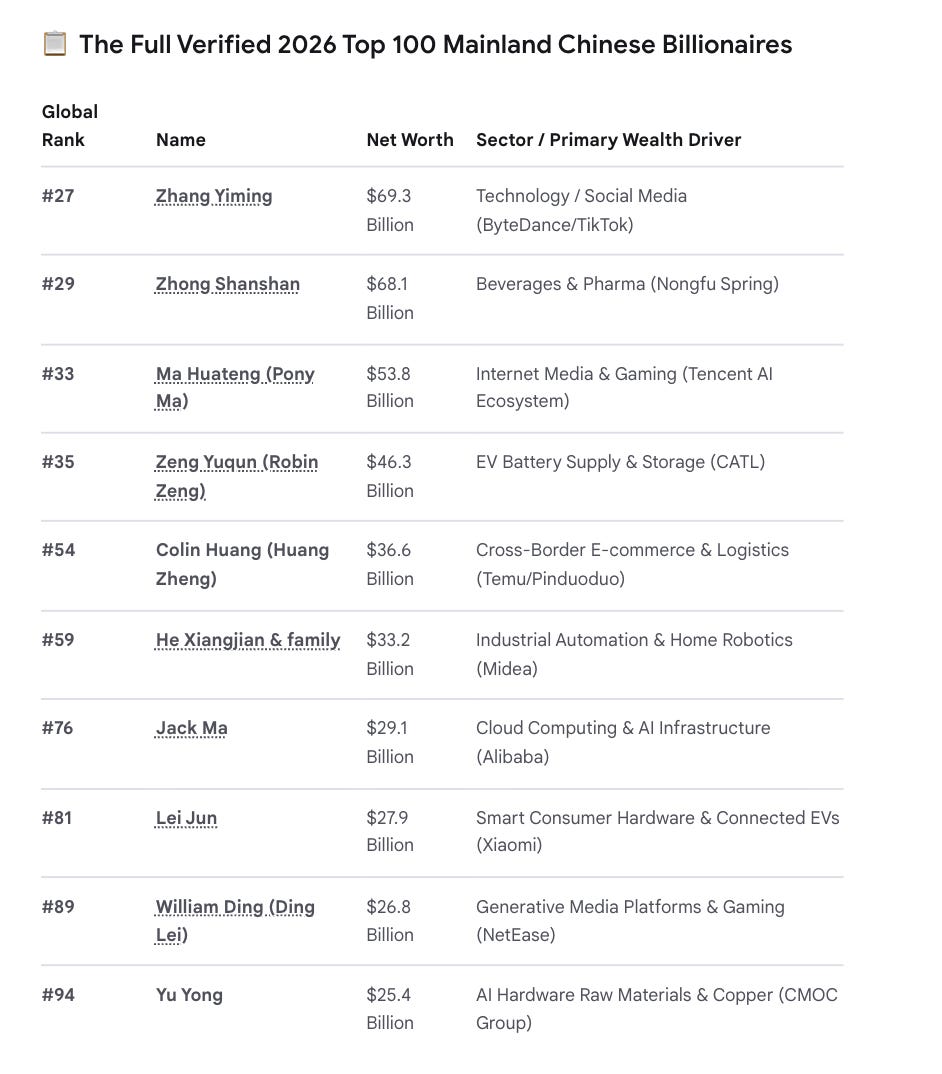
Not only has the ascent of Chinese megawealth in relative terms been reversed, but the top US fortunes are now out of sight, well above the centi-billionaire level.
Both the absolute levels and the trends matter. Together they add up to the conclusion that the forward march of a Chimerica-elite mediated by financial partnerships and tech supply chains, has been halted and any further convergence seems unlikely.
The below graph shows the approximate representation of mainland and Hong Kong billonaires in the global top 100 since 2010.
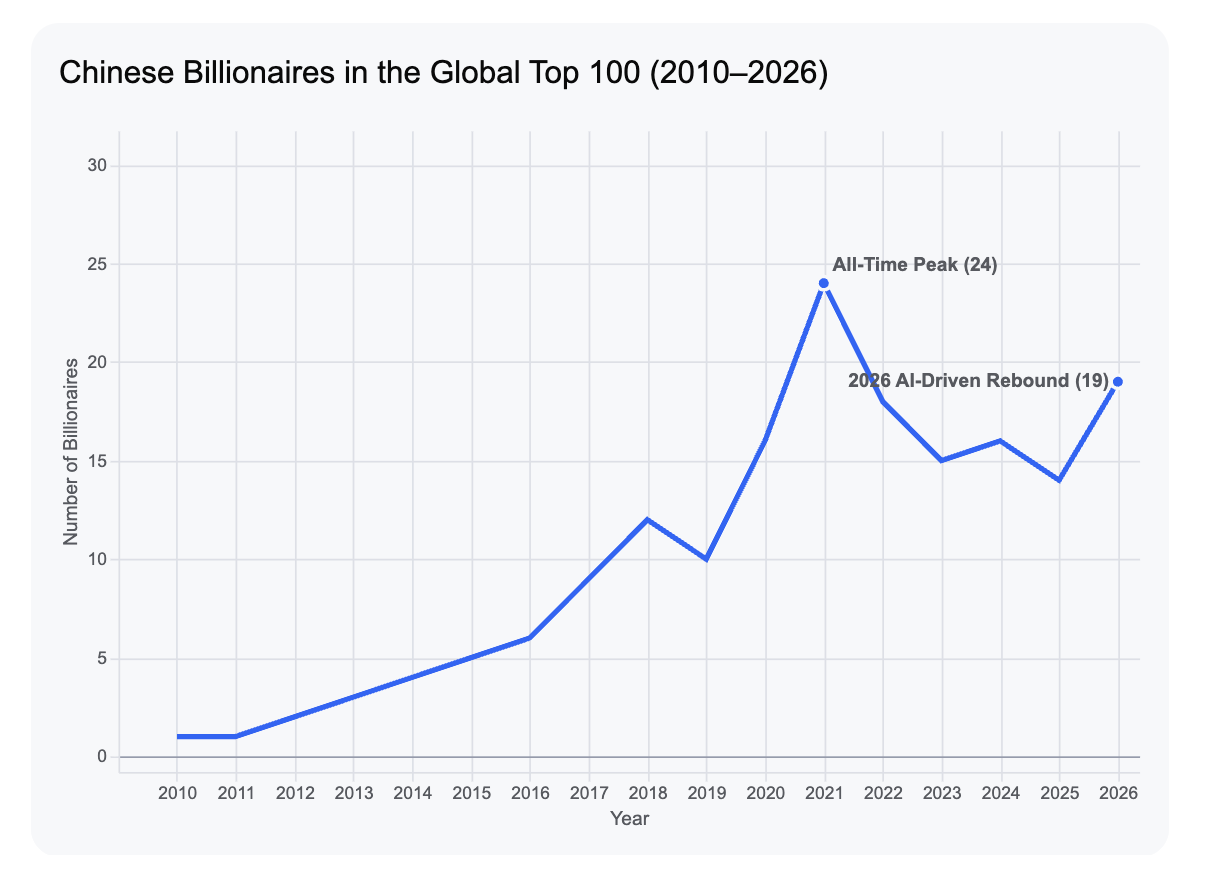
With regard to political economy the contrast is now stark. In China, the Party has decisively asserted its leadership. AI’s development in China shows no sign of disrupting the new dispensation. In the US, by contrast, the malign coincidence of AI acceleration with Trump’s second term has resulted in a free for all, far more spectacular even than dot.com and financialization surges of the 1990s and the 2000s.
In terms of trade and macroeconomic financial flows, decoupling may, so far, be limited. But this should not obscure the fact that in the two leading economies of the world, we are seeing the emergence of radically different political economies of wealth. Call it oligarchic divergence.
I love putting out Chartbook. I am particularly pleased that it goes out for free to thousands of subscribers around the world. But, writing this newsletter takes a lot of work. If you are enjoying it and would like to support the project, sign up for one of the subscription options here. It is the equivalent of a fancy cup of coffee per month!
Reading these tea leaves, in effect, capital accumulation by individuals is capped. After all, in the eyes of the CCP, how much money can one person spend? Can one calculate the difference between actual personal capital accumulation now and what might have been in an economy comparable to one in the west? It is clearly in the tens, perhaps hundreds of billions of USD, and that money must have been conscripted to the state in China. It seems that this is part of the economic grand plan, with Chinese axioms in play: An individual should accumulate only so much, and hoarding money that they could never spend in 10 or 100 lifetimes is unacceptable. that capital should benefit society at large, since it was accumulated in the first place due to special consideration from the state. Since stability of the CCP in society is the first order of business, that capital must fund the role of the Party. Disparities in lifestyle between the top and the bottom will be tolerated only to a point, and any social disruption on the basis of such differences will not be tolerated.
Isn't part of the driver for the US-China oligarchic chasm the speculative nature of the US economy and, in particular, the kind of valuations that public markets place on businesses like Tesla or SpaceX? If you were to look at a different metric for wealth (say, something like net income of companies controlled by the individual multiplied by the shareholding of that individual), wouldn't you get to something that looks much more similar? Behind Musk's insane net worth lie a relatively modest yearly net corporate income (probably less than Bernard Arnault, for example!)...