

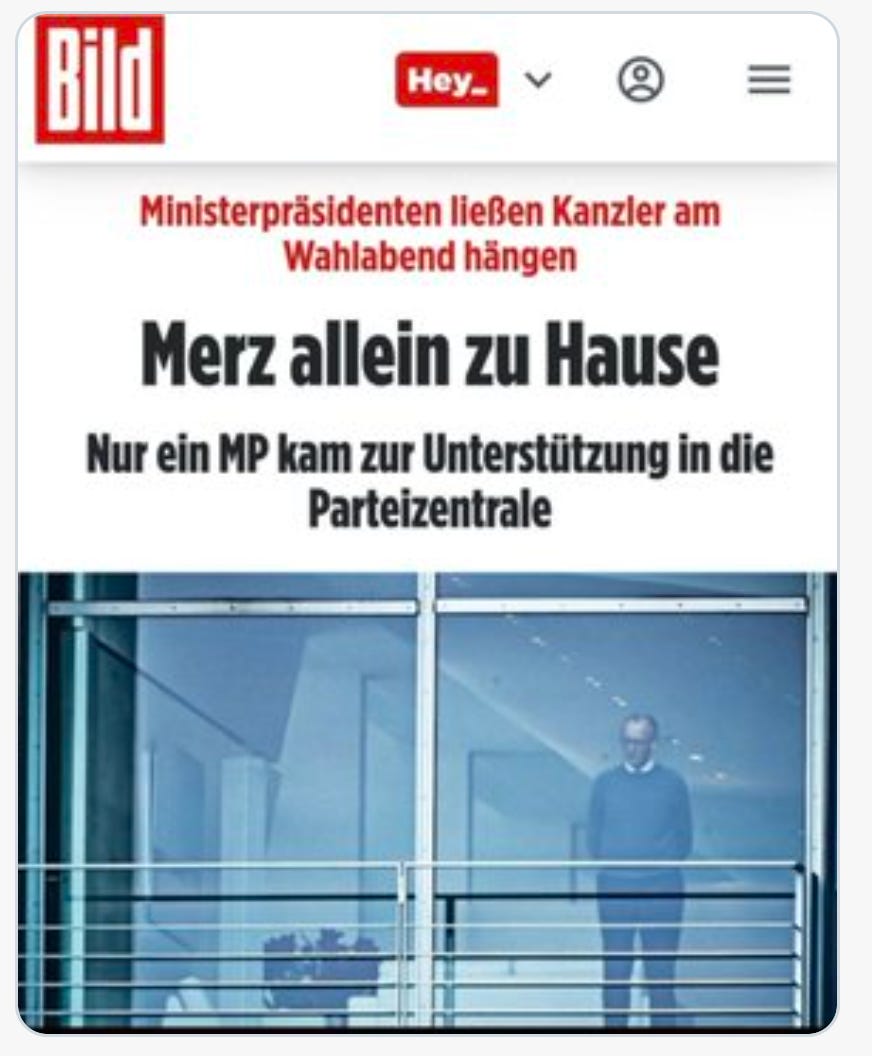
The German political system is in crisis and the position of Chancellor Merz is increasingly in question. On the night of the Saxony-Anhalt election, most of the leading lights of the CDU from the rest of Germany refused to join Merz in party HQ to watch the disaster unfold. Merz home alone is the headline in Bild Zeitung.
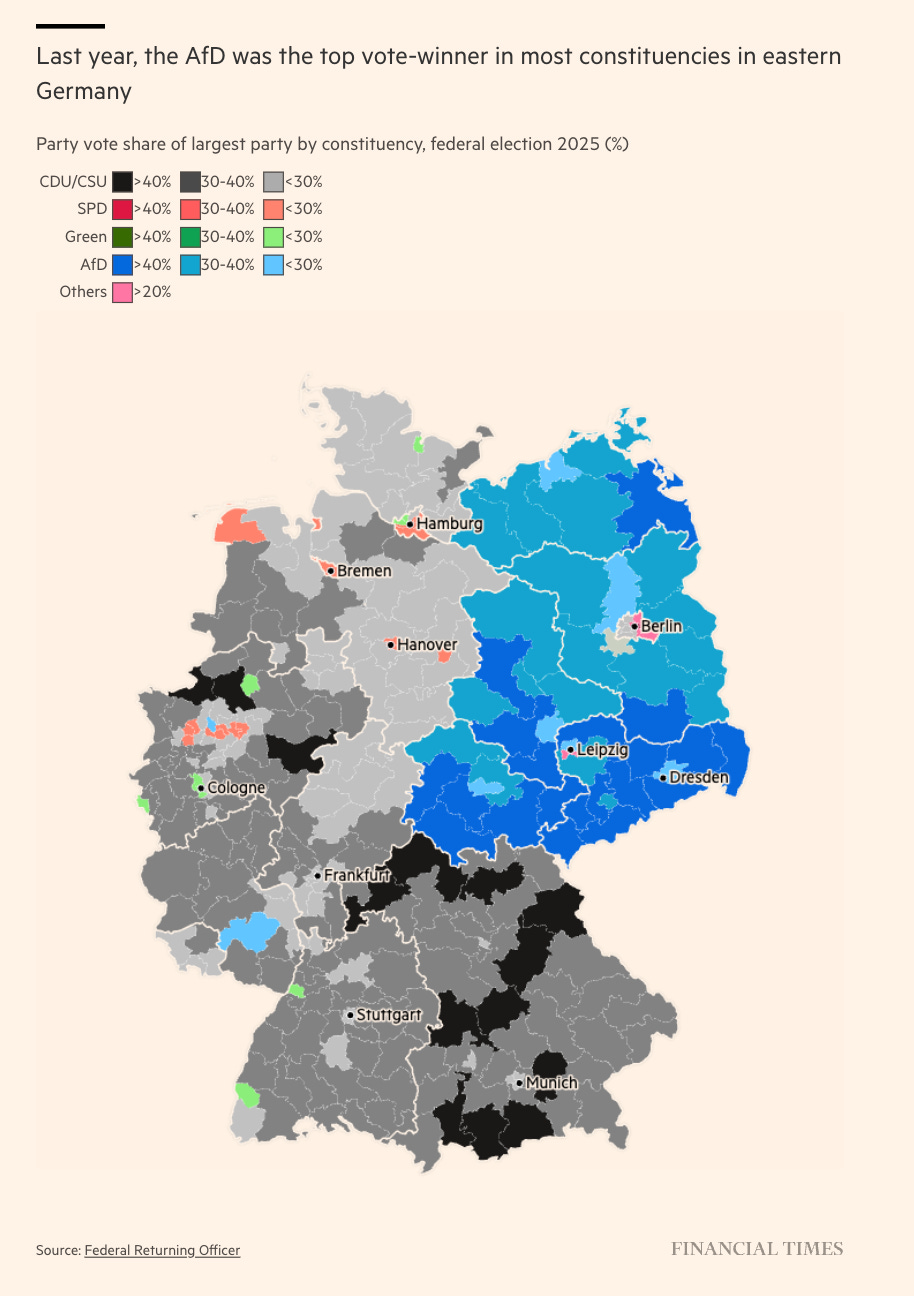
The disastrous showing of the CDU and the surge of the AfD should come as no surprise. The government formed by Merz after the elections triggered in February 2025 by the collapse of Olaf Scholz’s three-way coalition has always operated on a shallow basis of legitimacy. The key majority that lifted the debt brake and was supposed to open the way to a dynamic fiscal policy, was actually delivered by the lame duck parliament before the new MPs took their seats. It was a flagrant maneuver to allow the old parties of West Germany - the CDU and SPD - with the backing of the Greens, to avoid having to deal with the actual electoral map of Germany in 2025. In that election the signs of the earthquakes to come, were already clear to see.
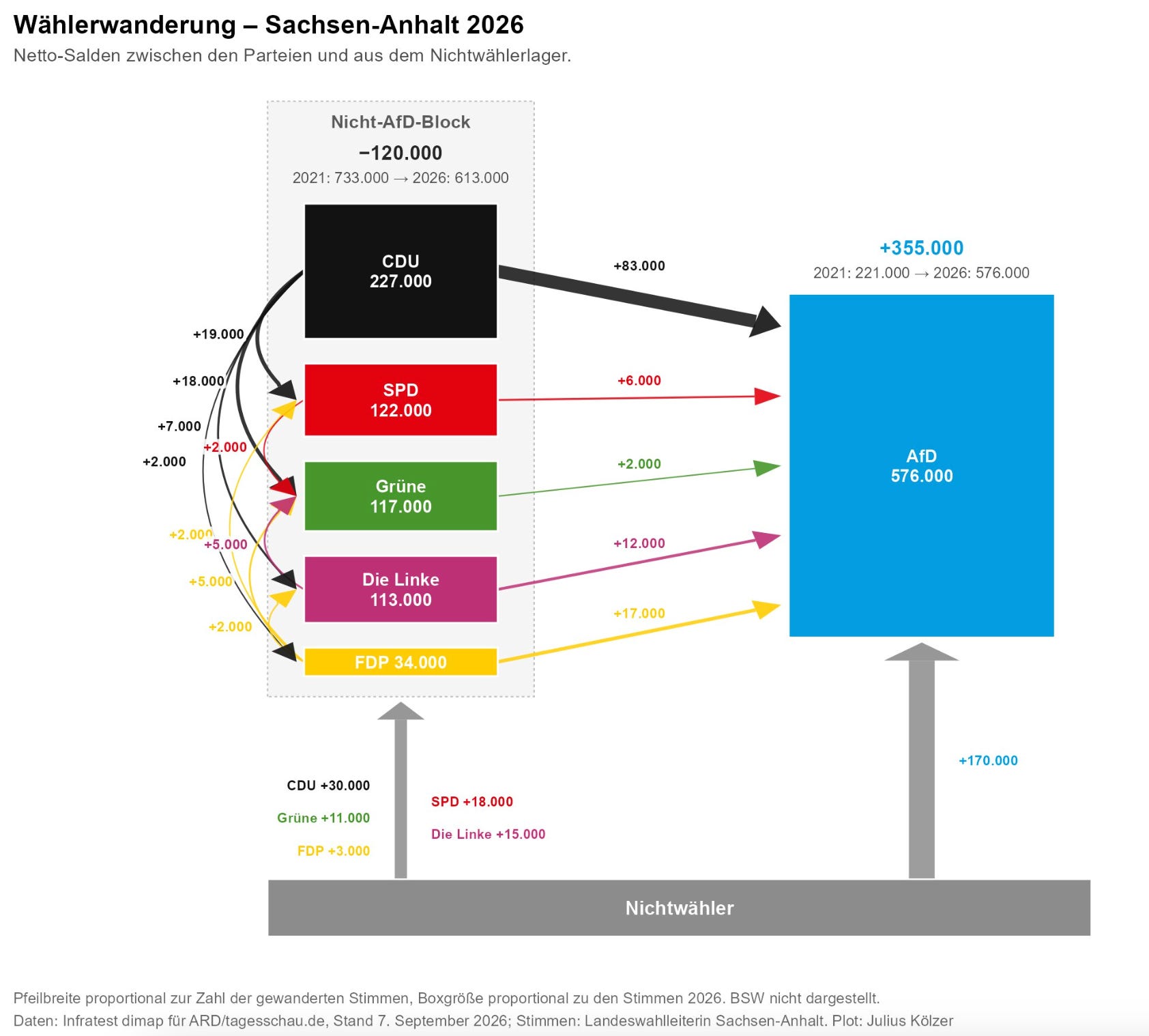
The dramatic thing that has happened in Saxony-Anhalt is not just the surge of the AfD but the utter collapse of the CDU, which holds a plurality in much of the rest of Germany. Despite having a relatively popular prime minister, the CDU lost 25 percent of the vote it received in 2021 to the AfD. If the AfD can replicate this across Germany, continuing to mobilize new voters and to take those of the CDU, Merz’s party is facing a disaster on the scale of the SPD, once its main rival.
On 20 September there are two more state level elections upcoming.
In the Baltic state of Mecklenburg Vorpommern the AfD is likely to score another dramatic win. Here, however, they face an unusually strong opposition in the form of the SPD led by a controversial but popular prime minister, perhaps best known to the outside world for her loud support of the Nordstream 2 pipeline.
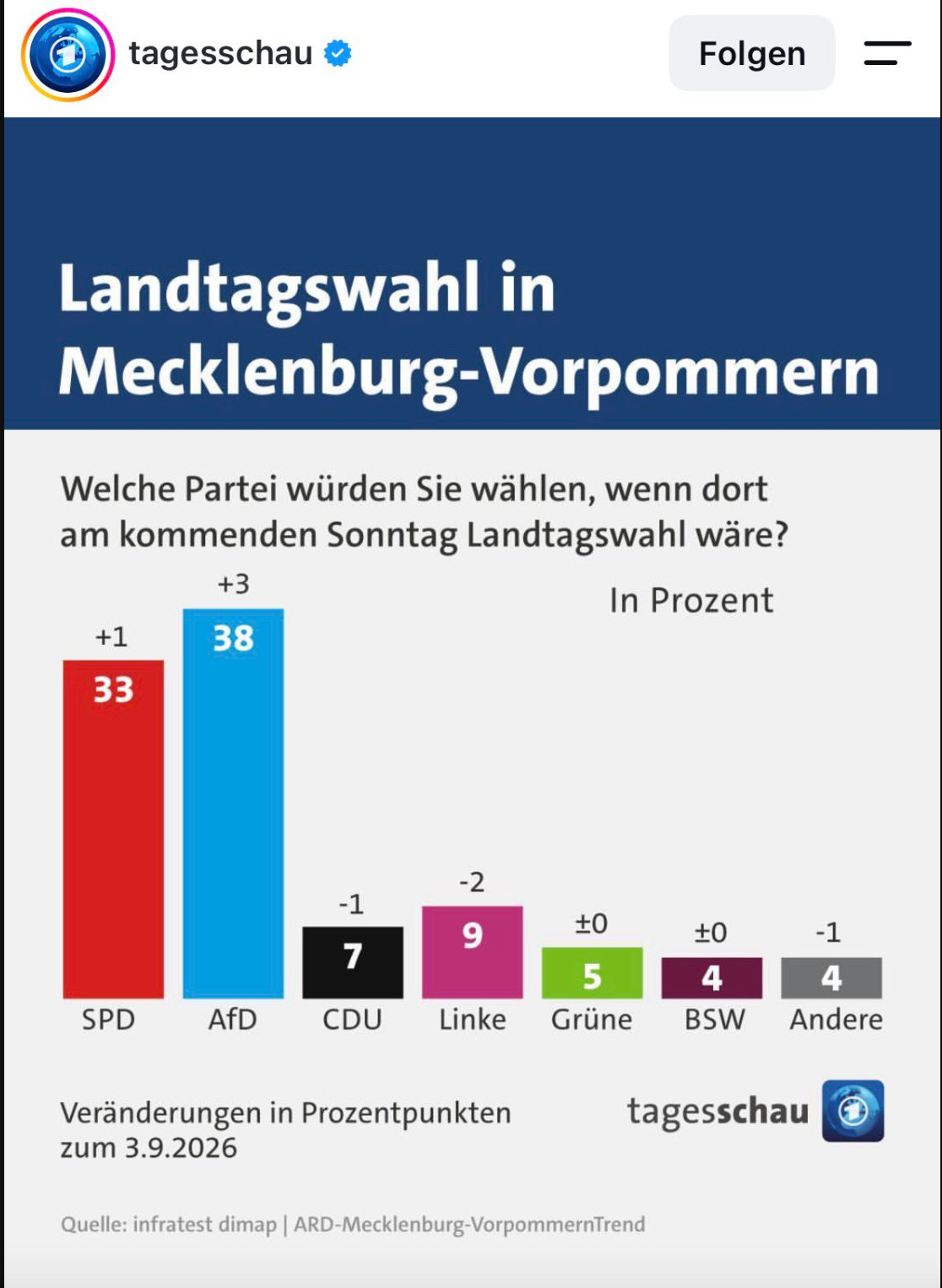
Where is Chancellor Merz’s CDU in Mecklenburg-Vorpommern? There is a chance that his party may not even make the 5 percent hurdle necessary for representation in German parliaments. That would be a true humiliation.
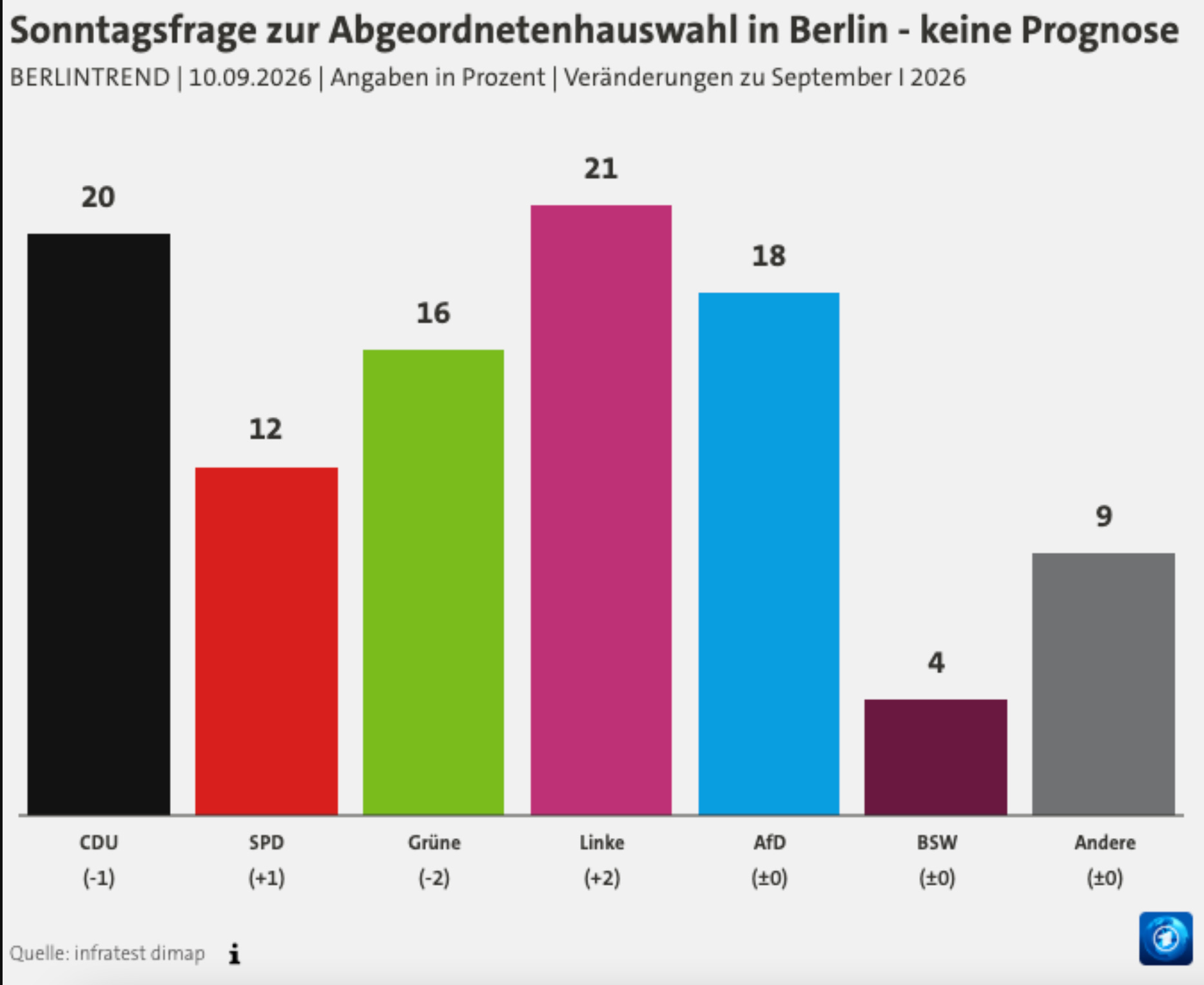
Meanwhile, Berlin represents the full complexity of the new German politics. The polls show five parties - Die Linke, SPD, Greens, CDU, AFD - each with a vote share of between 12 and 21 percent. Die Linke is likely to emerge as the strongest. The SPD - once the party of legendary Berlin mayor Willy Brandt - will come in fifth. The rest is profoundly uncertain.
Since at least some readers of this newsletter may have an interest in particular Berlin neighborhoods, here is the map of “swing constituencies” across the city courtesy of the Tagesspiegel.
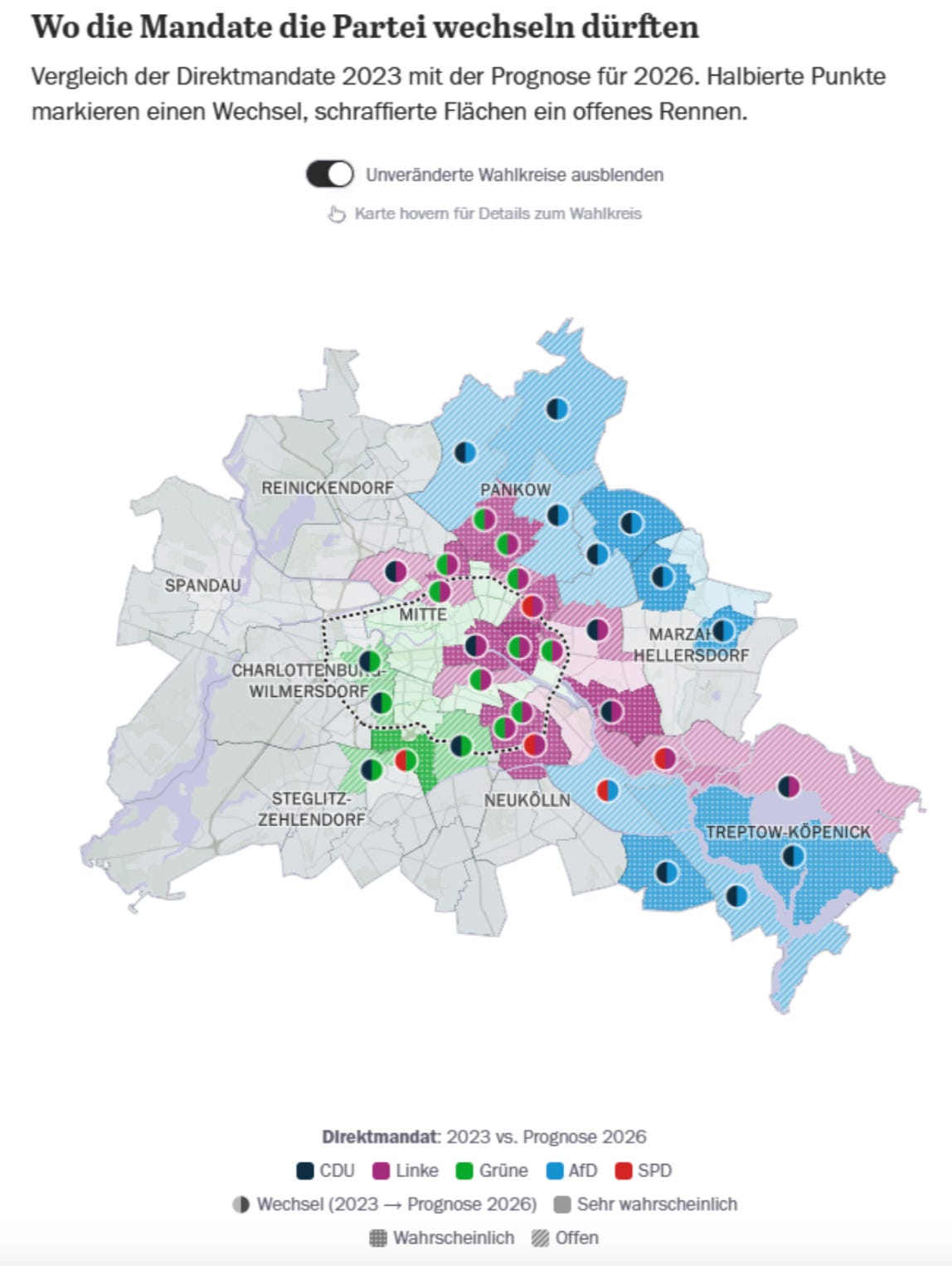
The prediction is for comfortable West Berlin neighborhoods at the center of the city to shift from the CDU to the Greens. For Die Linke to make gains at the expense of both the SPD and the Greens and for the AfD to beat the CDU in the Eastern suburbs. The result may, or may not be, a functioning majority.
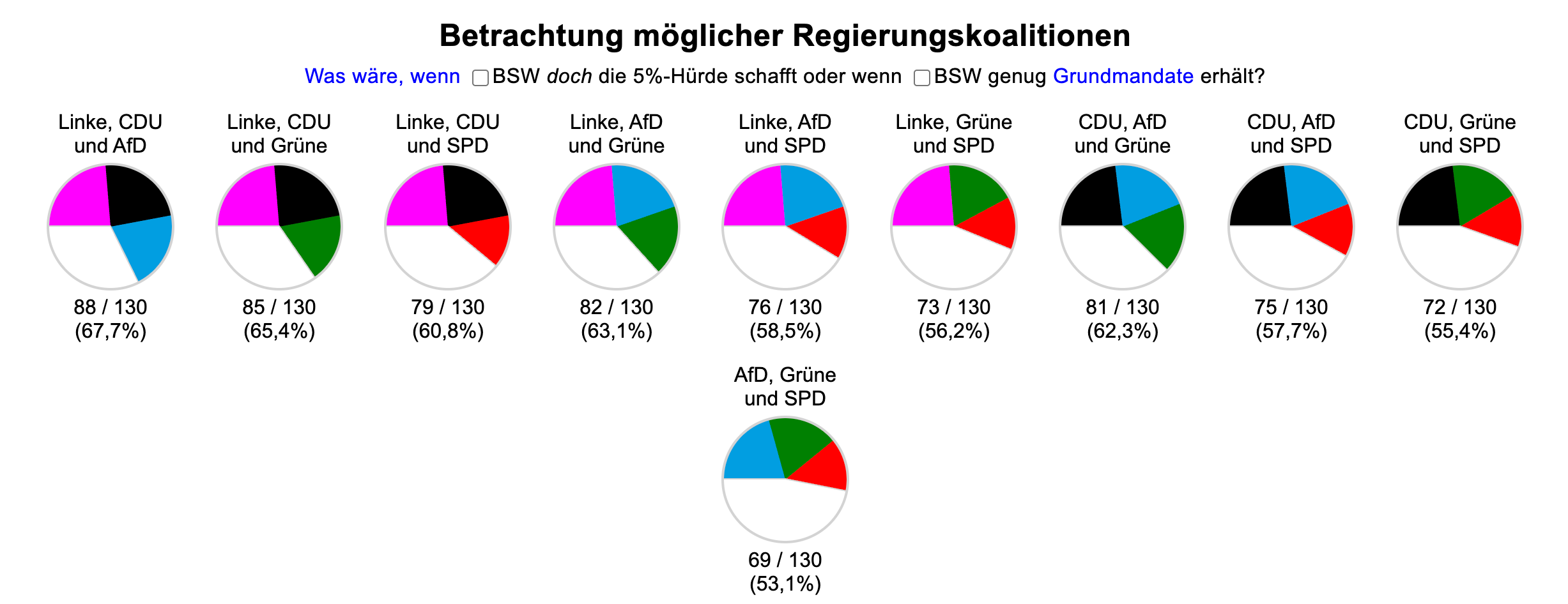
In Berlin as a whole, at least if recent polling is to be believed, the AfD is unlikely to make spectacular gains. What has emerged for me from the latest flood of analysis concerning the AfD, is just what a strange party it is.
Cam and I discuss the AfD’s program in the podcast this week. If you can access it via google translate, the AfD’s state-level program is really worth checking out.
Like other parties of the European far-right, the AfD enjoys substantial support amongst voters who self-identify as “workers” (by no means the majority self-description in modern Germany). They also score well with voters who self-identify as suffering financial difficulties. Indeed, the concerns of AfD voters about both the economy and the cost of living are significantly more pronounced than those of the supporters of other parties.
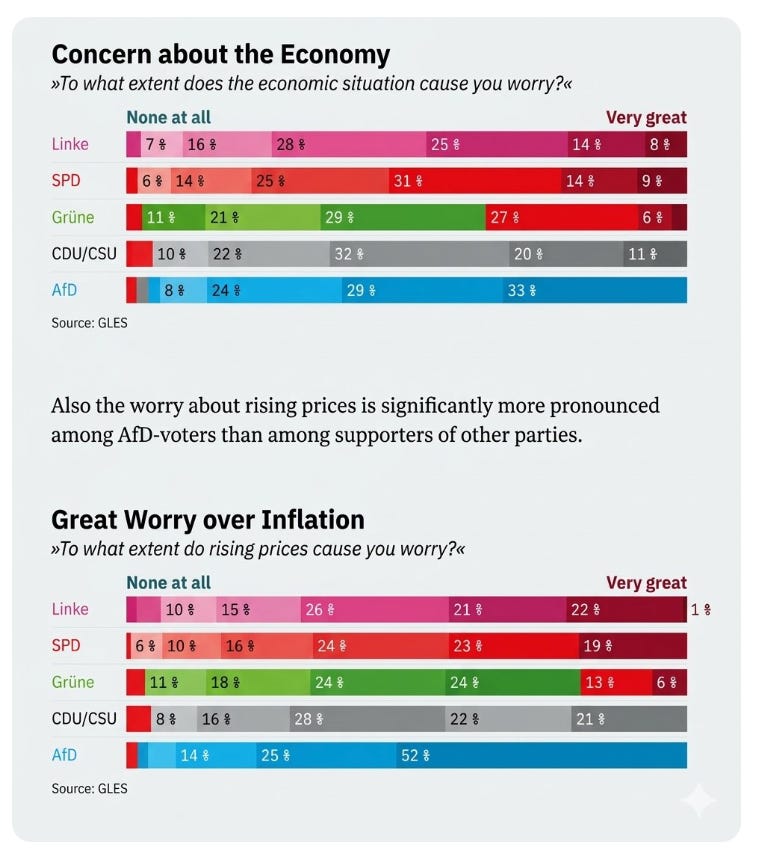
Source: Zeit translated by Gemini
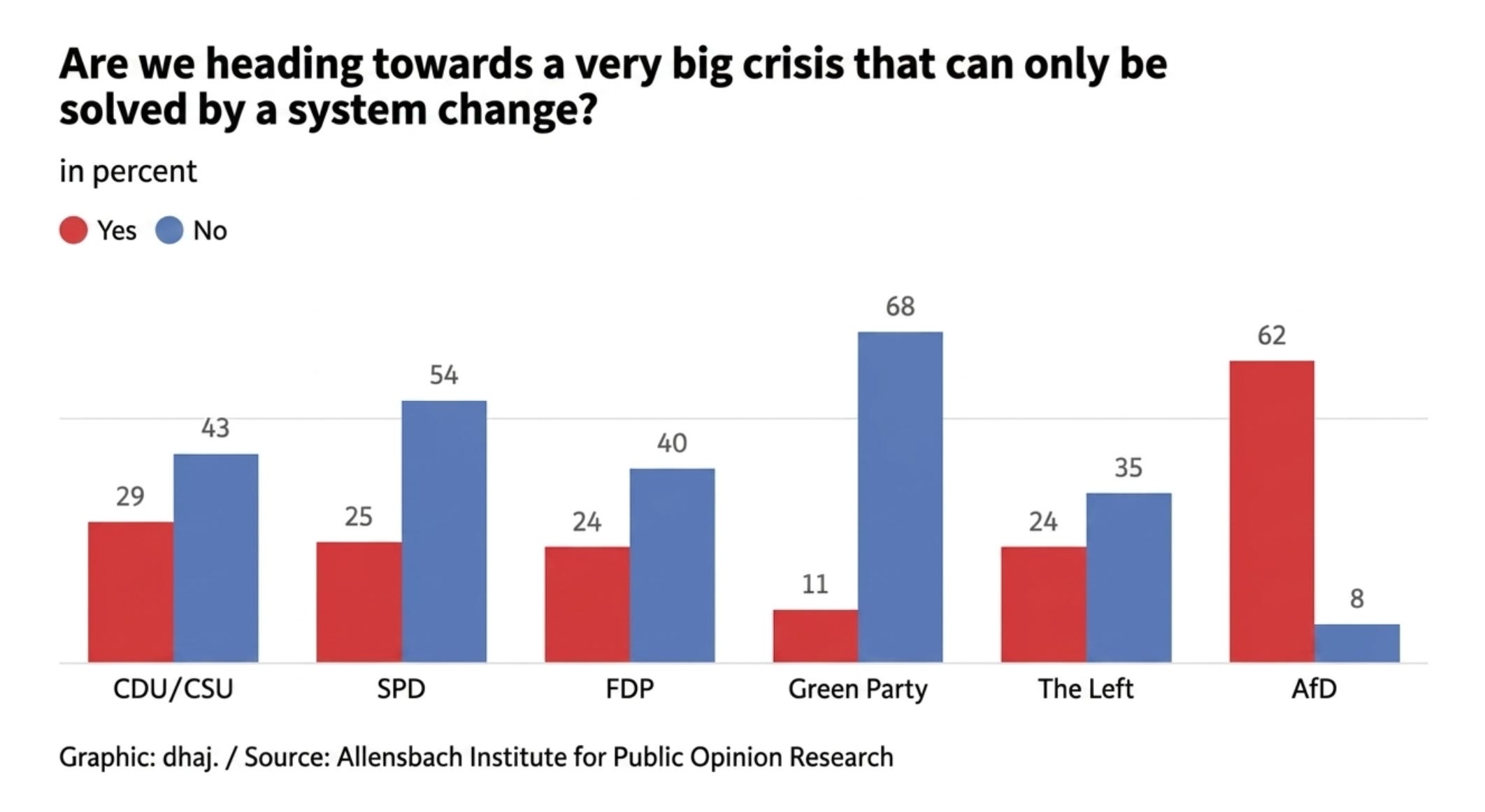
AfD voters are worriers and they are often tempted to worry in apocalyptic ways. One of the polling results that has stayed with me is an Allensbach surveyed that asked: “Is society headed inexorably towards a major crisis, which we can only address by a regime change?”. 62 percent of AfD supporters agreed with this dramatic statement v. 30 percent in the population at large and eleven percent of greens.
Source: Allenbach, see Chartbook 235.
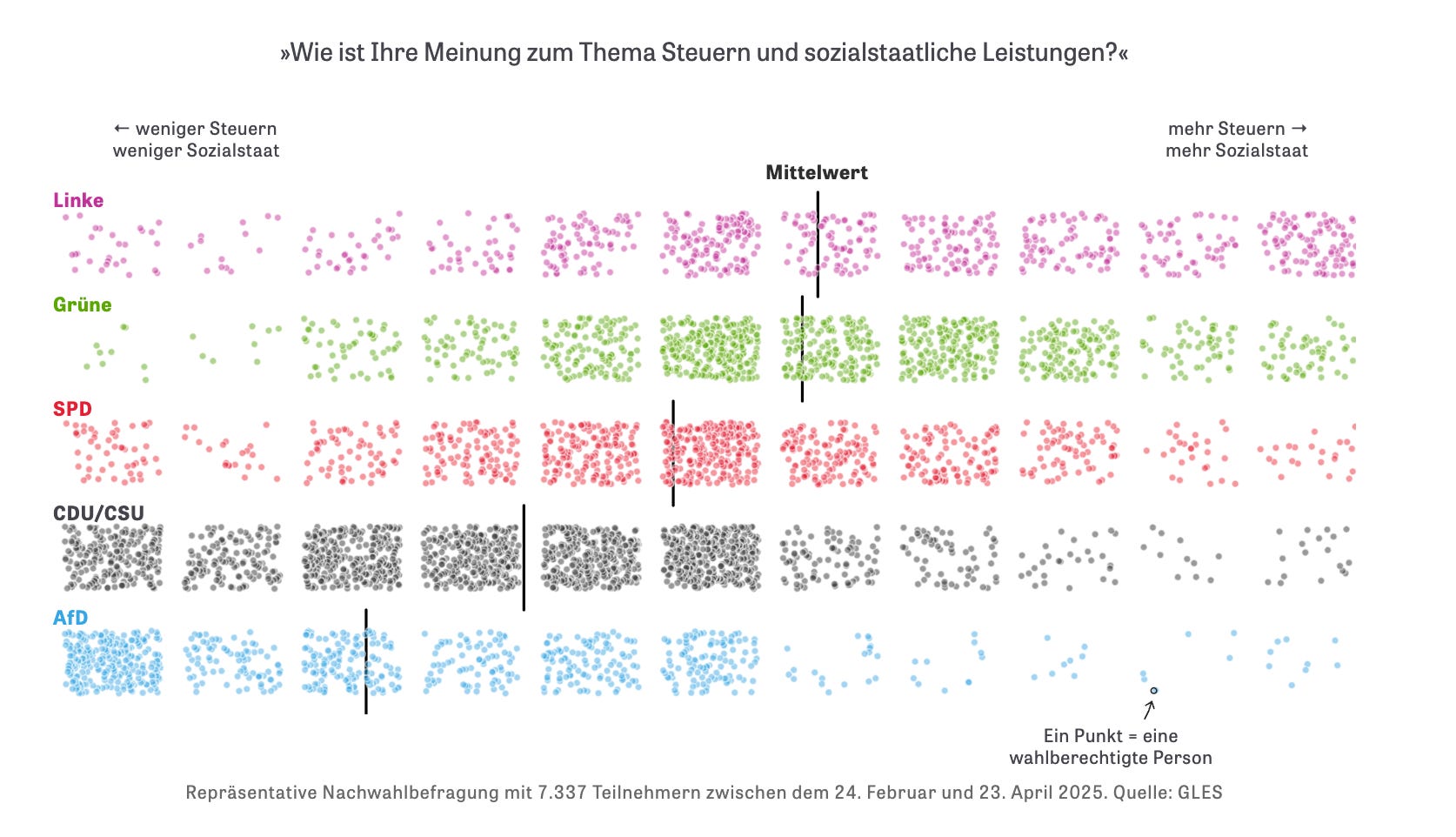
But granted that AfD have a lot of worries. I you look more deeply into the opinion polling data, as Julius Kölzer and Mark Schieritz of Die Zeit did, it is clear that in thinking about solutions, the average AfD voter is not an activist. On the spectrum of taxes and social policy preferences, AfD voters are clustered on the far-right wing of the conservative spectrum. The CDU has a far wider bandwidth of opinions on the critical balance between taxes and social spending, than the AfD who tend to resolutely support lower taxes and lower social spending. These are not voters who trust the state.
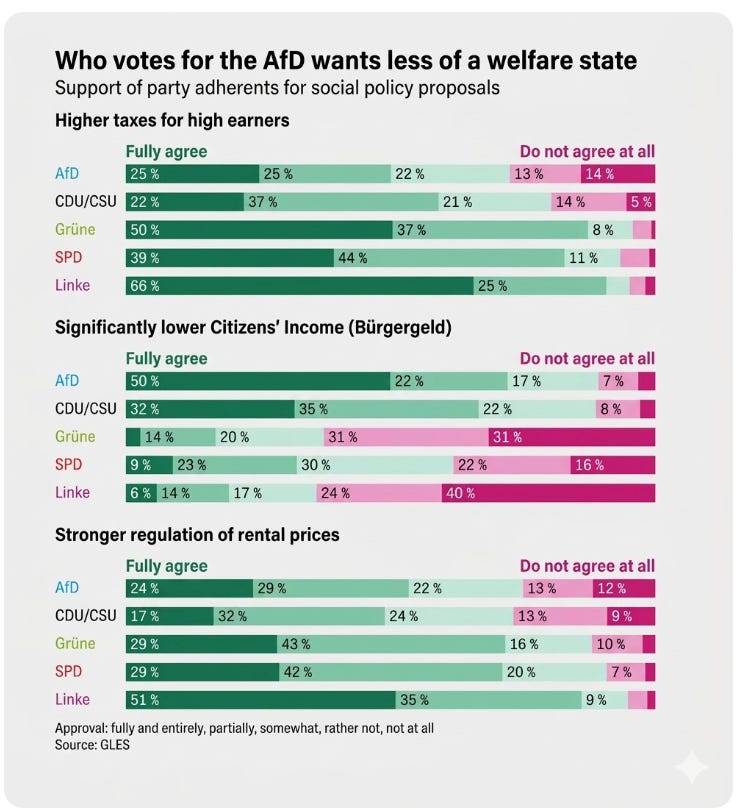
If you ask AfD voters about specific measures of redistribution and social intervention, they back up their general preferences with clear answers. Though there is some support for redistribution even in the ranks of the AfD, a larger majority oppose taxing higher incomes than in any other party(panel 1 below). A spectacular 50 percent of AfD voters favor slashing the Bürgergeld, a basic social welfare payment (panel 2). And though the party is divided over the question of rent regulation, its profile resembles that of the conservative CDU rather than the more left-wing parties (panel 3).
Source: Zeit translated by Gemini
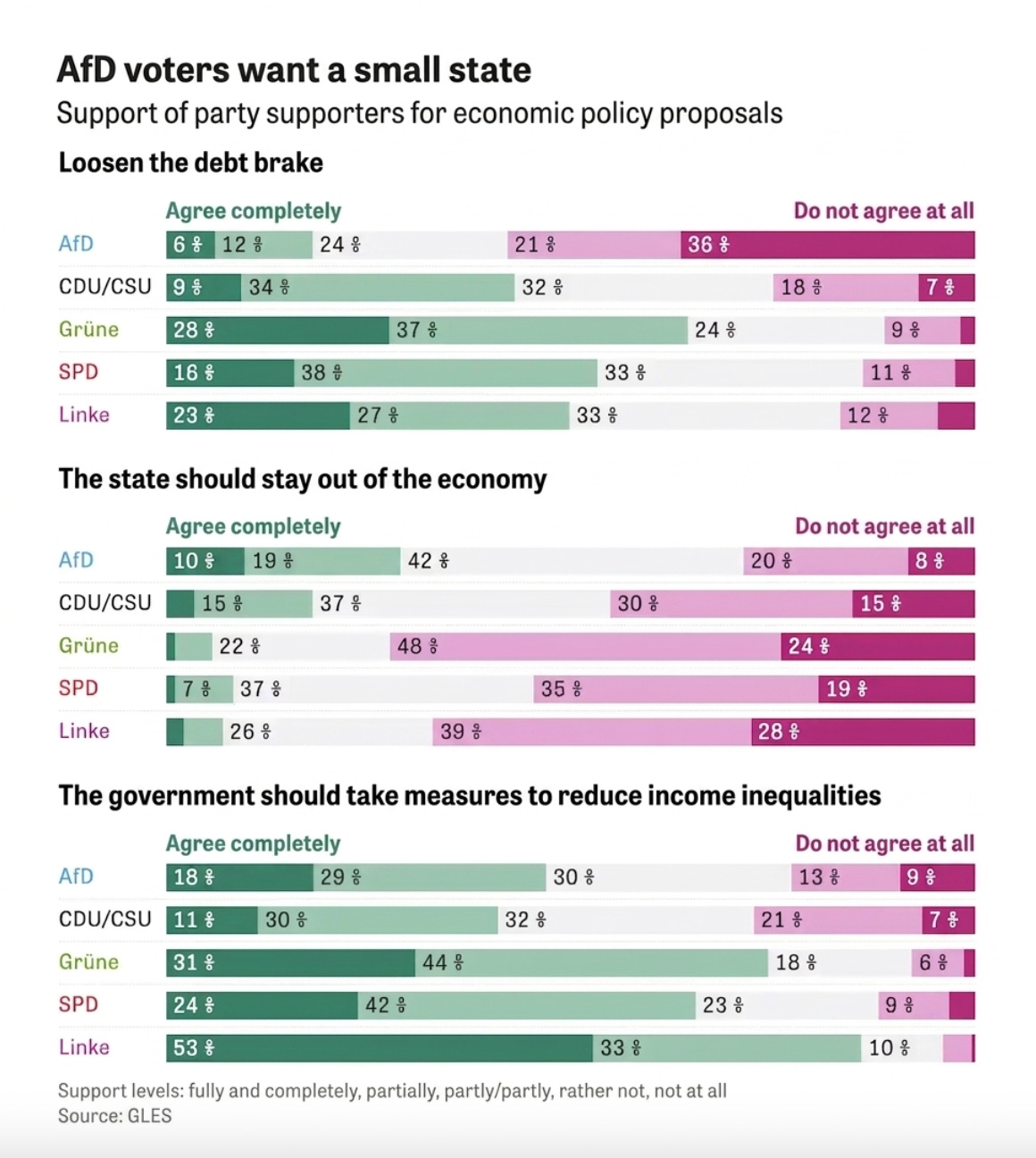
If you dig deeper and ask whether the German government should loosen the debt brake (Schuldenbremse, panel 1 below), the answer from the AfD, is a massive no. Again this is far more pronounced than for any other party. Party supporters also tend to think that the state should “keep out of the economy” (panel 2) and there is only lukewarm enthusiasm in the party for redistribution (panel 3), with the AfD again resembling the CDU rather than Die Linke.
Source: Die Zeit translated by Gemini
Rather than thinking of this set of preferences as incoherent, or merely the expression of a sectional petty bourgeois interest, it makes more sense, surely, to view it as a coherent set of anti-systemic views. Germany is in trouble. But the trouble goes deep and cannot be addressed by “more of the same” socio-economic measures in the domain of taxes or social spending or regulation. The state is not the solution, it is part of the problem. What is needed, in the eyes of AFD supporters, is something more dramatic. The AfD’s fixation on migration and the cultural battle for Germany’s “soul”, addresses that sense of drama and crisis in the way that none of the establishment parties currently can.
I love putting out Chartbook. I am particularly pleased that it goes out for free to thousands of subscribers around the world. But, writing this newsletter takes a lot of work. If you are enjoying it and would like to support the project, sign up for one of the subscription options here. It is the equivalent of a fancy cup of coffee per month!
What we are experiencing now is a tiny group of people amassing a destabilizing share of the planet’s wealth and cleverly manipulating the anger of those feeling the rip tide of loss to transform prosperous, democratic societies into authoritarian states designed to suppress dissidence and protect that wealth. Short term: successful tyranny; long term: chaos.
Somehow you left out AFD's ties to Russia/Putin.