

To have the two central agencies of government economic policy not engaged in a coherent division of labour, but pulling in opposite directions, points to a fundamental dissensus at the heart of government.
When this happens in the United States, still the anchor of the dollar system, and the players involved are the Federal Reserve and the US Treasury and the arena for their struggle is the $32 trillion market for US Treasuries - supposedly the world’s most important liquid safe asset - it would seem that we have the makings of a Battle Royale.
For obvious reasons, observers have long worried about the fiscal and monetary politics of Trumpianism. Trump and his minions have verbally and legally assaulted the Fed. With Kevin Warsh as the new Fed chair the verbal assault has relented somewhat. But the legal assault continues.
Nevertheless, the escalation of tension between the Fed and the US Treasury in August 2026, has taken markets and the commentariat by surprise.
What has caused the escalation is the rise in long-term bond yields that has gathered significant momentum, in part because of the fiscal fundamentals and in part because of the new round of supply shocks delivered by the Iran war and the prospect of a renewed rise in inflation. This shift in the market mood has happened just as Kevin Warsh is struggling to establish his conservative new regime at the Fed. In the long-run Warsh no doubt hopes that a new era of restrained Fed communication will allow a stable equilibrium at low rates of inflation and moderate bond yields. That is not the situation this summer. The inflation rate in the US is now back up to 3.7 percent and long-term bond yields are at rates not seen since the early 2000s.
Impatient for some immediate relief, the unthinkable has happened. US Treasury Secretary Scott Bessent, has announced interventions in the markets for US Treasuries to drive up bond prices and reduce long-term yields. After 2008 we got used to central banks buying bonds on a huge scale. But the central mission of Warsh’s chairmanship is to break the Fed out of that habit. For the US Treasury to be engaging in open manipulation of the bond market, is both a step in the opposite direction and a substantial expansion of government intervention.
Krishna Guha, vice-chair at Evercore ISI, said the Treasury’s move might not have only unsettled investors, “but folks on the FOMC as well”.
To make matters worse, Bessent justified his interventions by claiming that the Treasury market was out of line with “fundamentals” and that as the ultimate insider he has an asymmetrical informational advantage that warrants his interventions. Both claims contradict the new view of the Fed which seeks to disentangle policy from the market, to limit any use of its own asymmetrical informational advantage and to allow “real” market forces to speak.
On the face of it, this has the makings of a crisis that would make the battle between Liz Truss and the Bank of England, the moron premium and the upheaval in the UK gilt market, look like a storm in a teacup.
Historically, battles between Treasuries and central banks have defined the fiscal and monetary regime: in the 1951 Fed-Treasury accord, in the 1980s and 1990s in the establishing of independent central banks on the Bundesbank model in Europe.
In 2026, the stage seems set for a major clash.
The dramatis personae could hardly be more theatrical. Both Bessent and Warsh are former proteges of legendary macro trader Stanley Druckenmiller who took to the pages of the WSJ to criticize Bessent’s intervention.
The Treasury Department announced on Aug. 19 that it would double the size of its long-dated bond buybacks, from $2 billion to at least $4 billion per operation, aimed at the 10- to 30-year sector and running from Sept. 9 through Nov. 4. The announcement came after the 30-year yield touched a 19-year high. Yields fell within minutes. By the next afternoon they had round-tripped to levels above where they started. The market’s verdict was swift and correct: This wasn’t liquidity management, it was price management—and a mistake far larger than $4 billion suggests. Treasury’s announcement gave the game away. It justified the larger operations as liquidity support in sectors with “consistent strong sponsorship from market participants,” but strong sponsorship is the definition of a healthy, working market. There were no failed auctions, no dealer balance-sheet seizure, no forced unwinds, nothing resembling Treasurys in March 2020 or U.K. gilts in September 2022, the sort of genuine dysfunctional episodes that justify official action. Volatility was contained, and trading was orderly—not a malfunction but the machine doing its job. Consider what the machine was pricing. Inflation is 3% to 4% and has been above the Fed’s target since 2021. Unemployment is 4.1%, full employment by any definition. The deficit is running near 6% of gross domestic product, a number America has never before produced in peacetime at full employment. … The 10-year yield, even after the summer selloff, sits at or below the economy’s nominal growth rate. That means a borrower (federal government) running 6% deficits at full employment, with above-target inflation, still funds itself at roughly the rate its economy grows. … The bond market wasn’t being a vigilante, as some would argue. It was being a pushover that had finally begun to clear its throat, and Treasury moved to quiet even that. I have spent five decades trading on a simple premise: Markets aggregate information no committee possesses, and prices are how that information reaches decision makers. The long-term Treasury yield is the most important price in the world. It is also the only fiscal disciplinarian the U.S. has left. Neither party will run on entitlement reform. Both have spent the past decade expanding commitments while ignoring arithmetic. Democracies don’t repair their finances because a budget office publishes a table. They repair them only when the cost of inaction becomes visible and immediate, when mortgage rates bite, when auctions tail, when the political price of a rising long bond finally exceeds the political price of touching spending. Every basis point of artificial yield suppression is a subsidy to procrastination. Yield management always begins as a technical operation and ends as a policy commitment. From 1942 to 1951, the Federal Reserve capped long Treasury yields to finance World War II. The cap outlived the war, financed deficits with printed money, and fueled double-digit inflation. It took the 1951 Treasury-Fed Accord to dismantle the cap, followed by years of financial repression that quietly taxed a generation of savers. U.S. policymakers built the wall between debt management and price management for a reason. This intervention starts dissolving it. Within a day of the announcement, Treasury Secretary Scott Bessent indicated the operations could grow beyond $4 billion, and analysts observed that Treasury can double them again and again. When the bond market didn’t respond to this threat, senior Treasury officials told reporters that the department could use the Treasury General Account to intervene. Once markets believe Treasury is defending a price, every rise in yields becomes a test of official resolve, and the operations must grow to survive the tests.
Because this is 2026 it didn’t take much sleuthing to establish that Druckenmiller’s piece was in large part written by AI, a fact which Druckenmiller did not even deny. He clearly agrees with whatever the Algo has come up with and so it seems does the Wall Street Journal. It is hardly surprising that the Algo knows the script. This isn’t rocket science or predicting protein structures. What are at stake are elementary components of any conservative understanding of the fiscal and monetary constitution.
In response, Citadel Securities have come out and labelled Bessent’s actions as “financial repression” - holding interest rates down in the face of inflation.
Many of us in the critical macrofinance camp have long been arguing that financial repression is, indeed, the likely and least worst way forward. Perhaps we did not expect our prophecy to manifest in this form, but history sometimes works in strange ways.


Later this week Warsh goes to the exclusive gathering of central bankers at Jackson hole to deliver his first speech as Fed chair. What will he say? Will he openly challenge the Treasury Secretary of the United States? Market observers are nervous about a coming clash:
“I have a very dim view of the Treasury’s rationale and its tinkering. I think it’s a self-limiting, self-defeating strategy,” said Greg Peters, co-chief investment officer at PGIM Credit. “The markets are looking for something out of Warsh, but I am not sure what he’s supposed to do here.”
The very fact that we are asking such questions is itself shocking.
Given the unfolding script, the temptation to amplify the very real shock that is unfolding in financial markets, with the melodrama of Fin-Fi(ction) is irresistible. Serious-minded economists are asking whether US Treasuries can in any real sense be regarded as safe assets. Is this the beginning of the end of the dollar system? More on this, in the next installment of what is turning into a Chartbook mini-series.
But, first of all, let us return to 2026 and pinch ourselves. Is it plausible to imagine that Scott Bessent of all people is initiating a major pivot in policy? Who are we dealing with here? Are these Titans of financial history?
Being a fool or a blow-hard does not mean that you cannot have a real impact on the world. But one thing we should not take at face value is what such people say. In the case of the second Trump administration one thing we know is that they like to talk loud but they may only be carrying a teeny-tiny stick. In the first year of the Trump administration I argued that we should take the poolside, botox culture of Mar-a-Lago more seriously as a guide to strategic thinking than the pontifications of MAGA’s finance whisperers.
In 2026 is it time to take the bungling incoherence of Operation Epic Fury as our template?
Like major military operations, official bond market intervention can make a real difference. The Bank of Japan under Kuroda, the Fed under Ben Bernanke and Jerome Powell, the ECB under Draghi, all drove bond purchases to gigantic proportions. The Fed in March 2020 was buying more than $100 billion per DAY. This number is so staggering that the esteemed John Authers in a recent piece misremembered it as the monthly figure. It was the DAILY purchase!
So, in 2026, faced with a real bond market rout, when the Treasury Secretary wants to make a major impact on the biggest financial market in the world, he must, surely be talking about gargantuan numbers. Otherwise, he surely knows that it would be an embarrassing flop. He must be thinking in terms of hundreds of billions in purchases sustained over months, seriously restricting net supply to the market. You might think!
But then you remember we are in 2026. The year of Epic Fury.
In fact, the doubling of bond buy backs that Bessent has announced is so tiny that it requires a special graphic to explain:
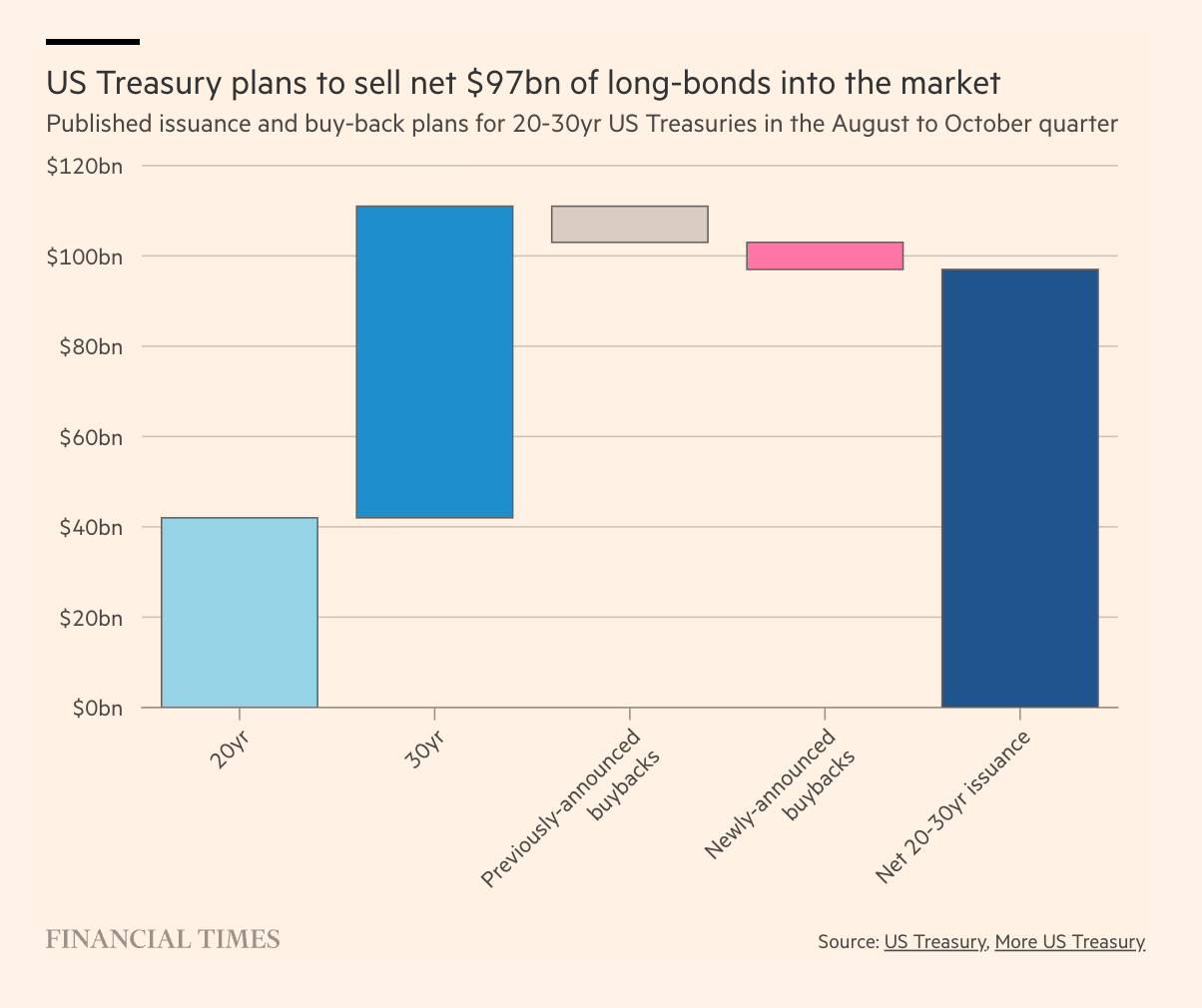
As Toby Nangle points out, this can have no significant impact on net issuance and has no prospect whatsoever of shifting the market.
Bessent himself does not seem to know what to make of his embarrassment.
On the one hand he wants to defuse the tension by arguing that all that the Treasury is doing is ironing out liquidity issues at the long-end, using its firepower and superior knowledge to facilitate a sensible repricing. Perhaps Bessent actually believes that serious fiscal consolidation is coming and expects market actors to follow him. If the movement in bond markets was mild, if sentiment was basically stable, such signalling might even have some effect - a kind of fiscal forward guidance. But given the scale of uncertainties and the gargantuan level of issuance, that is far from being the case.
So, Bessent pivoted to other side. Embarrassed by the market reaction, the Treasury let it be known “through sources” that it could actually tap up to $1 trillion dollars in the Treasury’s general account.
$1 trillion is a lot of money. But, once again, the market winces with embarrassment. As Robin Wigglesworth pointed out
… this just makes the Treasury seem even more desperate, like doubling down on a bad hand. The TGA is like the US government’s checking account at the Fed, where tax revenues, debt sale proceeds etc all pool up. But most of that money is going to concrete things, like running the US government, or there as a backup in case of a catastrophic market breakdown. It’s not idle financial firepower sitting there for Treasury secretaries that want to try their hand at bond trading again.
If the Treasury sets itself up to defend a price target with purchases funded from its current account with the Fed, it is simply setting itself up to shovel profits into the accounts of speculators who will eventually break the peg. The daily turnover is more than $ 1.2 trillion. No doubt the Fed could extend an overdraft to the Treasury. In the end, the government is a single financial unit. But this would involve a gross violation of long-established firewalls. The only agency that under the prevailing dispensation, has a truly unconstrained account is the central bank. That is what gave the Fed and its peers the firepower to boss bond markets. But, if the Fed under Warsh is committed to one thing, it is to abstaining from any such manipulation, except under conditions of an overt and life-threatening financial crisis.
No such conditions prevail.
So what is the upshot of this bizarre display by the US Treasury?
It would be highly surprising if the Treasury altered the course of interest rates and actually led to a new age of financial repression.
It would be surprising if Warsh at Jackson Hole decides to take a principled stance.
It would be no less surprising if Bessent were to turn out to be right and there were actually to be a fiscal consolidation in the US.
The most likely outcome is that there is no regime shift, but that the Treasury loses credibility, a “MAGA premium” further raises borrowing costs, increasing the deficit and thus compounding pressures in the bond market.
As Lisa Shalett, chief investment officer of Morgan Stanley Wealth Management, put it to the FT
intervening in the Treasury market “because you’re cranky” about rising yields “is not a compelling argument and smacks of whimsy”. “And you don’t want an unpredictable, whimsical Treasury”
The choice of words here is telling. The question is not whether Trump’s Treasury is a mighty historical force on the cusp of changing the financial regime and inaugurating a new era of financial repression. To speak in those terms is to engage in Fin-Fi melodrama. The problem is that under Bessent’s stewardship the Treasury is “cranky”, “unpredictable” and “whimsical”.
That seems right for 2026, the year of operation Epic Fury, the year when after wreaking real havoc in Iran, America found its mighty aircraft carrier battlegroups disabled by bargain basement drones, and a near mutiny of their crews provoked by prison-quality food and blocked toilets.
I love putting out Chartbook. I am particularly pleased that it goes out for free to thousands of subscribers around the world. But, writing this newsletter takes a lot of work. If you are enjoying it and would like to support the project, sign up for one of the subscription options here. It is the equivalent of a fancy cup of coffee per month!
As usual, well-written, excellent analysis. A quick question, however. I worked on Wall Street my whole career and watched the massive growth of hedge funds over the years. Yes, while working for Soros and Druckenmiller, Bessent benefitted from the association. He then opened Bessent Capital which was closed down after a number of years. (Not really explained why in what I read but didn't sound positive.) He returned as an Operations Manager of another hedge fund until in late 2015, he raised money for Key Square, a macro fund of over $4.5 billion, one of the largest fundraisings in the history of hedge funds at the time. Soros was a major investor at the time. However, while the fund made strong gains in 2016, its first full year of trading, it had inconsistent returns and significant losses after that. Soros pulled his investments out of Key at the end of 2018, along with Australia's Future Fund, Morgan Stanley Alternative Investment Partners and the New York City Police and Fire pension funds. By 2023, assets under management had decreased to below $800 million. So, in spite of all of the hype surrounding Bessent's success and wealth, he is, bottom line, a hedge fund guy who in his last run privately as a hedge fund manager was not successful before becoming Treasury Secretary. Now, he is treating the US Treasury in many ways as a hedge fund. In addition, how do we think this is going to turn out? The conflicts with the Fed, and of course with Trump who has no understanding at all of any of this, are alarming to an extreme, particularly given that Trump is someone who has always abrogated every debt he ever had, with Project 25 explicitly espousing 0 coupon, 100-year bond solution to US debt. Is it possible that becomes the only solution, a cram-down of US debt? Sorry to be so alarmist. I never in my lifetime thought I would be thinking this, much less saying it. But the incompetence of this crew is breathtaking.
The issue here is not immediately economic but political. Bessent's real mandate is to keep things under control until the midterms. After that, it doesn't matter to his boss, so it doesn't matter to him.