

"all history worthy of its name is contemporary history” - Benedetto Croce 1917.
In 2026 we are worrying about bond markets again. Long yields are surging across the developed worl. The US Treasury is engaged in unprecedented intervention and the markets are not responding. Yields are back up and the dollar is down.
Given the scale of the US Treasury market this is a matter of global concern.
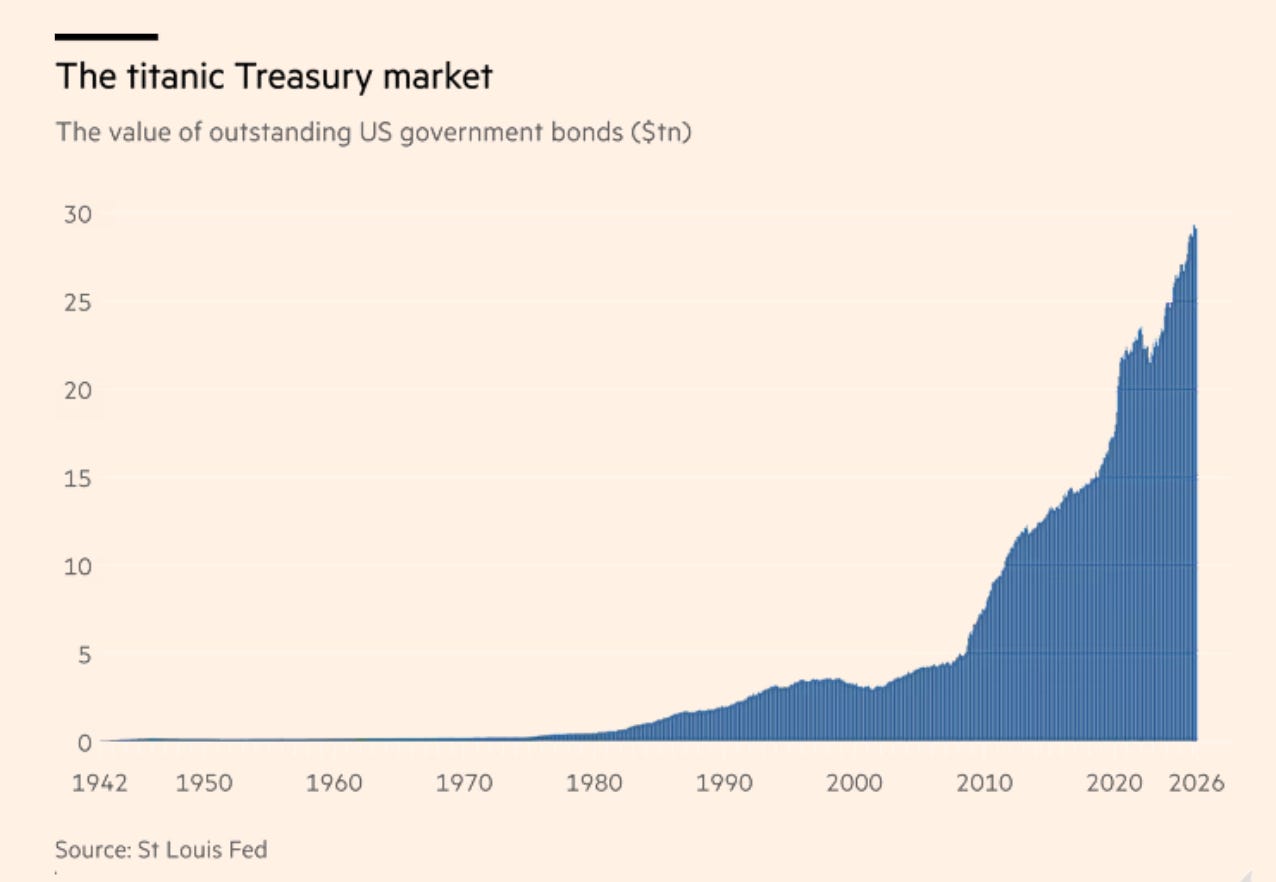
What is the worst thing that could happen? A large-scale sell off and a collapse of the Treasury market as a functioning institution.
Is it likely? More to say on that tomorrow. But the point to make here is simply that this is not a hypothetical. The near collapse of the US Treasury market, the most important financial market in the world, is something we have already lived through, in March 2020 as COVID spread around the world.
At the time, the world’s population had other things on its mind. But the Treasury market meltdown remains the most underrated shock in modern financial history.
I made it the center piece of my COVID book Shutdown. It is the core of Nick Timiraos Trillion Dollar Triage.
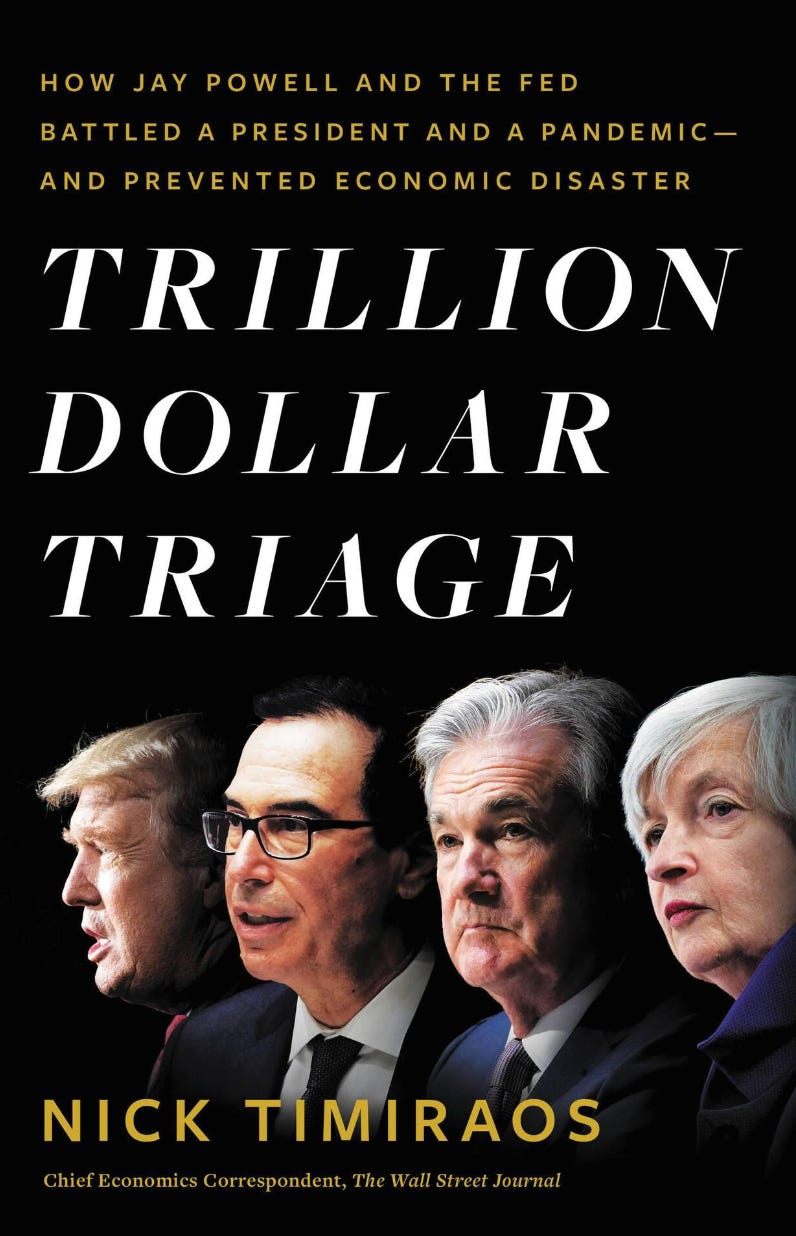
And it was highlighted in what was surely one of the most underrated journalistic feats of the last few months, Robin Wigglesworth’s oral history of the Fed’s COVID response in the pages of FT Alphaville back in February of this year. Sandwiched as it was between Trump’s interventions in Venezuela and Iran this journalistic retrospect did not attract the plaudits it deserved. I want to bring it back to the fore here, not simply because of its historical interest, but because it stakes out the terrain on which we seem again to be maneuvering. As has become clear in the last few weeks, we can’t think about the current mess in global bond markets without thinking of March 2020.
The truly lethal problem that was developing by the second week of March 2020 was that in the dash to cash, investors were selling not just equities and supposedly safe corporate bonds. They were also smashing the piggy bank of safe assets that they held in the form of US Treasuries. The result, as Daleep Singh - ex of Goldman Sachs then of the Obama Treasury and the NY Fed, later to join the Biden administration - told Timiraos, there was:
“nowhere to hide. There was no safe haven … What was truly the most frightening part of 2020 for me was how Treasury yields were spiking higher at the time that equity markets were plummeting. This was an un-hedge-able risk from a market perspective.”
The “Apocalypse Now” meeting of the FOMC came on March 15 2020. That was a SUNDAY! Not a normal day for a Fed policy meeting. It was timed to anticipate the market opening in Asia.
After words of thanks from Powell, the meeting started with Lori Logan of the New York Fed laying out “a long list of bad, terrible, no-good developments, such as airline bonds trading as if they were already in default; massive outflows from bond funds; dislocated trading across the board; even investment grade corporate bond issuance becoming “sporadic” and commercial paper market liquidity becoming “nearly nonexistent”.”
But, as Wigglesworth underlines, “the most alarming development was arguably happening in the US government bond market”
According to Logan:
Following several consecutive days of worsening liquidity in the Treasury market, market participants reported an acute decline in conditions toward the end of last week. A number of primary dealers reported that they had stopped making markets in off-the-run securities, and that this segment of the Treasury market had ceased to function effectively. This disruption to intermediation was due to extraordinary flows from investors seeking the safety of Treasury securities, particularly in the on-the-run Treasury securities, the most liquid, and from those selling off-the-run Treasury securities, which included reserve managers who sought to raise cash, hedge funds facing margin calls or seeking to reduce leverage, and asset managers looking to rebalance their portfolios. Dealers reported having difficulty selling these off-the-run securities and constraints on their ability to absorb any additional inventories that were coming their way. Given the central role of Treasury securities in pricing and in hedging, and as a store of value, this decline in liquidity spilled over into other markets and started to raise questions about the functioning of the financial system more broadly.
As one trader told Timiraos
“It was absolutely one-way traffic, and everybody was a seller. Everybody. Just raise cash,” said Christopher Vogel, a veteran trader who headed the rates and currency division at TD Securities, an arm of a large Canadian bank. “Anything near 99, 98, 97, 96 cents to the dollar? We’ll take it. The redemptions we saw were fierce, and the buying hands were in the pockets.” The result: sell Treasuries. “When cash is dear, you sell what you can, which may not necessarily be what you want,” said Hammack, the Goldman Sachs treasurer.
NY Fed President Williams double down on these alarming reports:
We are seeing stress and illiquidity and market dysfunction across a number of key, I would say, cornerstones of our financial system. This isn’t about the volatility in the stock market or some of those other markets. It is really about — to me, the primary focus for us is the fact that the U.S. Treasury securities market, which is, quite honestly, the most important market in the world, has shown a rapid deterioration in liquidity over the past week. . . . When I think about how these developments in the financial markets affect our ability to carry out our monetary policy and actually for those decisions to get to the businesses and households, it is absolutely essential that the Treasury security and the MBS markets are functioning well.
According to Wigglesworth global reserve managers sold $290 bn in Treasuries. Mutual funds unloaded $270 billion and hedge funds sold at least $180 billion, probably more.
Though the March 2020 sell off has been the subject of considerable research some of which has been reported on Chartbook, and though efforts have been made to reform the market, a subject to which we shall return, this scenario of dramatic, self-reinforcing selling that overwhelms private actors, remains the nightmare vision haunting the markets today, in 2026.
The response in 2020 was spectacular. As Wiggleswoth tells us: “Powell said that fixing the Treasury market was the main reason for the Sunday’s emergency meeting”
Logan explained what the Fed was already doing — primarily big repo operations — and what it now wanted to do to restore calm: buy a lot of bonds, starting with $40bn of Treasuries immediately that Monday. She revealed that the Fed had already bought $37bn the preceding Friday, three times more than the central bank had ever bought in a single day even in the wake of the 2008 crisis. Now Logan was proposing to do more than that every day.
On March 15th, given the scale of the looming disaster, the only point of debate concerned the scale of intervention. Neil Kashkari advocated that the Fed should simply announce unlimited purchases by just saying it would buy “as needed until we get markets functioning again”, rather than announce headline targets.
In making this argument, Kashkari himself was replaying his experience at the US Treasury in 2008 when he had been the point man for the widely reviled TARP bailout progam for America’s banks. On the basis of that experience he insisted that it was “much better for the Fed to overreact than underreact”.
“back in the financial crisis, the one mistake that, collectively, the Treasury, where I was, and the Fed repeatedly made is that we were always slow, we were always too little, and we were always timid. And that was because we didn’t know “Is this it?”—right? Is this as bad as the crisis is going to get? We didn’t want to overreact. But, as Charlie said, when the downside scenario is the great financial crisis, the downside scenario is a deep, deep recession, the downside scenario is an Italy scenario, the right policy response is to overreact, because you want to clip that very deep — maybe it’s small, but very deep — hole. I just think, as we think about policies for this and coming meetings, we should not worry about overreacting. We should be erring on the side of doing too much, not doing too little. . . . “
This was 2020, so the Atlanta Fed’s Raphael Bostic actually raised the question of “negative interest rates, and pointed out that the Fed might also get questions about modern monetary theory”.
Over the following weeks there would indeed be a gigantic fiscal policy push backed up by Fed purchases of Treasuries running at a staggering $75bn a day - a combination that could easily be read as the implementation of an MMT-style program of combined fiscal and monetary policy. The result transformed the Fed’s balance sheet far more dramatically than the 2008 crisis.
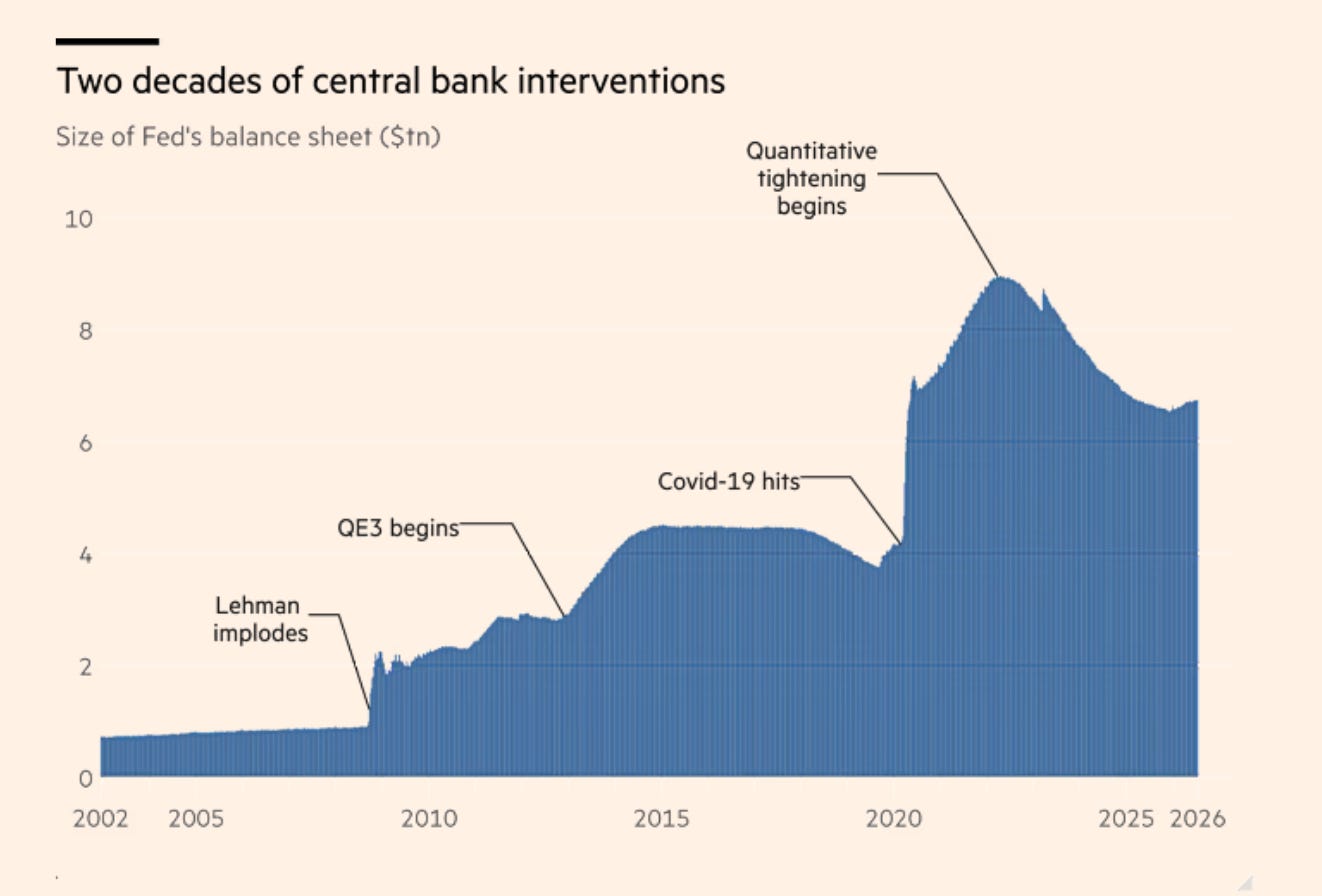
By the end of March 2020 that had done the trick in stabilizing the markets, enabling the April meeting of the FOMC to take on a calmer and more retrospective mode. By April 2020 it was already becoming clear what some of the forces had been that had contributed to the disastrous implosion of Treasury market liquidity. As Wigglesworth tells us:
Fed vice chair Lael Brainard zoomed in on some of these “notable vulnerabilities” in her subsequent comments. A wave of redemptions at bond funds and muni funds raises questions of whether liquidity management frameworks are sufficiently robust. Prime money market funds are once again under the spotlight, after a wave of redemptions led to stresses that required emergency interventions. The need to exit crowded positions among hedge funds with relative value strategies contributed to the massive distortions in Treasury securities markets.
Quarles echoed these comments:
I do think that this event has thrown into relief some vulnerabilities in the nonbank financial sector that we have talked about for some time but that had not been addressed in the wake of the previous crisis or not addressed completely, perhaps because of response fatigue or just the more difficult nature of the response. But I do think that it will be incumbent on the Financial Stability Board to pick up some of these questions about nonbank finance and to look at them much more intently.
It was again down to Kashkari to adopt a more urgent and more political tone:
I think the fact that this is happening 12 years after 2008 is just shocking to me and probably shocking to all of us. Over the longer term, I think it is going to raise many more fundamental questions about our regulatory system, not just for banks, but for nonbanks. I mean, the basic theory of our regulatory reforms coming after ’08 is that institutions should be self-insuring. And yet we’ve already demonstrated that that’s failed. The Federal Reserve has taken extraordinary actions in the past month, and I support those actions. It was the right thing to do to stand up all of these facilities to support financial markets. And now everybody knows that we’re there. And we were there in ’08, we are there now, and we’re going to be there in the future. And so, even after we officially deactivate these facilities when the COVID-19 crisis passes, in a sense, these facilities are always on in the background now. And so, to me, I think we have to ask, over the long term, much more fundamental questions about the structure of our financial markets. Think about overnight funding markets. Is there any social value to allowing institutions — banks or nonbanks — to fund themselves overnight? The only social value that occurs to me is that they can maximize their profits in the short run, knowing that the Federal Reserve is going to be there in the long run when things get scary.
No one in August 2026 is saying that anything like the COVID shutdown of March 2020 is going to play out in the near future. The US economy is in far more robust shape. But the shock of March 2020 is in the system. When Wigglesworth wrote last week about the “The Treasury market’s toxic codependency” with hedge funds, it is March 2020 experience that he invoked.
To riff on Croce: If it is true that all true history is contemporary history, then it is also true that any serious engagement with current moment, with contemporary reality, must necessarily be historical.
This is how Daleep Singh recalled the meltdown of 2020:
“It was sheer, unadulterated panic, of a magnitude that was far worse than in 2008 and 2009. Far worse,” said Singh, who had spent the 2008 crisis on the interest-rate desk at Goldman’s trading floor in London. The idea of shutting down markets was especially discouraging. “It was a profoundly un-American thing to contemplate, to just shut everything down, and almost fatalistic—that we’re not going to get out of this.”
2020 appeared to Singh through a double layer of history: the experience of 2008 set off against something older, something supposedly authentic and essential, the deep ideological ground of Americanness. In 2026 Bessent as Trump’s Treasury Secretary and Warsh as Powell’s successor are adding their own layers.
I love putting out Chartbook. I am particularly pleased that it goes out for free to thousands of subscribers around the world. But, writing this newsletter takes a lot of work. If you are enjoying it and would like to support the project, sign up for one of the subscription options here. It is the equivalent of a fancy cup of coffee per month!
A quick glance at reporting on this panic gives the impression that traders were Even selling their most desirable assets. As if they had already sold everything else and were down to the Crown Jewels. But isn’t it true that in a crisis you sell Treasuries first… because they are the most marketable and least damaged assets you have? You certainly don’t want to lock in losses by selling bespoke high yield assets at fire sale prices. And no one will buy them. It makes perfect sense for the Fed to buy Treasuries; it’s a swap of one US liability for another. Water for ice. The question is whether, in the next panic, the Fed will buy the asset-backed securities (representing risky consumer loans, e.g.) that the asset managers have been bundling and selling to the life insurers they own. That would be cash for trash, right? And all the losses would be socialized. How much of that debt did the Fed buy in 2020? Panic in the Treasury market is a great man bites dog story. But this is why you hold the safe asset. So you can sell it in a crisis and not lock in a massive loss. IMO.
This is absolutely chilling: the FT's reporting needs to be widely disseminated: even when US media have reported on the same thing, the articles have been nowhere near as clear or as trenchant.
The bottom line now is, "it will be incumbent on the Financial Stability Board to pick up ... questions about nonbank finance and to look at them much more intently." It's ironic to quote Randy Quarles on what to do as he was in substantial part to blame (though he denies it) for the Silicon Valley Bank mini-crisis, which reflected his relaxation of post-crisis liquidity requirements. And, of course, the Trumpistanis are now trying as hard as possible to dilute Dodd-Frank, disenable the Financial Stability Board, and reduce financial regulation generally. That, plus the wackiness of the administration's pushing crypto more or less assure that the coming crisis will be a doozy. And there is less room for constructive intervention, given the acceleration of accumulation of public- and private-sector debt. Surely Bessant and Warsh must wake up at night with the cold hand on their guts, even if they pretend to be optimistic in public.