
Chartbook 432 "Writing column. Talking w peril" - polycrisis or stroke?

Why do people, more specifically, rich, famous and powerful men, do the things they do?
Money, power, fame, sex, form a fungible flux.
But in what configurations do these impulses circulate? How are they organized and contained? What inner demons and desires drive them?
The deranging thing about the Epstein revelations, is how utterly disinhibited that flux can become.
It brings us back hard to what we actually mean when we talk about “polycrisis” or “rupture”.
Are such terms hard enough for what we are actually witnessing? What is actually going on?
In 2022, the FT declared polycrisis to be one of the words of the year.
For some people it was a call for a new and more complicated social-scientific model.
For others it was the opposite. Not a new model but an acknowledgement of the fact that none of the familiar models were working. The phrase pointed to a “knowledge crisis”.
To my surprise the most prominent person to endorse this more radical reading was none other than Larry Summers, in conversation with Martin Wolf.
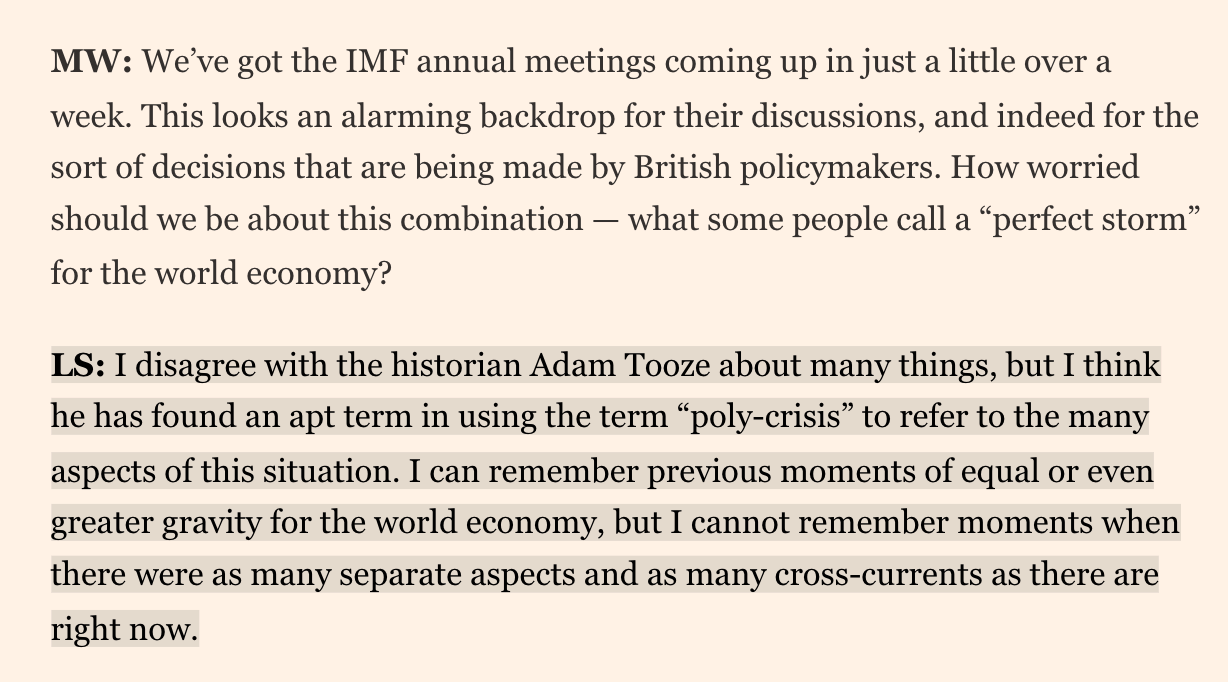
At least publicly, what we were talking about back then were big social structural forces. These, after all, were the polite days of 2022.
Even at the time, critics suggested that the popularity of the concept of polycrisis was a symptom of “neoliberal order breakdown syndrome” (NOBS).
After the Epstein revelations and the reaction or non-reaction to them, we clearly do need a deeper motivational analysis, not to say therapeutic or even psychiatric evaluation.
Berlusconi - the anti-hero of the Bungaboys - would not even attend an Epstein party. He wasn’t into “pizza” and “grape juice”. He preferred better wine and food and less kidnapping.
Our end of the end of history is worse.
Mark Carney in his speech at Davos called on people to recognize hypocrisy and double standards that had always underpinned the talk of a “rules-based international order”.
We knew the story of the international rules-based order was partially false that the strongest would exempt themselves when convenient, that trade rules were enforced asymmetrically. And we knew that international law applied with varying rigour depending on the identity of the accused or the victim. This fiction was useful, and American hegemony, in particular, helped provide public goods, open sea lanes, a stable financial system, collective security and support for frameworks for resolving disputes. So, we placed the sign in the window. We participated in the rituals, and we largely avoided calling out the gaps between rhetoric and reality. This bargain no longer works. Let me be direct. We are in the midst of a rupture, not a transition.
The “liberal international order” was not the only sign that we placed in the shop window of the Western world.
Rights. Decency. Respect for basic societal taboos. These were things that we claimed too.
At an even more elementary level, we claimed to be able to discriminate, to tell the difference between “good guys” and “bad guys”.
What the Epstein material reveals is not just the extent to which many figures of the establishment were involved in his world of sordid sex, but also their promiscuous mixing across political boundaries, the blurring of supposedly opposite positions.
In Epstein’s network the seemingly sharp lines between the liberal establishment - Clinton, Gates, Summers, Chomsky etc - and the supposed agents of polycrisis - the Russians, the Israelis, Trump and his cronies - were blurred.
There were no crisp lines of decorum. No one and nothing was beyond reach. Everything was up for grabs, whether that be “Snow White” or insider tips on the Eurozone crisis, bitcoin and Ukraine.
So when Summers talks about polycrisis what is he actually seeing?
Reading the Epstein correspondence from the first Trump term, both NOBS and polycrisis fall so far short. They, after all, imply some serious underlying commitments to the status quo. Some “rupture”.
Whereas what we are actually glimpsing through the released emails and txts are the slightly more cogent participants at a messy, dark, orgy watching from within their own derangement the worst of all take power.
Friday November 30 2018 - Monday December 3 2018.
As I realized with a shock, the most intensively reported exchange between Epstein and Larry Summers took place in November-December 2018, precisely the moment that Summers wrote a piece in the Washington Post that I have always thought of as one of the most insightful pieces on US-China relations of its era.
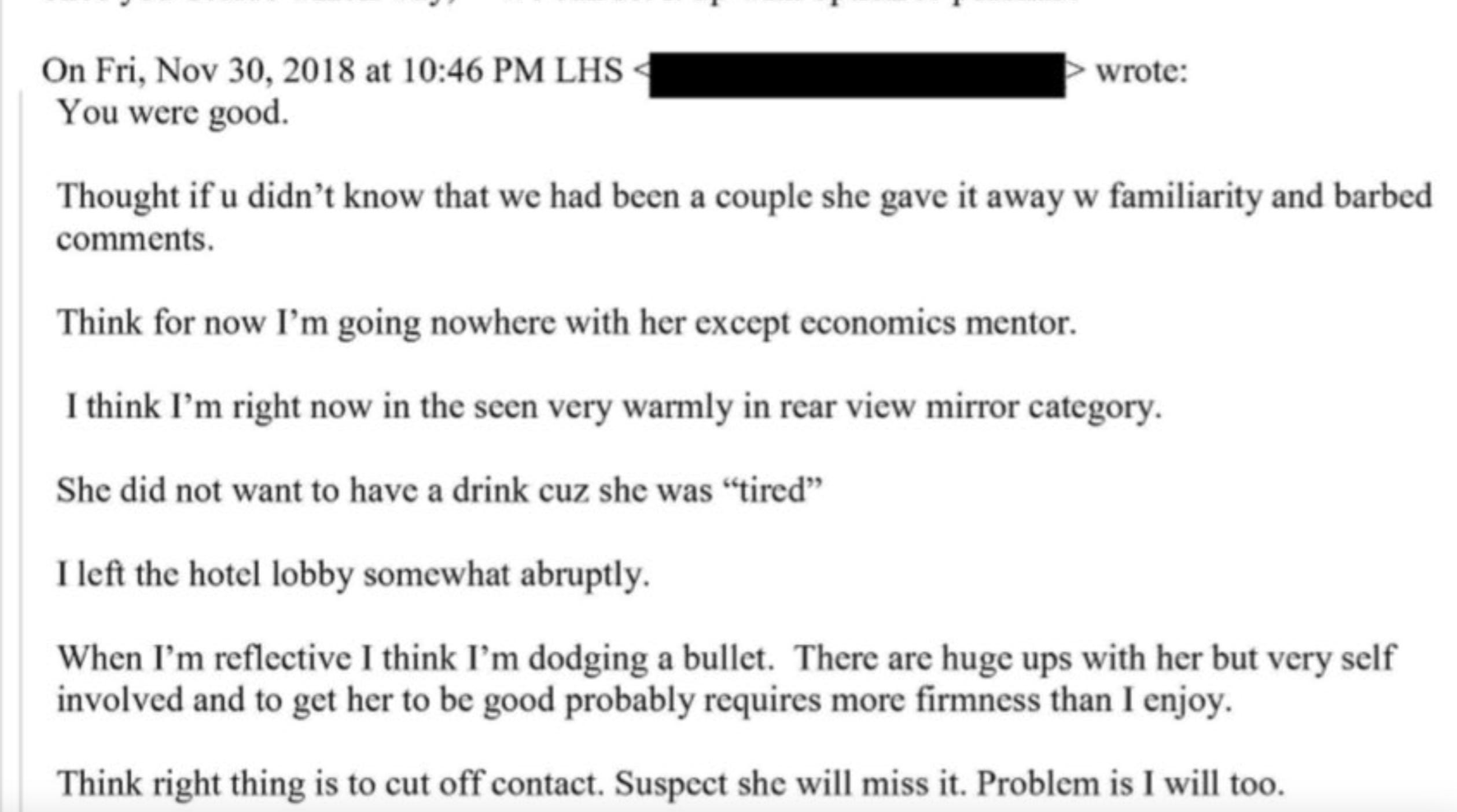
That exchange with Epstein was on Friday, presumably about Thursday night.
The WaPo piece came out on Monday, presumably finalized over the weekend.
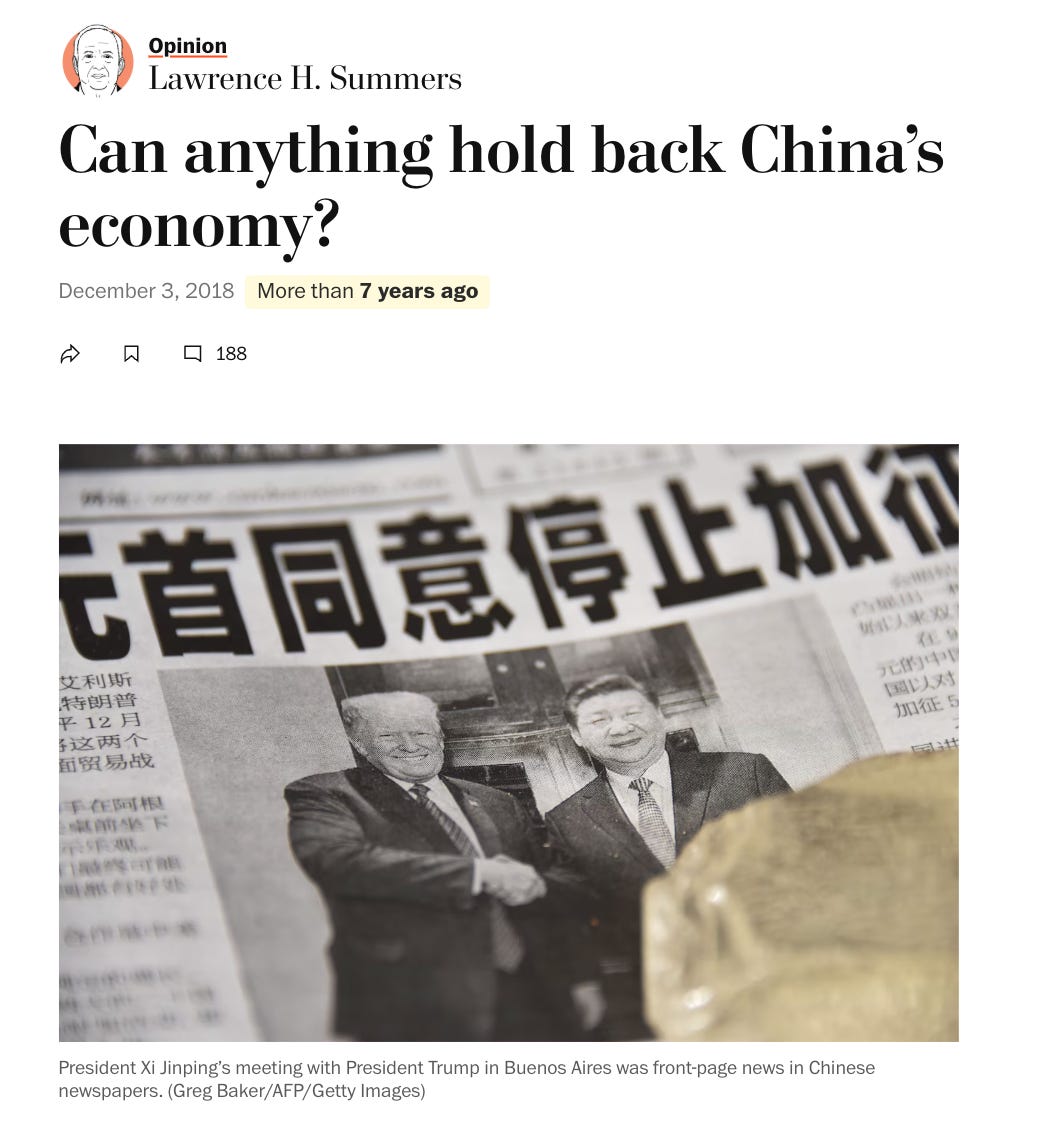
That Wapo piece is dear to me. As much as an op ed piece can be.
If memory serves it came up again with Ezra Klein last week, though it does not seem to have made it into the transcript. It certainly did with Kaiser Kuo.
I keep coming back to it because as cogently as anyone has in Washington it poses the question: “Can the US live with the rise of China?”
“Can the United States imagine a viable system in years to come in which it is diminished to half the size of China, the world leader? Could a political leader acknowledge that reality in a way that permits negotiation over what such a world would look like?”
These are prescient and vital questions from Summers.
What difference does it make to realize the context in which this piece was composed?
For most people, the energy of writing comes from strange places. We would not want someone looking over our shoulder.
But, in this case the shocking thing is not that Summers had smart ideas while he was involved in locker room chat with a sex offender about a problematic love interest.
The shock is to realize the extent to which the language of the Washington Post piece resonates with Summers’ language in discussing his love life with Epstein.
In a bad dream you could see the Washington Post piece and the Epstein texts blurring into a single uninterrupted flow:
“Can anything hold back the ”yellow peril”? How do I contain my attraction? How do we get to a rational affair?”
“ I like relationships without drama”
We “require a viable strategy for addressing our legitimate grievances. Unfortunately, neither rage nor proclamation constitutes such a strategy. A viable approach would involve feasible objectives clearly conveyed and supported by carrots and sticks, along with a willingness to define and accept success.”
“Has she become nationalistic? Would not surprise me”
“goes back to family priority. Community . And you suffer the imprimatur of being part of the enemy hierarchy”
“It appears fate has weighed in”
“More exploitation by peril. Should I stop calling? As she is in china. i have no idea what is real.”
“meet fickle with fickle”
“Guess tough and mean is sexier”
“I gave you a chance you blew it off. I get it. It took me awhile because I had such strong feelings. But it is sinking in”
“Can the United States/Summers/West imagine a viable system in years to come in which it is diminished to half the size of China, the world leader?”
“Could a political leader/Summers/the West acknowledge that reality in a way that permits negotiation over what such a world would look like?”
“Admitting she is not secure. Will take some probing. She is admitting weakness.”
“While it might be unacceptable to the United States/Summers/The West to be so greatly surpassed in economic scale, does it have the means to stop it? Can China be held down without inviting conflict?”
“she thinks she is a soldier at war. No soldier wants to be called cute”
“We are in a long game. Lets see how and if she starts to wonder”
“I would discount any comment re Eg tienaman. But I think current signal … is genuine.”
“I’m not so sure that being mentored by me, having me support her child, being elevated to a leader on China in global economy by collaborating with me and getting to have me as partner if she can find courage to tell her parents is really so useless.”
“How about asking ? What would you need to feel secure?”
“While it might be unacceptable to the United States to be so greatly surpassed in economic scale, does it have the means to stop it?”
“i think the china trade conflict has a major effect. . i have spoken to many of my chinese contacts in different places. and its all weird. .”
“whatever sense of humor they used to fake is gone.”
“These are hard questions without obvious answers. But that is no excuse for ignoring them and focusing only on short-run frustrations.”
“Btw, do you know many that are not self absorbed?”
“Has she asked you to come out and write what a bad idea attacking china is?”
“is she spooked after the pseudo recruitment event?”
“A bit. She listened to me a bit and commented yesterday that the folk called her office”
“it will definitely take a face to face to figure out. hopefully horizontal”
“The hook is in”
“Suppose China had been fully compliant…”
“Hope springs eternal”
“China appears to be willing to accommodate Summers/United States on specific trade issues/matters of (commercial) intercourse as long as the United States accepts its right to flourish and grow,…”
“I predict she will only be interested in discussing Chinese economy. Having admitted vulnerability she will now need to deny”
“Strategy working as predicted.“
“That is a deal the United States/Summers/TheWest should take while it can. It can bluster but it cannot, in an open world, suppress China. Trying to do so risks strengthening the most anti-American elements in Beijing.”
“Trump, for all his failings, has China’s attention on economic issues in a way that eluded his predecessors. The question is whether he will be able to use his leverage to accomplish something important. That will depend on his ability to convince the Chinese that the United States is capable of taking yes for an answer, and on his willingness to go beyond small-bore commercialism”
Why are you up so late?
Writing column. Talking w peril
It feels as though we are inside a surreal live reenactment of Joan Scott’s canonical essay on gender as a useful category of analysis.
“A rational affair?”
Is that not exactly what we want too want?
That certainly is what Europeans were craving at Davos.
It is what Carney proposed. Start with honesty. No more hypocrisy. Variable geometry. Wide not deep. The strength of our values and the value of our strength.
But set all that talk alongside the exchanges between Epstein and Larry Summers - Carney’s sometime analogue - and the doubt creeps in.
Are we, like Summers, fantasizing about stabilizing our desires and needs in an inherently dangerous and uncertain world? Are we kidding ourselves?
Does it lay us open, to Epstein’s swift counter:
“Did you had a stroke … ?”
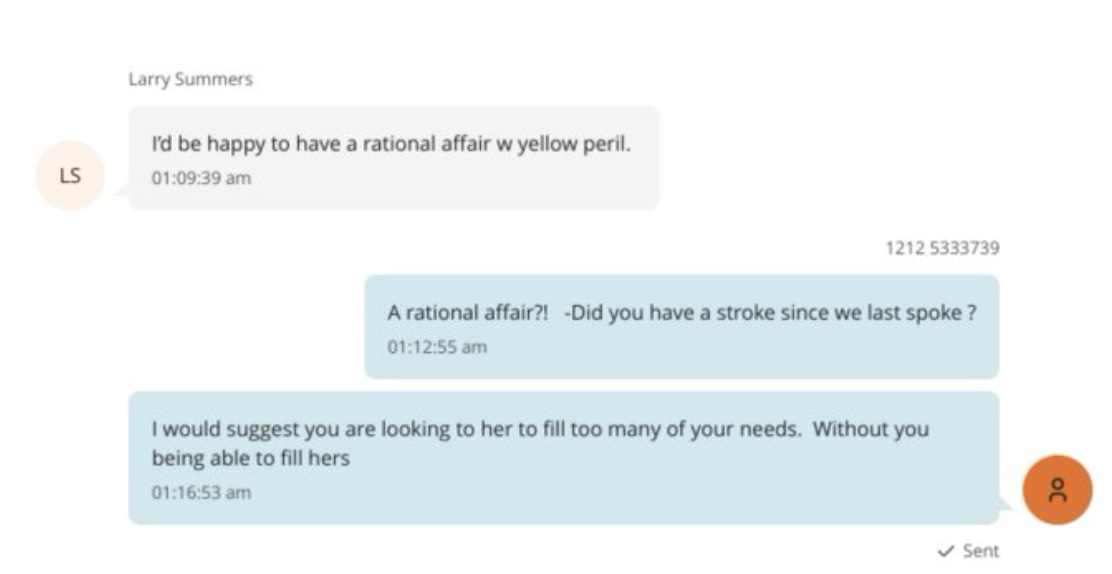
What are you thinking? Don’t you understand? “Rational affairs” are not how the world works.
Not in love. Not in politics. Not in life.
Epstein’s quip was meant as a brutal put down. And Summers meekly retreated.
But, perhaps, rather than retreating, what if we roll with the punch?
Perhaps, Epstein’s jibe actually contains a truth. As does his follow on: “You are looking to her to fill too many of your needs. Without you being able to fill hers.”
Part of the devil’s attraction was clearly that, at least on some occasions, he gave sage advice.
Better than ChatGPT.
With all this material, someone must be training an Epstein algo.
We are in 2026 after all, this isn’t the warm up act of Trump’s first term.
At Davos Carney spoke of a “rupture, not a transition”.
And we lapped it up. He struck a bold note, befitting of a leader. But did he promise too much?
Was it too clean. Too composed?
Too much the cool, put-together guy at the orgy?
After the last few weeks are we really feeling composed?
A rupture, is sudden and disorientating. Are we really feeling it?
Not so much neoliberal order breakdown syndrome, as something closer to what Epstein described:
A stroke.
No wonder we have sweet dreams of “rational affairs” and “variable geometries”!
Our condition is actually serious.
Humiliating.
“Knowledge crisis”, indeed.
Rupture?
More like polycrisis as incontinence.
It will be a long road back. There is no getting over this.
"I should have thought," said the officer as he visualized the search
before him, "I should have thought that a pack of British boys―you're all
British, aren't you?―would have been able to put up a better show than
that―I mean―"
"It was like that at first," said Ralph, "before things―"
this is from the ending scene of Golding's Lord of the Flies novel.
We should stop expecting rational behavior from people in power. It suffices to watch Alexander Sokurov's Fairytale film and their conversations in purgatory between Churchill, Stalin, Roosevelt, Hitler and Mussolini all taken from archive material .
Rights. Decency. Respect for basic societal taboos. These were things that we claimed too.
At an even more elementary level, we claimed to be able to discriminate, to tell the difference between “good guys” and “bad guys”.
I am sorry, but for anyone who needed Epstein to stop believing in the above, I got a George Carlin quote
"It's called the American Dream, 'cause you have to be asleep to believe it"